



Begin of page section:
Page sections:

  • Go to contents (Accesskey 1)
  • Go to position marker (Accesskey 2)
  • Go to main navigation (Accesskey 3)
  • Go to sub navigation (Accesskey 4)
  • Go to additional information (Accesskey 5)
  • Go to page settings (user/language) (Accesskey 8)
  • Go to search (Accesskey 9)

End of this page section. Go to overview of page sections

Begin of page section:
Page settings:

English en
Deutsch de
Search
Login

End of this page section. Go to overview of page sections

Begin of page section:
Search:

Search for details about Uni Graz
Close

End of this page section. Go to overview of page sections


Search

Begin of page section:
Main navigation:

Page navigation:

  • University

    University
    • About the University
    • Organisation
    • Faculties
    • Library
    • Working at University of Graz
    • Campus
    Developing solutions for the world of tomorrow - that is our mission. Our students and our researchers take on the great challenges of society and carry the knowledge out.
  • Research Profile

    Research Profile
    • Our Expertise
    • Research Questions
    • Research Portal
    • Promoting Research
    • Research Transfer
    • Ethics in Research
    • Commission for Scientific Integrity
    Scientific excellence and the courage to break new ground. Research at the University of Graz creates the foundations for making the future worth living.
  • Studies

    Studies
    • Prospective Students
    • Students
    • Registration for Study Programme (Winter semester 2026/27)
    • Study Days 22-26 June 2026
  • Community

    Community
    • International
    • Location
    • Research and Business
    • Alumni
    The University of Graz is a hub for international research and brings together scientists and business experts. Moreover, it fosters the exchange and cooperation in study and teaching.
Topics
  • Sustainable University
  • Researchers answer
  • Work for us
Close menu

End of this page section. Go to overview of page sections

Begin of page section:
You are here:

University of Graz News Aus alten Texten Neues lernen

End of this page section. Go to overview of page sections

Tuesday, 19 December 2017

Aus alten Texten Neues lernen

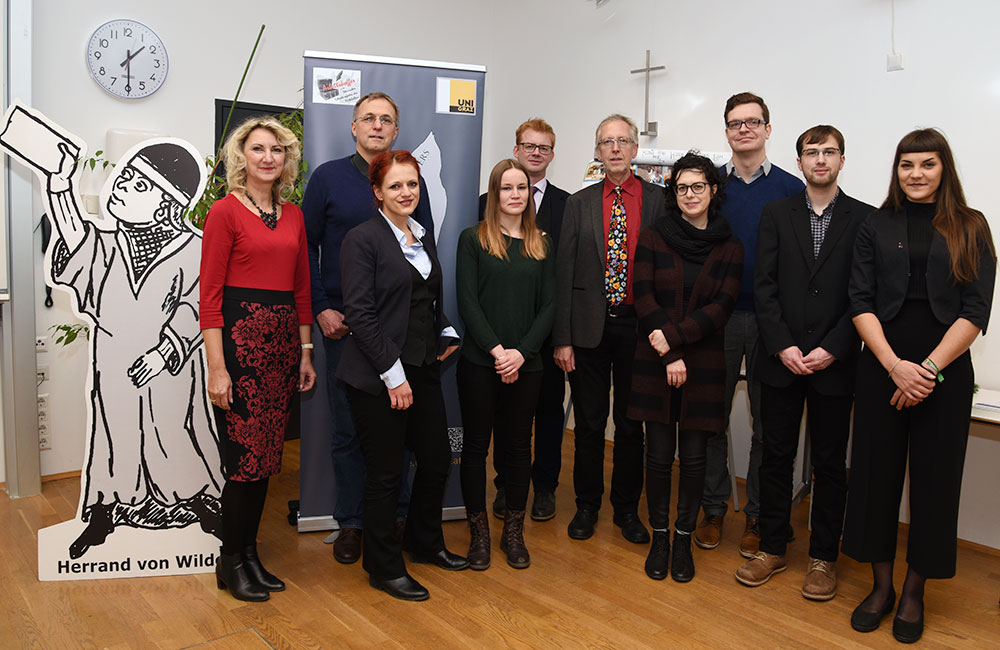
V.l.: Studiendekanin Margit Reitbauer, Thomas Möbius (Gießen), Ylva Schwinghammer, Selina Galka (Uni Graz), Klaus Vogelgsang (Augsburg), Wernfried Hofmeister, Gerlinde Schneider (Uni Graz), Michael Steinmetz (Gießen), Wolfgang Holanik, Lisa Glänzer (Uni Graz). Foto: Uni Graz/Pichler

Auftaktsymposium zum Projekt "Arbeitskoffer 3D" (v.l.): Studiendekanin Margit Reitbauer, Thomas Möbius (Gießen), Ylva Schwinghammer und Selina Galka (Uni Graz), Klaus Vogelgsang (Augsburg), Wernfried Hofmeister und Gerlinde Schneider (Uni Graz), Michael Steinmetz (Gießen), Wolfgang Holanik und Lisa Glänzer (Uni Graz). Foto: Uni Graz/Pichler

Das Sparkling-Science-Projekt „Arbeitskoffer zu den Steirischen Literaturpfaden des Mittelalters“ geht in die dritte Runde

Es ist eines der erfolgreichsten Projekte im Förderprogramm „Sparkling Science“: der Arbeitskoffer zu den Steirischen Literaturpfaden des Mittelalters unter der Leitung von Ao.Univ.-Prof. Dr. Wernfried Hofmeister und der Koordination von Dr. Ylva Schwinghammer vom Institut für Germanistik der Uni Graz. Nun geht das Projekt in die dritte und letzte Runde. Am 15. Dezember 2017 fand das Auftaktsymposium zum neuen „Arbeitskoffer zu den Steirischen Literaturpfaden des Mittelalters 3D“ statt, zu dem auch ReferentInnen aus Deutschland angereist waren. Bis 2019/20 wird sich das Projekt mit der Literatur- und Wissensvermittlung im öffentlichen und digitalen Raum befassen.

„Literatur zitiert das Leben“ und „Literatur macht Sinn.“ Mit diesen Worten unterstrich Studiendekanin Margit Reitbauer bei der Eröffnung des Auftaktyymposiums die Bedeutung von Literatur. Ein Credo, das hinter dem gesamten Arbeitskoffer-Projekt steht: Die Literatur des Mittelalters soll für den Deutschunterricht sowie für die Kulturvermittlung im öffentlichen Raum aufbereitet und in ihrer Relevanz für die Gegenwart nähergebracht werden. „Wer dazu bereit ist, in das Denkuniversum mittelalterlicher Texte einzutauchen, wird dort einen Wissensschatz entdecken, der dem Menschen in seinen idellen wie materiallen Grundbedürfnissen dienlich war und wohl über alle Zeiten hinweg wertvoll bleiben wird“, ist Wernfried Hofmeister überzeugt.

Aufbauend auf die Vorgängerprojekte Arbeitskoffer 1 und Arbeitskoffer 2.0 steht nun das Verständnis eines literarischen Textes als Speicher und Katalysator von Wissensbeständen im Mittelpunkt. Das Herzstück stellt das mit dem Austrian Center for Digital Humanities entwickelte Textportal dar, das eine eigenständigen Erschließung der von den SchülerInnen aufbereiteten mittelalterlichen Literaturzeugnisse ermöglicht und eine Fülle von begleitenden Materialien bereithält.


created by Gudrun Pichler

Related news

Full effort in the heat: the Sports Centre was in full swing at the Kleeblattlauf

On 19 June 2026, 2,000 runners and hundreds of supporters made their way to the Rosenhain for a sporting end-of-term event.

Save, invest or guarantee: What Austrians expect from the state

Austria needs to make savings. But where? And what should the Republic actually be spending its money on? The answers are provided by the initial findings of a major study involving the University of Graz. 99 per cent of those surveyed are in favour of the state ensuring healthcare provision. Almost three-quarters would like to see more public funding for education, whilst only around three per cent are in favour of cuts in this sector.

Complying with the norm: Why Do Standards Shape Our Lives, Elisabeth Staudegger?

Standards determine whether a sheet of paper fits in a printer or whether a charging plug can power multiple devices. These standards shape our everyday lives. But who actually sets these standards? Where are the weaknesses, and how could science help to improve them? Elisabeth Staudegger, Head of the ‘Law and IT’ Department at the Institute for Legal Foundations at the University of Graz, host the Academic Standards Day on 16 June. Here she relays how sciences can contribute to the topic of standardisation and reveals her personal favourite standard.

More body awareness than a culture war

In Italy, sex education lessons will in future only be permitted with parental consent, and will be banned entirely in nurseries and primary schools. At the same time, Pride Month highlights why knowledge about the body, relationships, boundaries and diversity is important for young people. A study by the University of Graz shows how important knowledge about the body, contraception, relationship skills and protection against violence is

Begin of page section:
Additional information:

University of Graz
Universitaetsplatz 3
8010 Graz
Austria
  • Contact
  • Web Editors
  • Moodle
  • UNIGRAZonline
  • Imprint
  • Data Protection Declaration
  • Accessibility Declaration
Weatherstation
Uni Graz

End of this page section. Go to overview of page sections

End of this page section. Go to overview of page sections

Begin of page section:

End of this page section. Go to overview of page sections

