Begin of page section:
Page sections:

  • Go to contents (Accesskey 1)
  • Go to position marker (Accesskey 2)
  • Go to main navigation (Accesskey 3)
  • Go to sub navigation (Accesskey 4)
  • Go to additional information (Accesskey 5)
  • Go to page settings (user/language) (Accesskey 8)
  • Go to search (Accesskey 9)

End of this page section. Go to overview of page sections

Begin of page section:
Page settings:

English en
Deutsch de
Search
Login

End of this page section. Go to overview of page sections

Begin of page section:
Search:

Search for details about Uni Graz
Close

End of this page section. Go to overview of page sections


Search

Begin of page section:
Main navigation:

Page navigation:

  • University

    University
    • About the University
    • Organisation
    • Faculties
    • Library
    • Working at University of Graz
    • Campus
    Developing solutions for the world of tomorrow - that is our mission. Our students and our researchers take on the great challenges of society and carry the knowledge out.
  • Research Profile

    Research Profile
    • Our Expertise
    • Research Questions
    • Research Portal
    • Promoting Research
    • Research Transfer
    • Ethics in Research
    Scientific excellence and the courage to break new ground. Research at the University of Graz creates the foundations for making the future worth living.
  • Studies

    Studies
    • Prospective Students
    • Students
  • Community

    Community
    • International
    • Location
    • Research and Business
    • Alumni
    The University of Graz is a hub for international research and brings together scientists and business experts. Moreover, it fosters the exchange and cooperation in study and teaching.
  • Spotlight
Topics
  • Our digital Advent calendar
  • Sustainable University
  • Researchers answer
  • Work for us
Close menu

End of this page section. Go to overview of page sections

Begin of page section:
You are here:

University of Graz News Antike Vasen erzählen

End of this page section. Go to overview of page sections

Friday, 19 December 2014

Antike Vasen erzählen
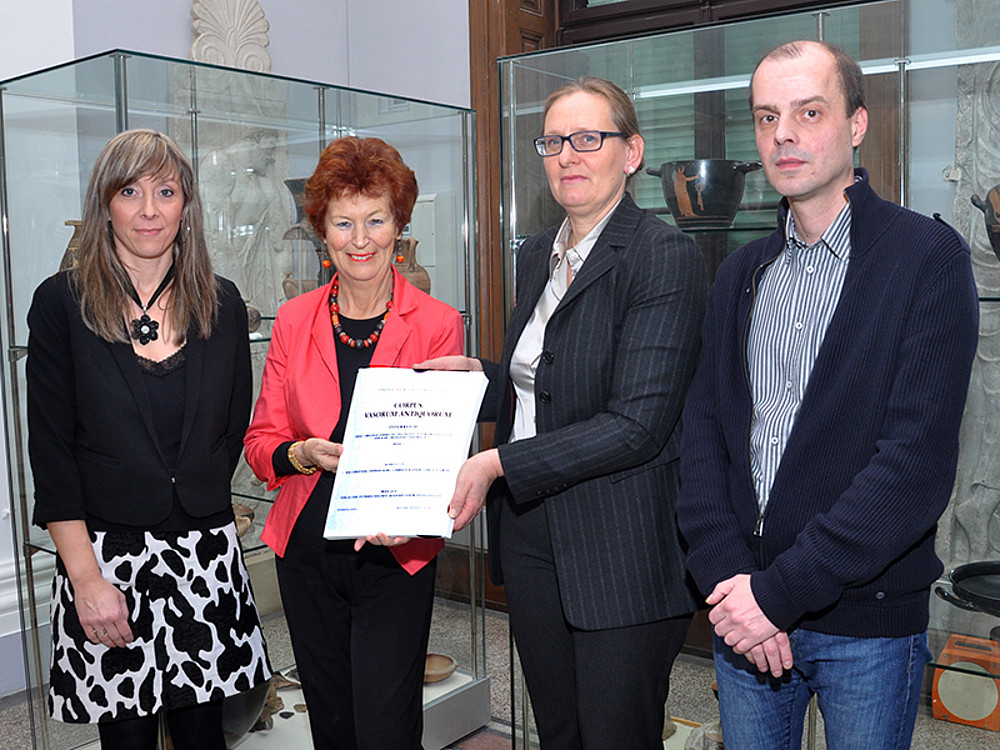
Präsentieren die neue Publikation: Maria Christidis, Gerda Schwarz, Gabriele Koiner und Stephan Karl (v.l.) Foto: Uni Graz/Schweiger

Präsentieren die neue Publikation: Maria Christidis, Gerda Schwarz, Gabriele Koiner und Stephan Karl (v.l.) Foto: Uni Graz/Schweiger

Archäologie mit Computertomographie und UV-Fluoreszenz-Fotografie: Publikation über historische Vasen erschienen

Eine Reise durch den Mittelmeerraum der Antike ermöglichen die historischen Vasen am Institut für Archäologie der Karl-Franzens-Universität Graz. 93 Objekte, die aus einer bereits 1865 gegründeten Lehrsammlung hervorgegangen sind, wurden nun erstmals umfassend wissenschaftlich dokumentiert. Neben der Besprechung der Keramik kamen auch Computertomographie und UV-Fluoreszenz-Fotografie zur berührungs- und zerstörungsfreien Untersuchung der Gefäße zum Einsatz. Unter dem Titel „Corpus Vasorum Antiquorum Österreich“ ist kürzlich der erste Band erschienen. Für die Publikation verantwortlich zeichnen Maria Christidis, Stephan Karl, Gabriele Koiner und Gerda Schwarz, Fotos und Zeichnungen steuerten Johanna Kraschitzer und Stephan Karl bei.

Die zu einem großen Teil erstmals der Fachwelt vorgestellten Werkstücke umspannen sowohl räumlich als auch zeitlich einen großen Bogen und bieten ein breites Spektrum unterschiedlichster Gattungen antiker Keramik. Die Vasen stammen aus der Bronzezeit Zyperns, der geometrischen, archaischen und klassischen Zeit Griechenlands sowie aus etruskischen, kampanischen, apulischen, apulisch-lukanischen und sizilischen Werkstätten. „Gerade eine Sammlung wie jene des Grazer Instituts, die weniger nach ästhetischen Gesichtspunkten als vielmehr zu didaktischen Zwecken zusammengestellt wurde, vermag Einblick in die vielfältigen Rätsel zu geben, die die Beschäftigung mit antiker Keramik noch für uns bewahrt hat“, berichten die AutorInnen Dr. Maria Christidis, Dr. Gabriele Koiner, Ao.Univ.-Prof. Dr. i.R. Gerda Schwarz und Dr. Stephan Karl unisono.

Das Corpus Vasorum Antiquorum (abgekürzt CVA) ist ein internationales Forschungsprojekt zur Erforschung und Publikation antiker Keramik. Es geht auf die Initiative des französischen Archäologen Edmond Pottier zurück, der ein erstes vorbereitendes Treffen 1919 in Paris veranstaltete. Es wurde beschlossen, Keramik nach einheitlichen Richtlinien in einem Corpus gesammelt zu publizieren. Der erste Band, Louvre, fasc. 1, von Pottier erschien 1922.
Das CVA publiziert antike griechische, italische und zypriotische Tongefäße vom 7. Jahrtausend v. Chr. bis zur Spätantike nach Ländern und Museen aufgeteilt in einzelnen Faszikeln.

Der druckfrische Band wurde mithilfe finanzieller Unterstützung seitens des FWF (Projekt PUB 157-V21) gedruckt.

Corpus Vasorum Antiquorum Österreich
Graz, Originalsammlung des Instituts für Archäologie der Karl-Franzens-Universität Band 1 (Österreich 6)
Wien, Verlag der Österr. Akademie der Wissenschaften 2014
Bearbeitet von Maria Christidis, Stephan Karl, Gabriele Koiner, Gerda Schwarz
Fotos und Zeichnungen von Johanna Kraschitzer und Stephan Karl

created by Andreas Schweiger

Related news

Chemical Christmas show at the University of Graz: An explosive evening at the Schauspielh

At the beginning of December, the University of Graz transformed the theater into a laboratory: as part of “Chemical Life,” teacher training students staged a chemical Christmas show for Styrian school classes—complete with ethanol rockets, nitrogen snow, and glowing effects. An evening designed to inspire interest in studying chemistry.

Train by train: Koralm railway accelerates exchange between the Universities

Lectures at the University of Klagenfurt in the morning, seminars at the University of Graz in the afternoon: Austria's longest tunnel and a journey time of around 45 minutes make it easy. The Koralm railway increases the speed of networking between the two university locations. The collaboration builds on existing cooperation - for example in the areas of teacher training, Slavic studies and as employers, the universities are well coordinated.

On the trail of the Big Bang: University of Graz receives 1.5 million euros for doctoral programmes

The Austrian Science Fund FWF has selected the Doctoral Programme in Theoretical Particle Physics at the University of Graz for funding from the Doc.funds. Six young scientists will be funded for 3.5 years. They will gain fundamentally new insights into the origins of the world.

From trans women and knee prostheses: sports science prizes awarded

Walking better with a prosthesis, successfully getting rid of excess weight, training more effectively, more fairness for trans people in sport: these were the topics addressed by the students at the University of Graz who were awarded the sports science prizes for their Master's theses on 3 December 2025.

Begin of page section:
Additional information:

University of Graz
Universitaetsplatz 3
8010 Graz
Austria
  • Contact
  • Web Editors
  • Moodle
  • UNIGRAZonline
  • Imprint
  • Data Protection Declaration
  • Accessibility Declaration
Weatherstation
Uni Graz

End of this page section. Go to overview of page sections

End of this page section. Go to overview of page sections

Begin of page section:

End of this page section. Go to overview of page sections