



Begin of page section:
Page sections:

  • Go to contents (Accesskey 1)
  • Go to position marker (Accesskey 2)
  • Go to main navigation (Accesskey 3)
  • Go to sub navigation (Accesskey 4)
  • Go to additional information (Accesskey 5)
  • Go to page settings (user/language) (Accesskey 8)
  • Go to search (Accesskey 9)

End of this page section. Go to overview of page sections

Begin of page section:
Page settings:

English en
Deutsch de
Search
Login

End of this page section. Go to overview of page sections

Begin of page section:
Search:

Search for details about Uni Graz
Close

End of this page section. Go to overview of page sections


Search

Begin of page section:
Main navigation:

Page navigation:

  • University

    University
    • About the University
    • Organisation
    • Faculties
    • Library
    • Working at University of Graz
    • Campus
    Developing solutions for the world of tomorrow - that is our mission. Our students and our researchers take on the great challenges of society and carry the knowledge out.
  • Research Profile

    Research Profile
    • Our Expertise
    • Research Questions
    • Research Portal
    • Promoting Research
    • Research Transfer
    • Ethics in Research
    • Commission for Scientific Integrity
    Scientific excellence and the courage to break new ground. Research at the University of Graz creates the foundations for making the future worth living.
  • Studies

    Studies
    • Prospective Students
    • Students
  • Community

    Community
    • International
    • Location
    • Research and Business
    • Alumni
    The University of Graz is a hub for international research and brings together scientists and business experts. Moreover, it fosters the exchange and cooperation in study and teaching.
  • Spotlight
Topics
  • Sustainable University
  • Researchers answer
  • Work for us
Close menu

End of this page section. Go to overview of page sections

Begin of page section:
You are here:

University of Graz News Am Campus der Uni Graz entsteht ab 2024 das Haus der Bildungswissenschaften

End of this page section. Go to overview of page sections

Tuesday, 19 December 2023

Am Campus der Uni Graz entsteht ab 2024 das Haus der Bildungswissenschaften

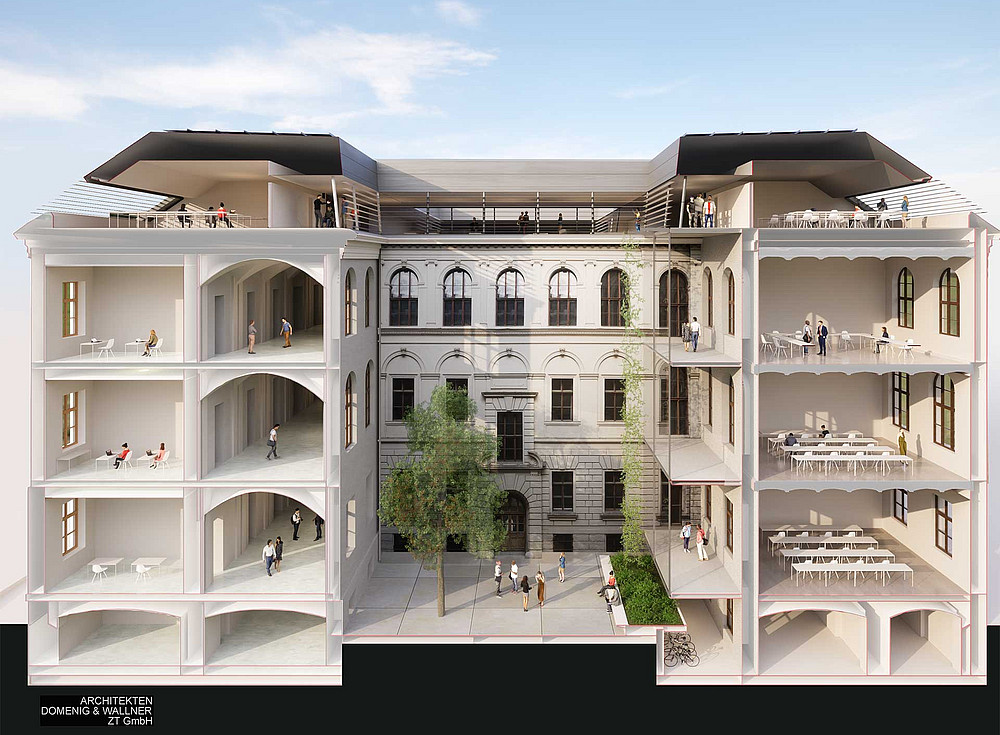
Rendering des Gebäudes

Die historische Fassade bleibt erhalten, innen wird die mehr als 5000 Quadratmeter große Nutzfläche alle zeitgemäßen Anforderungen erfüllen. Rendering: Domenig & Wallner ZT-GmbH

Ein Campus in Innenstadtnähe, mit 13 Hektar Grünraum sowie modernen und historischen Gebäuden: All das macht die Universität Graz zum beliebten Lernort und Lebensraum. Und dieser wird mit einer weiteren umfassenden Sanierung noch attraktiver. Das denkmalgeschützte Haus Universitätsplatz 4 wird ab Sommer 2024 komplett renoviert und an moderne Standards angepasst.

Wo früher medizinische Institute für Hygiene sowie Gerichtsmedizin beheimatet waren, werden ab 2027 die Bildungswissenschaften der Uni Graz unter einem Dach zusammengeführt. „Die Erziehungs- und Bildungswissenschaften gehören zu den stark nachgefragten Studien und haben hohe gesellschaftliche Relevanz“, begründet Rektor Peter Riedler die Investition.

Historische Substanz, modernes Innenleben

Rund 50 Millionen Euro wird die Bundesimmobiliengesellschaft, Eigentümerin der meisten Uni-Gebäude, in das Lifting investieren. Während außen die historische Fassade erhalten bleibt, wird innen die mehr als 5000 Quadratmeter große Nutzfläche alle zeitgemäßen Anforderungen erfüllen. Zwei neue Aufzüge stellen den barrierefreien Zugang sicher, ebenso wie das Dachgeschoß, das neu aufgesetzt und künftig zahlreiche Seminarräume beherbergen wird. Eine angefügte Glasgalerie im Innenhof wird auf einer Ebene das Gebäude umlaufen und so die Etagen verbinden.
Die Gestaltung stammt vom Grazer Architekten-Team Domenig & Wallner ZT-GmbH.

Die Bauarbeiten werden im Juli 2024 beginnen, 125 Jahre nach der Eröffnung des Gebäudes, das vom Architekten Wilhelm von Rezori entworfen wurde. Ursprünglich waren dort Institute der Medizinischen Fakultät, ab 2004 der Med Uni Graz beheimatet, die kürzlich auf den Campus beim LKH Graz übersiedelt sind.
Nach Renovierung und Umbau werden die Arbeitsbereiche der Erziehungs- und Bildungswissenschaften, die derzeit auf mehrere Standorte verteilt sind, sowie das Dekanat der Umwelt-, Regional- und Bildungswissenschaftlichen Fakultät einziehen.

Ressourcenschonend und klimafreundlich

Das Haus der Bildungswissenschaften wird historische Bausubstanz mit moderner Technologie vereinen. Dazu werden sämtliche Installationen von Grund auf erneuert. Auf dem Dach wird eine Photovoltaik-Anlage errichtet, die umgerechnet den Energiebedarf von rund 18 Einfamilienhäusern deckt. Beheizt wird das Gebäude über ein Niedrigtemperatursystem, das aus Wärme von Servern aus dem benachbarten RESOWI-Zentrum sowie der geplanten Geothermie-Anlage des Graz Center of Physics gespeist wird.
„Damit werden wir unabhängig von externen Zuliefer:innen und kommen unserem Ziel, bis 2040 echte Klimaneutralität zu erreichen, einen großen Schritt näher“, sagt Rektor Peter Riedler.
Nachhaltiger Mobilität wird ebenfalls Augenmerk geschenkt: Das Untergeschoß wird zur Fahrradgarage mit 300 Stellplätzen.

Die Flächen, die durch die Zusammenführung der Bildungswissenschaften frei werden, machen in Folge im Wallzentrum in der Merangasse 70 für ein „Haus der Sprachen und Kulturen“ Platz.

created by Andreas Schweiger

Related news

Building biological bridges: Chemist discovers an ecological tool for the pharmaceutical industry

Building a relationship on a solid foundation is also important in chemistry. To produce medicines, disinfectants or plant protection products, stable bonds between carbon atoms must be formed. Conventional chemical methods rely on environmentally harmful reagents and solvents to carry out the desired reaction. This process also produces unusable by-products. Chemist Lilla Gal has discovered an enzyme that enables the same process to take place efficiently and sustainably. The results of her research were recently published in the prestigious journal Angewandte Chemie.

Higher Education Strategy 2040: Austria’s universities on course for the future

Austria has 77 higher education institutions, which is above the EU average – but does this really make sense? The new Higher Education Strategy 2040 focuses on cooperation rather than mergers. As one of the six largest universities in Austria, the University of Graz plays a central role in this.

Climate research in Greenland: Old data provides new insights

The polar explorer and University of Graz professor Alfred Wegener left behind a unique collection of climate data from Greenland. A research team from the University of Graz is now analysing this 100-year-old treasure trove of data and comparing it with current measurements.

Diversity in nature and science: How we talk about plants and each other

Ginkgo, kiwi, hemp: they exist as male and female plants. Anyone who paid attention in biology class will confirm this. But is this categorisation, established by Carl von Linné almost 300 years ago, still valid today? An interdisciplinary team at the University of Graz is questioning these attributions and using this as a starting point to provide food for thought for gender-sensitive interaction between students, scientific and teaching staff.

Begin of page section:
Additional information:

University of Graz
Universitaetsplatz 3
8010 Graz
Austria
  • Contact
  • Web Editors
  • Moodle
  • UNIGRAZonline
  • Imprint
  • Data Protection Declaration
  • Accessibility Declaration
Weatherstation
Uni Graz

End of this page section. Go to overview of page sections

End of this page section. Go to overview of page sections

Begin of page section:

End of this page section. Go to overview of page sections