



Begin of page section:
Page sections:

  • Go to contents (Accesskey 1)
  • Go to position marker (Accesskey 2)
  • Go to main navigation (Accesskey 3)
  • Go to sub navigation (Accesskey 4)
  • Go to additional information (Accesskey 5)
  • Go to page settings (user/language) (Accesskey 8)
  • Go to search (Accesskey 9)

End of this page section. Go to overview of page sections

Begin of page section:
Page settings:

English en
Deutsch de
Search
Login

End of this page section. Go to overview of page sections

Begin of page section:
Search:

Search for details about Uni Graz
Close

End of this page section. Go to overview of page sections


Search

Begin of page section:
Main navigation:

Page navigation:

  • University

    University
    • About the University
    • Organisation
    • Faculties
    • Library
    • Working at University of Graz
    • Campus
    Developing solutions for the world of tomorrow - that is our mission. Our students and our researchers take on the great challenges of society and carry the knowledge out.
  • Research Profile

    Research Profile
    • Our Expertise
    • Research Questions
    • Research Portal
    • Promoting Research
    • Research Transfer
    • Ethics in Research
    • Commission for Scientific Integrity
    Scientific excellence and the courage to break new ground. Research at the University of Graz creates the foundations for making the future worth living.
  • Studies

    Studies
    • Prospective Students
    • Students
  • Community

    Community
    • International
    • Location
    • Research and Business
    • Alumni
    The University of Graz is a hub for international research and brings together scientists and business experts. Moreover, it fosters the exchange and cooperation in study and teaching.
Topics
  • Sustainable University
  • Researchers answer
  • Work for us
Close menu

End of this page section. Go to overview of page sections

Begin of page section:
You are here:

University of Graz News Alzheimer's disease

End of this page section. Go to overview of page sections

Monday, 04 April 2022

Alzheimer's disease

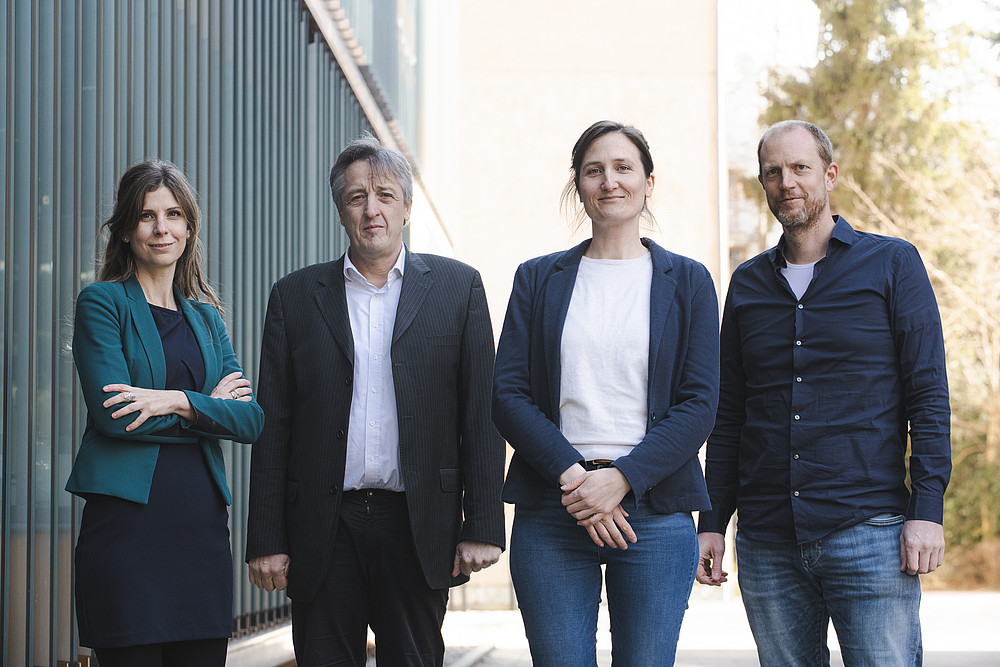
Molecular biologists Jelena Tadic, Frank Madeo, Julia Ring and Tobias Eisenberg (left to right) are one step closer to deciphering Alzheimer's disease. Photo: Uni Graz/Tzivanopoulos. ©Uni Graz/Tzivanopoulos

Molecular biologists Jelena Tadic, Frank Madeo, Julia Ring and Tobias Eisenberg (left to right) are one step closer to deciphering Alzheimer's disease. Photo: Uni Graz/Tzivanopoulos.

Researchers at the University of Graz are one step closer decoding the disease

In Alzheimer's disease, neuronal cells of the brain die leading to this most common form of dementia. Yet, researchers still try to fully understand why this is happening. It is known that specific protein deposits (composed of aggregated proteins or smaller peptides) are partly responsible for this. Researchers at the University of Graz have now discovered a driving factor for their formation. A particular protein that is supposed to protect neurons drives the harmful clumping of protein in the case of this disease. The international research team published their findings in the scientific journal EMBO Molecular Medicine today.

In more detail, the researchers examined one of the so-called chaperone proteins, which normally protect "immature" proteins from dangerous clumping. However, a particular chaperone named DnaJA1 does not behave helpful in the case of Alzheimer’s disease. “This protein causes a peptide called amyloid beta to clump even more. The resulting amyloid beta deposits are transported to mitochondria, the powerhouse of the cell, and trigger stress. This stress eventually causes cells to die,” explains Julia Ring, co-first author of the study.

The examined chaperone thus has two faces. “This is an important indication for future therapy research. Many other chaperones protect neurons and are therefore being discussed as possible targets in Alzheimer's therapy," adds Jelena Tadic, also co-first author of the study. However, a final judgment on the dual role of this chaperone will only be possible when sufficient data from human studies support the knowledge gained from model systems.


Publication: Ring Julia, Tadic Jelena, et al. […] Tobias Eisenberg, Frank Madeo (2022), The HSP40 chaperone Ydj1 drives amyloid beta 42 toxicity. EMBO Mol Med. DOI: 10.15252/emmm.202113952.


created by Gerhild Leljak

Related news

A substantial community: the key role of soil crusts in the earth system

They are often overshadowed by the plant world: lichens, fungi, mosses and bacteria, which form unique communities on rocks and trees or as soil crusts. Bettina Weber from the University of Graz is bringing this biological alliance into the research spotlight. Her research shows that these communities form an essential part of the Earth’s critical zone and play a key role in the interactions between land and atmosphere. Bettina Weber was honoured by the European Geosciences Union for her groundbreaking research at the beginning of May.

The digital world of tomorrow: University of Graz works with people to shape the future

Digitalisation is supposed to make everything better: artificial intelligence that even organises travel. The car that drives itself. Robots that care for us in our old age. But what kind of future do people actually want? What role should technology play in this? The University of Graz is exploring these questions through a new research facility. At the Graz Sociodigital and Participatory Futures Studio – or GraSP Futures Studio for short – young and old work together with researchers to design visions of the future that also critically examine technical innovations.

Eurovision: Why the Song Contest is always political

The 2026 Eurovision Song Contest sits at the intersection of music, geopolitics and culture. Josef Mühlbauer from the University of Graz explains why the ESC has always been a reflection of European politics, and how this major event highlights cultural affinities and social change.

Superti-Furga will becomefounding director of the CORI Institute in Graz

The Austrian Academy of Sciences (ÖAW) is establishing a new flagship centre for research into metabolic diseases in collaboration with the three universities in Graz. This innovative research approach combines mathematics and experimental biology with artificial intelligence

Begin of page section:
Additional information:

University of Graz
Universitaetsplatz 3
8010 Graz
Austria
  • Contact
  • Web Editors
  • Moodle
  • UNIGRAZonline
  • Imprint
  • Data Protection Declaration
  • Accessibility Declaration
Weatherstation
Uni Graz

End of this page section. Go to overview of page sections

End of this page section. Go to overview of page sections

Begin of page section:

End of this page section. Go to overview of page sections

