



Begin of page section:
Page sections:

  • Go to contents (Accesskey 1)
  • Go to position marker (Accesskey 2)
  • Go to main navigation (Accesskey 3)
  • Go to sub navigation (Accesskey 4)
  • Go to additional information (Accesskey 5)
  • Go to page settings (user/language) (Accesskey 8)
  • Go to search (Accesskey 9)

End of this page section. Go to overview of page sections

Begin of page section:
Page settings:

English en
Deutsch de
Search
Login

End of this page section. Go to overview of page sections

Begin of page section:
Search:

Search for details about Uni Graz
Close

End of this page section. Go to overview of page sections


Search

Begin of page section:
Main navigation:

Page navigation:

  • University

    University
    • About the University
    • Organisation
    • Faculties
    • Library
    • Working at University of Graz
    • Campus
    Developing solutions for the world of tomorrow - that is our mission. Our students and our researchers take on the great challenges of society and carry the knowledge out.
  • Research Profile

    Research Profile
    • Our Expertise
    • Research Questions
    • Research Portal
    • Promoting Research
    • Research Transfer
    • Ethics in Research
    • Commission for Scientific Integrity
    Scientific excellence and the courage to break new ground. Research at the University of Graz creates the foundations for making the future worth living.
  • Studies

    Studies
    • Prospective Students
    • Students
    • Welcome Weeks for First Year Students
  • Community

    Community
    • International
    • Location
    • Research and Business
    • Alumni
    The University of Graz is a hub for international research and brings together scientists and business experts. Moreover, it fosters the exchange and cooperation in study and teaching.
Topics
  • Sustainable University
  • Researchers answer
  • Work for us
Close menu

End of this page section. Go to overview of page sections

Begin of page section:
You are here:

University of Graz News 70 years of neutrality: Between tradition and new challenges

End of this page section. Go to overview of page sections

Wednesday, 22 October 2025

70 years of neutrality: Between tradition and new challenges

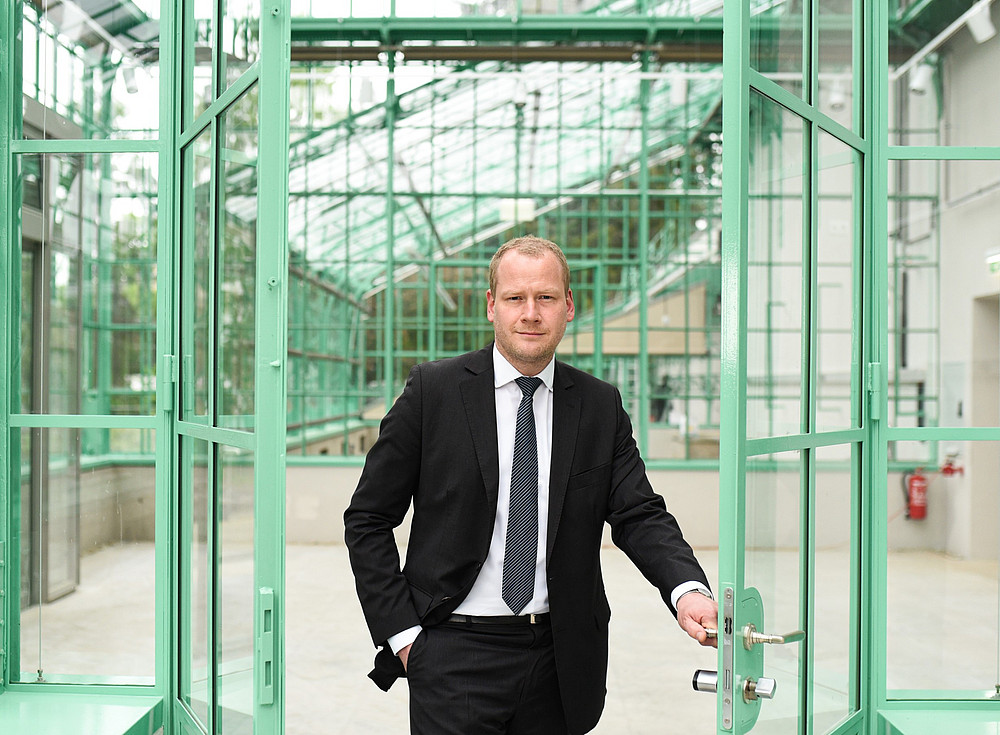
Portrait of a businessman in a suit, holding open the door to a green glass entrance building with a large industrial iron frame and steel structure. he is standing inside an indoor garden

Constitutional lawyer Christoph Bezemek emphasizes the importance of neutrality in the 21st century. Photo: University of Graz/Tzivanopoulos

Neutrality has characterized Austria since 1955. But what does it mean today in light of EU membership and the war in Ukraine? Constitutional lawyer Christoph Bezemek from the University of Graz analyzes the evolution of the concept and provides insights into its future role.

On October 26, 2025, Austria will celebrate the 70th anniversary of the Second Republic. A central component of the country's independence was the inclusion of perpetual neutrality in the constitution, which was adopted on October 26, 1955. But what significance does this commitment have in the 21st century? Constitutional lawyer Christoph Bezemek provides the answer:

1: Why was neutrality so crucial for Austria when the state was founded in 1955?

Austria's neutrality is not part of the State Treaty of Vienna, but it was implicitly a requirement for it, at least on the Soviet side. In the absence of an explicit international treaty obligation, it was declared “of its own free will” by the constitutional legislator in the “Federal Constitutional Law of October 26, 1955, on the Neutrality of Austria” and brought to the attention of the international community. In this respect, it can be seen as the keystone of the restoration of Austrian sovereignty, which was to have a significant impact on the country's identity over the following decades.

2: It is often claimed that neutrality actually became obsolete with Austria's accession to the EU. Why is that?

Austria's neutrality, in terms of how it is understood and how this understanding is lived out, is subject to continuous change, which is often described with the words “integral” and “differential” neutrality. This refers to an evolution from a comprehensive understanding of neutrality, including in the sense of economic non-alignment, to a more restrictive understanding that revolves strongly around the question of military non-alignment with a duty to provide assistance. With Austria's accession to the European Union, this understanding changed once again. The Federal Constitution opened up to the Common Foreign and Security Policy and thus, in addition to the possibility of participating in economic sanctions, also to combat missions, which, however, still require a mandate from the UN Security Council. The original neutrality relationship is thus undergoing another decisive modification.

3: Only a few hundred kilometers away from Austria, war is raging in Ukraine. Is neutrality still appropriate in view of these threats?

Whether neutrality is appropriate is a question of perspective and, beyond that, one of political opportunity. Although its existence or suitability is often questioned, neutrality forms the essential foundation of the “Austrian Security Strategy 2024,” especially against the backdrop of Russia's attack on Ukraine. This document underscores what is often said by political actors in Austria: “Military neutrality” is not synonymous with “neutrality in the mind-set.” This maxim, in turn, illustrates the ongoing change in the understanding of neutrality and, at the same time, that the evolution of the concept is by no means complete. This further development seems far more likely in the long term than a formal departure from neutrality, which, in the eyes of its numerous proponents, is by no means obsolete even after the end of the Cold War and whose identity-shaping effect is also perceived by large sections of the population.

Are you interested in government and law? Study law at the University of Graz.

created by Roman Vilgut

Related news

A fresh start, a calling, holidays: what draws people from other career paths to teaching

They used to develop software; now they teach maths in the classroom. Career changers are expected to help address the shortage of qualified teachers in Austria’s schools. In their doctoral theses at the Institute for Educational Research and Teacher Training at the University of Graz, Melanie Gürentz and Claudia Mair examined how these new teachers perceive their new professional roles.

Talent Talks bridge the gap in career guidance

The Styrian Chamber of Commerce (WKO Steiermark), the Styrian Chamber of Labour (AK Steiermark) and the AMS are joining forces when it comes to training young people and, through the “Talent Talks”, are creating a seamless pathway to career guidance. This takes preparation and follow-up support – just in time for the start of the term and the scheme’s tenth anniversary – to a whole new level. A new survey conducted by the Talent Centre among 2,687 former participants to mark the anniversary shows just how important this development is. Of the young people who received follow-up support from the Talent Report, 74.6 per cent stated that they had a good understanding of their own strengths and talents following the Talent Check. Without follow-up support, the figure was 66.5 per cent – a significant difference of 8.1 percentage points.

ERC Starting Grants: three million euros for two researchers at the University of Graz

Two researchers from the University of Graz have secured prestigious and generously funded grants from the EU. Starting Grants from the European Research Council (ERC), each worth 1.5 million euros, have been awarded to the human geographer Heide Bruckner and the social scientist Silvana Weiss.

Austria’s emissions rose in 2025: University of Graz researchers analyse the causes

The Environment Agency Austria has today published the figures for the country’s greenhouse gas emissions in 2025. While emissions fell sharply year on year from 2022 to 2024, they rose again by just under 0.7 per cent in 2025. Researchers at the University of Graz have analysed how much of this increase was due to structural changes in the economy and how much was attributable to external factors over which there is little control. “In 2025, the colder winter compared with 2024 increased emissions by 0.81 per cent, while the weak economy reduced them by 0.38 per cent. If we factor out these influences, we find an underlying increase of 0.26 per cent compared with the previous year,” reports economist Karl Steininger. “This clearly means that Austria is not on track to meet its climate targets, which require a substantial reduction in emissions by 2030.”

Begin of page section:
Additional information:

University of Graz
Universitaetsplatz 3
8010 Graz
Austria
  • Contact
  • Web Editors
  • Moodle
  • UNIGRAZonline
  • Imprint
  • Data Protection Declaration
  • Accessibility Declaration
Weatherstation
Uni Graz

End of this page section. Go to overview of page sections

End of this page section. Go to overview of page sections

Begin of page section:

End of this page section. Go to overview of page sections