Begin of page section:
Page sections:

  • Go to contents (Accesskey 1)
  • Go to position marker (Accesskey 2)
  • Go to main navigation (Accesskey 3)
  • Go to sub navigation (Accesskey 4)
  • Go to additional information (Accesskey 5)
  • Go to page settings (user/language) (Accesskey 8)
  • Go to search (Accesskey 9)

End of this page section. Go to overview of page sections

Begin of page section:
Page settings:

English en
Deutsch de
Search
Login

End of this page section. Go to overview of page sections

Begin of page section:
Search:

Search for details about Uni Graz
Close

End of this page section. Go to overview of page sections


Search

Begin of page section:
Main navigation:

Page navigation:

  • University

    University
    • About the University
    • Organisation
    • Faculties
    • Library
    • Working at University of Graz
    • Campus
    Developing solutions for the world of tomorrow - that is our mission. Our students and our researchers take on the great challenges of society and carry the knowledge out.
  • Research Profile

    Research Profile
    • Our Expertise
    • Research Questions
    • Research Portal
    • Promoting Research
    • Research Transfer
    • Ethics in Research
    Scientific excellence and the courage to break new ground. Research at the University of Graz creates the foundations for making the future worth living.
  • Studies

    Studies
    • Prospective Students
    • Students
  • Community

    Community
    • International
    • Location
    • Research and Business
    • Alumni
    The University of Graz is a hub for international research and brings together scientists and business experts. Moreover, it fosters the exchange and cooperation in study and teaching.
  • Spotlight
Topics
  • Sustainable University
  • Researchers answer
  • Work for us
Close menu

End of this page section. Go to overview of page sections

Begin of page section:
You are here:

University of Graz Spotlight Rewriting literary history: ERC Starting Grant for Markus Hafner
End of this page section. Go to overview of page sections

Rewriting literary history: ERC Starting Grant for Markus Hafner

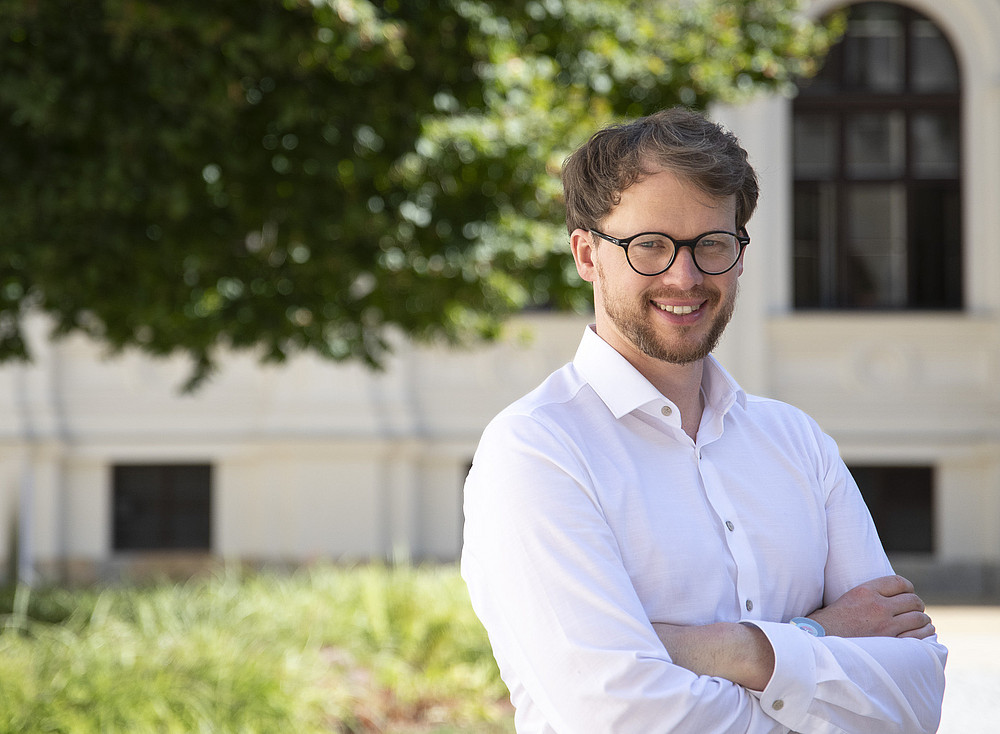
Markus Hafner

Born in Bavaria, Markus Hafner studied at the universities of Munich and Athens, among others. Photo: Uni Graz/Angele

With the ERC grant, Markus Hafner aims to address questions of anonymous and collective authorship in antiquity and, for the first time, to give space to the unheard voices of Greek texts in the fields of poetry, religion and technology.

In many cases, the tradition and especially the authors of ancient texts have not been clearly clarified and still receive little attention. "While modern literary history is dominated by big author names, in antiquity nameless texts also had an intrinsic value," says Markus Hafner, a classical philologist from Graz. On Tuesday, 5 September 2023, the Bavarian-born Dr. Hafner, who teaches and researches at the Department of Classics at the University of Graz, was selected by the European Research Council (ERC) of the European Commission as the winner of a Starting Grant worth 1.5 million for the project "COLLAPSE – Collaboration and Pseudepigraphy. Facing the Anonymous in Imperial Greek Literature". Together with an international research group, Dr. Hafner wants to take a closer look at hitherto unnoticed texts from ancient Greece over the next few years, reassess them and define their role in literary history.

"In times of artificial intelligence and omnipresent digitalisation, we often forget that anonymously written texts have always existed," Dr. Hafner emphasises. With the ERC funding, he wants to address questions of anonymous and collective authorship in antiquity and, for the first time, give space to the unheard voices of Greek texts in the fields of poetry, religion and science writing. "Some writings – comparable to the wiki texts we are familiar with – were written rather collaboratively. Many authors sometimes worked together on one text," says the researcher. Unfortunately, so far attention has only been paid to works by well-known authors, so that writings written collectively have not been taken into account.

The project, which will run from January 2024 to the end of 2028, aims to change this. To this end, four doctoral students and two postdocs will work with Markus Hafner to research the sources anew.

About the principal investigator
Markus Hafner studied Classical Philology, Philosophy and Education at the LMU Munich and the University of Athens. After his doctorate, he taught various classes and carried out research at universities in Germany and the USA. Since 2020 he has been an Assistant Professor, and since 2022 a professor of Classical Philology (esp. Greek) at the University of Graz.

created by Konstantin Tzivanopoulos

Related news

University of Graz: Discover the apprentice game and secure jobtraining

The University of Graz not only educates students – it also offers apprenticeships in eight future-oriented professions – even with a school-leaving certificate if desired! From metal technology in the physics workshop to IT systems engineering: discover apprenticeships now and immerse yourself in the world of university apprentices with an interactive game.

Green carpet, wooden staircase, reading room: the specialist history library is back

In just eight months, the university renovated, expanded and modernised the specialist library for history on Heinrichstraße. A total of 200,000 volumes are now available, corresponding to around 3,000 metres of shelving. Head Felicitas Schober explains what has changed and why smaller collections are now also housed there. A local inspection.

Listening to the Middle Ages: exhibition brings poverty then and now to life

What connects Giulio, a blacksmith who worked in Bologna almost 500 years ago, with a single mother from Styria who recently lost her job? Both are afraid that they will soon be unable to pay their rent. How does it feel to have existential worries? An exhibition at the University of Graz provides personal insights into experiences of poverty then and now. Listening stations give a voice to people from the Middle Ages. The exhibition opened on 5 March 2026 in the foyer of the University Library Graz.

Diversity buddies at the University of Graz: Support on equal terms

The University of Graz is strengthening its commitment to equal opportunities with its new Diversity Buddies. University members can find easily accessible contact persons here for questions relating to equality and diversity. All employees can get involved and take action.

Begin of page section:
Additional information:

University of Graz
Universitaetsplatz 3
8010 Graz
Austria
  • Contact
  • Web Editors
  • Moodle
  • UNIGRAZonline
  • Imprint
  • Data Protection Declaration
  • Accessibility Declaration
Weatherstation
Uni Graz

End of this page section. Go to overview of page sections

End of this page section. Go to overview of page sections

Begin of page section:

End of this page section. Go to overview of page sections