Begin of page section:
Page sections:

  • Go to contents (Accesskey 1)
  • Go to position marker (Accesskey 2)
  • Go to main navigation (Accesskey 3)
  • Go to sub navigation (Accesskey 4)
  • Go to additional information (Accesskey 5)
  • Go to page settings (user/language) (Accesskey 8)
  • Go to search (Accesskey 9)

End of this page section. Go to overview of page sections

Begin of page section:
Page settings:

English en
Deutsch de
Search
Login

End of this page section. Go to overview of page sections

Begin of page section:
Search:

Search for details about Uni Graz
Close

End of this page section. Go to overview of page sections


Search

Begin of page section:
Main navigation:

Page navigation:

  • University

    University
    • About the University
    • Organisation
    • Faculties
    • Library
    • Working at University of Graz
    • Campus
    Developing solutions for the world of tomorrow - that is our mission. Our students and our researchers take on the great challenges of society and carry the knowledge out.
  • Research Profile

    Research Profile
    • Our Expertise
    • Research Questions
    • Research Portal
    • Promoting Research
    • Research Transfer
    • Ethics in Research
    • Commission for Scientific Integrity
    Scientific excellence and the courage to break new ground. Research at the University of Graz creates the foundations for making the future worth living.
  • Studies

    Studies
    • Prospective Students
    • Students
  • Community

    Community
    • International
    • Location
    • Research and Business
    • Alumni
    The University of Graz is a hub for international research and brings together scientists and business experts. Moreover, it fosters the exchange and cooperation in study and teaching.
  • Spotlight
Topics
  • Sustainable University
  • Researchers answer
  • Work for us
Close menu

End of this page section. Go to overview of page sections

Begin of page section:
You are here:

University of Graz Spotlight It crawls and flies: The campus as a valuable place of biodiversity

End of this page section. Go to overview of page sections

It crawls and flies: The campus as a valuable place of biodiversity

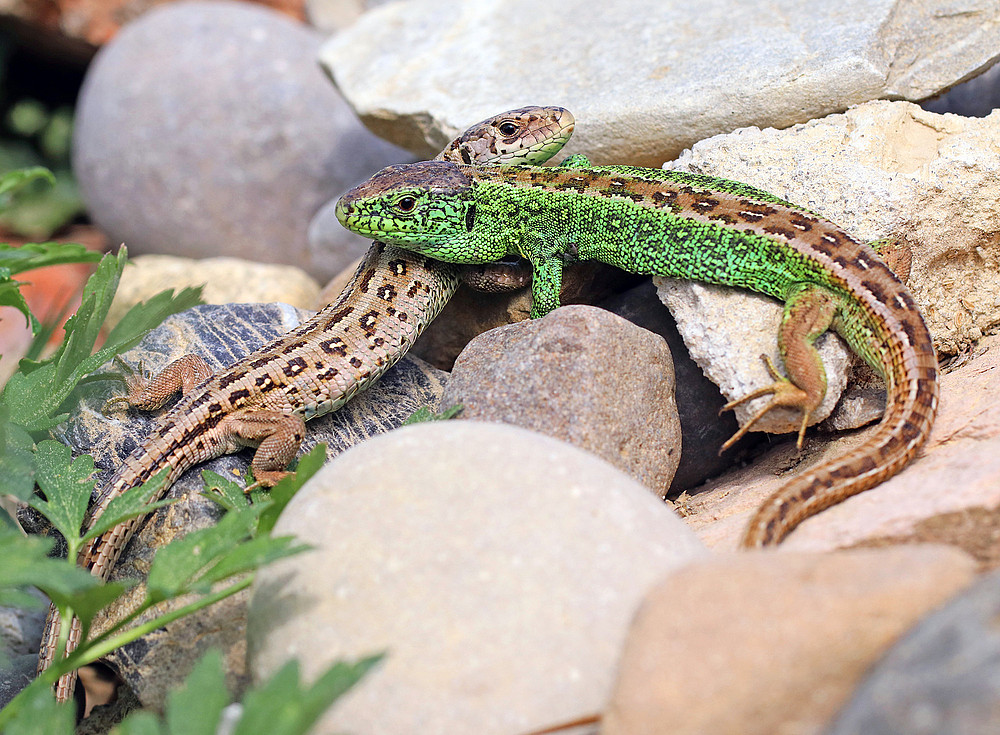
A brown and a green sand lizard on stones ©Willi - stock.adobe.com

Sand lizards – here a female (brown) and a male – need diverse structures, such as stones or dead wood for basking. Photo: Willi - stock.adobe.com

It is a living and recreational space for students, for people who work at the university and for those who live in the neighbourhood: the green campus of the University of Graz. Many plants and animals also feel at home here. For example, the sand lizard, which has now become rare in Graz, and more than 150 tree species. To ensure that the diversity of flora and fauna continues to grow, the University of Graz is taking targeted measures to promote biodiversity.


The pretty sand lizard – during the mating season the males impress in green – was once widespread in Graz. Today, there are only a few isolated populations left in the city, the largest of which is in the Botanical Garden and the surrounding area.

Wilderness corridor in the city

With a total of around 600 trees, plus hedges, shrubs and perennials, lawns and flowering areas as well as gardens, the University of Graz campus offers valuable habitats for flora and fauna. In addition to Universitätsplatz, the area includes several locations - from the Training and Diagnostics Centre at Rosenhain to the Wall building in Merangasse.

"As one of the largest green spaces in Graz, the campus is an important biotope and forms a corridor for the spread of species as a bridge between the Stadtpark and Hilmteich," explains Christian Sturmbauer from the Institute of Biology at the University of Graz. "The Botanical Garden in particular, with its old trees, is an important stepping stone towards Leechwald", says the biodiversity expert.

For more biodiversity

In recent decades, biodiversity has declined massively in many places. However, it is crucial for functioning ecosystems and thus for the preservation of our livelihoods. The University of Graz has therefore set itself the goal of promoting biodiversity with various measures. The first steps have already been taken. In 2023, the campus received a total of 50 new trees and a flowering strip on the north meadow on Universitätsplatz as a source of food for bees and other insects. More shrubs and perennials have also been planted. Experts from the Botanical Garden contributed their knowledge. Among other things, they made sure that climate-resistant, primarily native plants that are attractive to insects and birds, such as rowanberry and elderberry, were selected.

In front of the Universitätsplatz 2 building, the trunk of a felled plane tree has been providing a deadwood habitat for a community of fungi, insects, woodlice and other organisms for several months. Right next to it, a "4-star" insect hotel beckons. Biologist Gernot Kunz has researched which structures in nesting aids are particularly valuable for species relevant to nature conservation and has built them in. "Our insect hotel was used by the red mason bee, the European orchard bee, the giant resin bee, the blue cuckoo wasp and a species of digger wasp, among others," reports Kunz. "However, accompanying investigations have shown that the nesting aid is too shallow. We will therefore be replacing the frame to give the nest more depth," explains the insect expert. "Luxury" hotels optimised in this way will soon be erected at other locations.

The University of Graz received support from the Bundesimmobiliengesellschaft to promote bird biodiversity. It sponsored 20 nesting boxes, which were attached to trees on campus.

"HeinrichBiCool" is the name of the recently launched project to green the University Centre for Theology at Heinrichstraße 80, which aims to cool the building and create a new biodiverse habitat at the same time. There will also be plenty of greenery around the Graz Centre of Physics, which is currently under construction, with rows of trees providing shade and a park-like city terrace.

ÖKOTEAM Graz has just analysed the possibilities for promoting biodiversity across the entire campus. Together with experts from the Department of Biology, further measures are now to be planned and implemented.

Gernot Kunz next to the insect hotel at Universitätsplatz 2 ©University of Graz / Eklaude
©University of Graz / Eklaude
Gernot Kunz has equipped the insect hotel with structures that invite different species to nest. Photo: University of Graz / Eklaude
A male European orchard bee clutches a female during mating. ©Gernot Kunz
©Gernot Kunz
The insect hotel is used by the European orchard bee, among others. A male clings to a female during mating. Photo: University of Graz / Kunz
Flower strip, with a historic university building in the background ©Uni Graz/angelemichael
©Uni Graz/angelemichael
In 2023, a flower strip was created on the northern lawn at Universitätsplatz to provide food for insects. Photo: University of Graz / Angele
The Botanical Garden from above ©Zepp-Cam Furian & Seidl OEG
©Zepp-Cam Furian & Seidl OEG
With its old trees, the Botanical Garden is an important biotope for biodiversity in the urban area. Photo: Zepp-Cam Furian & Seidl OEG
created by Gudrun Pichler

Related news

Long Night of Research: How many languages are there in the world?

From a linguistic perspective, there are worlds of difference between Bern, Berlin and Vienna. A dialect impersonator will demonstrate live just how varied German can sound. How many languages are there in the world? What are their distinctive features? Which of these are spoken in Austria? These and other questions will be answered during the Long Night of Research at the University of Graz: on Friday, 24 April 2025, from 5 pm to 11 pm, in the University Library. Visitors can immerse themselves in the diversity of languages without travelling far by taking part in a quiz at the station.

Dual role: Researchers show that platelets can worsen disease

Platelets are best known as rapid responders in the event of injury. They stop bleeding and are indispensable for wound healing. “However, thrombocytes can also aggravate diseases, especially when inflammatory processes are involved,” explains Marion Mußbacher, a pharmacist at the University of Graz. She investigated the “dual role” of platelets in relation to fatty liver disease, a condition closely linked to obesity and type 2 diabetes.

Forscher:innen entdecken natürlichen Wirkstoff zum Schutz vor Lebererkrankungen

Die Leber leidet still. „Fetteinlagerungen, strukturelle Zerstörung des Gewebes oder mutierende Tumorzellen – all das fliegt eine Weile unter dem Radar. Begleitet werden diese Veränderungen oft von leichten, jedoch chronischen Entzündungen“, erklärt Andreas Koeberle, Pharmazeut an der Universität Graz. Er hat mit seinem Team und Kolleg:innen der Universität Innsbruck den Wirkstoff Mitrephoron B untersucht, der neue Behandlungsansätze ermöglicht. Die Ergebnisse der Studie wurden kürzlich in der Open-Access-Fachzeitschrift „Theranostics“ veröffentlicht.

Climate at the cliffs: Researchers unravel the evolution of the Greenland ice margin

Vertical ice walls, up to 40 metres high: in "Game of Thrones" they were dramatised as fortifications; during the Cold War, they were studied with great interest. How these imposing walls along Greenland’s 80,000-kilometre-long ice margin formed, how they are evolving, and what impact they have on the climate is not yet fully understood. Researchers from the Universities of Graz and Innsbruck have come one step closer to solving the mystery. The results of their latest study have been published in the journal The Cryosphere.

Begin of page section:
Additional information:

University of Graz
Universitaetsplatz 3
8010 Graz
Austria
  • Contact
  • Web Editors
  • Moodle
  • UNIGRAZonline
  • Imprint
  • Data Protection Declaration
  • Accessibility Declaration
Weatherstation
Uni Graz

End of this page section. Go to overview of page sections

End of this page section. Go to overview of page sections

Begin of page section:

End of this page section. Go to overview of page sections