



Begin of page section:
Page sections:

  • Go to contents (Accesskey 1)
  • Go to position marker (Accesskey 2)
  • Go to main navigation (Accesskey 3)
  • Go to sub navigation (Accesskey 4)
  • Go to additional information (Accesskey 5)
  • Go to page settings (user/language) (Accesskey 8)
  • Go to search (Accesskey 9)

End of this page section. Go to overview of page sections

Begin of page section:
Page settings:

English en
Deutsch de
Search
Login

End of this page section. Go to overview of page sections

Begin of page section:
Search:

Search for details about Uni Graz
Close

End of this page section. Go to overview of page sections


Search

Begin of page section:
Main navigation:

Page navigation:

  • University

    University
    • About the University
    • Organisation
    • Faculties
    • Library
    • Working at University of Graz
    • Campus
    Developing solutions for the world of tomorrow - that is our mission. Our students and our researchers take on the great challenges of society and carry the knowledge out.
  • Research Profile

    Research Profile
    • Our Expertise
    • Research Questions
    • Research Portal
    • Promoting Research
    • Research Transfer
    • Ethics in Research
    • Commission for Scientific Integrity
    Scientific excellence and the courage to break new ground. Research at the University of Graz creates the foundations for making the future worth living.
  • Studies

    Studies
    • Prospective Students
    • Students
    • Welcome Weeks for First Year Students
  • Community

    Community
    • International
    • Location
    • Research and Business
    • Alumni
    The University of Graz is a hub for international research and brings together scientists and business experts. Moreover, it fosters the exchange and cooperation in study and teaching.
Topics
  • Sustainable University
  • Researchers answer
  • Work for us
Close menu

End of this page section. Go to overview of page sections

Begin of page section:
You are here:

University of Graz News Zwischen Wunsch und Wirklichkeit

End of this page section. Go to overview of page sections

Tuesday, 28 June 2016

Zwischen Wunsch und Wirklichkeit

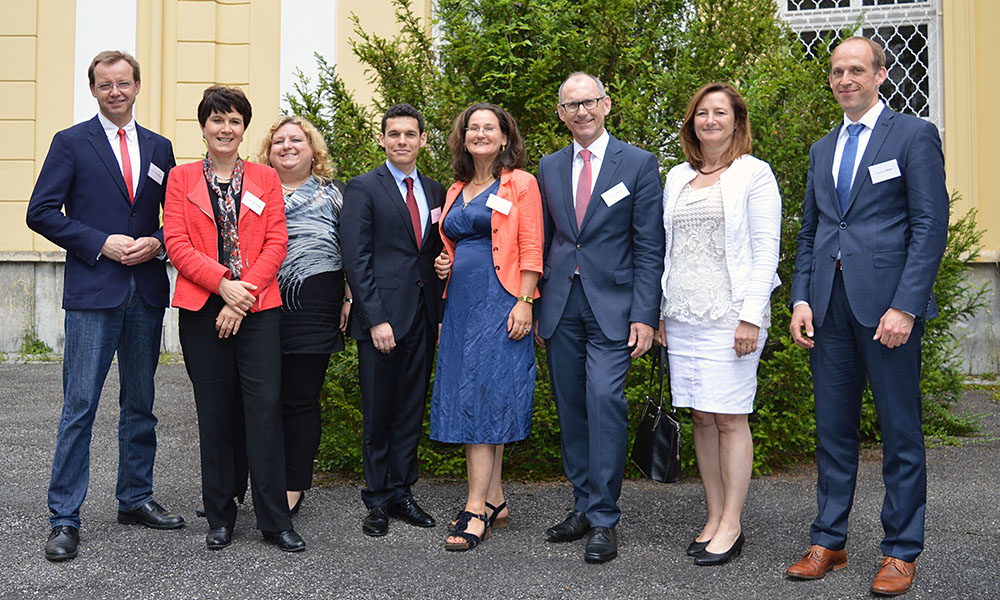
V.l.: Gottfried Kirchengast, Eva Schulev-Steindl, Erika Wagner (Uni Linz), Daniel Ramos (WTO), Yvonne Karimi-Schmidt (Uni Graz), Gerhard Schnedl, Monika Hinteregger (Uni Graz), Thorsten Müller (Stiftung Umweltenergierecht, Würzburg) Foto: Spitzer, CCCA

V.l.: Gottfried Kirchengast, Eva Schulev-Steindl, Erika Wagner (Umweltrecht, Uni Linz), Daniel Ramos (Trade & Environment Division, WTO), Yvonne Karimi-Schmidt (Völkerrecht, Uni Graz), Gerhard Schnedl, Monika Hinteregger (Zivilrecht, Uni Graz), Thorsten Müller (Stiftung Umweltenergierecht, Würzburg). Foto: Heide Spitzer, CCCA

Zweites Grazer Umweltrechtsforum diskutierte Möglichkeiten, wie Legislative und Jurisdiktion den Klimaschutz verbessern können

Wie können Gesetzgeber und Gerichte in Österreich und der EU ihren essenziell nötigen Beitrag zum Klimaschutz in Zukunft besser leisten? Diese Frage diskutierten rund achtzig nationale und internationale ExpertInnen aus Wissenschaft und Praxis beim zweiten Grazer Umweltrechtsforum am 16. Juni 2016 im Meerscheinschlössl der Karl-Franzens-Universität.

Einig war man sich, dass aus naturwissenschaftlicher Sicht in Sachen Klimawandel dringender Handlungsbedarf besteht und die europäische und österreichische Gesetzgebung bislang zu wenig initiativ war. „Auch bei völkerrechtlichen Verträgen, wie dem allseits gelobten Pariser Klimaabkommen von 2015, stellt sich die Frage der ,Verpflichtungskraft‘“, so Univ.-Prof. Dr. Eva Schulev-Steindl vom Institut für Öffentliches Recht und Politikwissenschaft, die gemeinsam mit ihrem Institutskollegen Ass.-Prof. Dr. Gerhard Schnedl und Univ.-Prof. Dr. Gottfried Kirchengast, Leiter des Wegener Center für Klima und Globalen Wandel der Uni Graz, die wissenschaftliche Leitung der Tagung innehatte. Strittig war – das zeigte insbesondere die Podiumsdiskussion mit VertreterInnen von Wirtschaft und Verwaltung –, welches das wirksamste juristische Instrumentarium zum Klimaschutz ist, wie zum Beispiel Emissionshandel versus CO2-Steuern.

„Neue Wege gehen so genannte ,Klimaklagen‘“ gegen Staaten oder Unternehmen wegen mangelhaften Engagements bei der Verringerung von Treibhausgas-Emissionen, wie sie bereits in mehreren Ländern, etwa den Niederlanden, USA und Pakistan, angestrengt wurden", berichtet Schulev-Steindl. „Die Reformüberlegungen konzentrierten sich in dieser Hinsicht auf das Privatrecht: Es zeigte sich, dass Klagen auf Schadenersatz oder Unterlassung zur Geltendmachung von (künftigen) Klimaschäden mit vielen rechtlichen Herausforderungen verbunden sind – diese sind freilich nicht unüberwindbar.“

Insgesamt zeigte sich, dass die rechtswissenschaftliche klimabezogene Forschung ein hohes innovatives Potenzial und hohe Wichtigkeit zur Stärkung der österreichischen Klimaforschung sowie zur Unterstützung rechtlicher Umsetzungen in der Praxis hat. Daher ist als Nächstes auch eine koordinierte österreichweite Vernetzung im Rahmen des Klimaforschungsnetzwerks Climate Change Centre Austria (CCCA) geplant.

Das Umweltrechtsforum wurde vom Institut für Öffentliches Recht und Politikwissenschaft in Kooperation mit dem Wegener Center für Klima und Globalen Wandel, der Kommission Klima- und Luftqualität der Österreichischen Akademie der Wissenschaften und dem CCCA organisiert.

created by Eva Schulev-Steindl, Gerhard Schnedl, Gottfried Kirchengast & Gudrun Pichler

Related news

Jurassic Sounds: Biologist reconstructs insect songs from 165 million years ago

It was apparently not just the roars of the dinosaurs that made up the soundscape of the animal world during the Jurassic period. Crickets and grasshoppers communicated through a variety of songs and high-pitched sounds, as Thorin Jonsson from the Institute of Biology at the University of Graz discovered together with colleagues from the universities of Lincoln, Bristol (UK), Beijing (China) and Tempe (USA). The findings on what are so far the oldest traces of sound on Earth have just been published in the journal PNAS.

EU funding boosts international exchange between universities

The University of Graz is further expanding its international study opportunities through the European university alliance Arqus and is taking the lead in two key projects. In future, students will benefit from even more joint degree programmes and from simplified recognition of academic achievements through the Joint European Degree Label.

Rescue and risks: Researchers have surveyed public perceptions of AI

The use of artificial intelligence has had to be made transparent since 2 August 2026. The EU’s AI Act, which has been in force since then, also sets out how risky an application is and which security measures apply as a result. However, the assessment of risks by the legislation differs in some cases significantly from the perceptions of the Austrian public. This is the finding of a representative study carried out by data scientist Stefan Thalmann from the University of Graz and his team.

The Healing Sea: Researchers discover new approaches to treating chronic inflammation in sponges

Chronic inflammation plays a key role in many diseases, ranging from metabolic disorders and cardiovascular diseases to tissue damage following injuries or infections. “Normally, the body is able to resolve inflammation on its own. If this process becomes unbalanced, immune cells remain permanently active and continue to drive negative changes in the tissue,” explains Andreas Koeberle, a pharmacist at the University of Graz.

Begin of page section:
Additional information:

University of Graz
Universitaetsplatz 3
8010 Graz
Austria
  • Contact
  • Web Editors
  • Moodle
  • UNIGRAZonline
  • Imprint
  • Data Protection Declaration
  • Accessibility Declaration
Weatherstation
Uni Graz

End of this page section. Go to overview of page sections

End of this page section. Go to overview of page sections

Begin of page section:

End of this page section. Go to overview of page sections