



Begin of page section:
Page sections:

  • Go to contents (Accesskey 1)
  • Go to position marker (Accesskey 2)
  • Go to main navigation (Accesskey 3)
  • Go to sub navigation (Accesskey 4)
  • Go to additional information (Accesskey 5)
  • Go to page settings (user/language) (Accesskey 8)
  • Go to search (Accesskey 9)

End of this page section. Go to overview of page sections

Begin of page section:
Page settings:

English en
Deutsch de
Search
Login

End of this page section. Go to overview of page sections

Begin of page section:
Search:

Search for details about Uni Graz
Close

End of this page section. Go to overview of page sections


Search

Begin of page section:
Main navigation:

Page navigation:

  • University

    University
    • About the University
    • Organisation
    • Faculties
    • Library
    • Working at University of Graz
    • Campus
    Developing solutions for the world of tomorrow - that is our mission. Our students and our researchers take on the great challenges of society and carry the knowledge out.
  • Research Profile

    Research Profile
    • Our Expertise
    • Research Questions
    • Research Portal
    • Promoting Research
    • Research Transfer
    • Ethics in Research
    • Commission for Scientific Integrity
    Scientific excellence and the courage to break new ground. Research at the University of Graz creates the foundations for making the future worth living.
  • Studies

    Studies
    • Prospective Students
    • Students
    • Registration for Study Programme (Winter semester 2026/27)
  • Community

    Community
    • International
    • Location
    • Research and Business
    • Alumni
    The University of Graz is a hub for international research and brings together scientists and business experts. Moreover, it fosters the exchange and cooperation in study and teaching.
Topics
  • Sustainable University
  • Researchers answer
  • Work for us
Close menu

End of this page section. Go to overview of page sections

Begin of page section:
You are here:

University of Graz News Zur Würde des Tieres

End of this page section. Go to overview of page sections

Friday, 15 April 2016

Zur Würde des Tieres

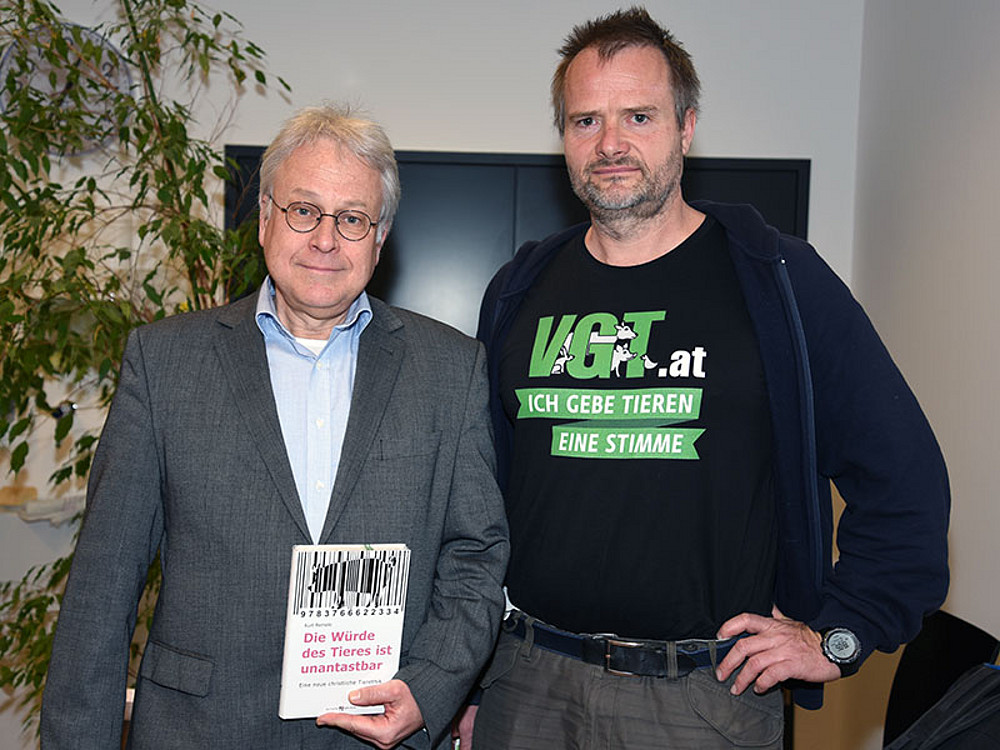
V.l.: Autor Kurt Remele mit Martin Balluch, Obmann des Vereins gegen Tierfabriken. Fotos: Uni Graz/Pichler

V.l.: Autor Kurt Remele mit Martin Balluch, Obmann des Vereins gegen Tierfabriken. Fotos: Uni Graz/Pichler

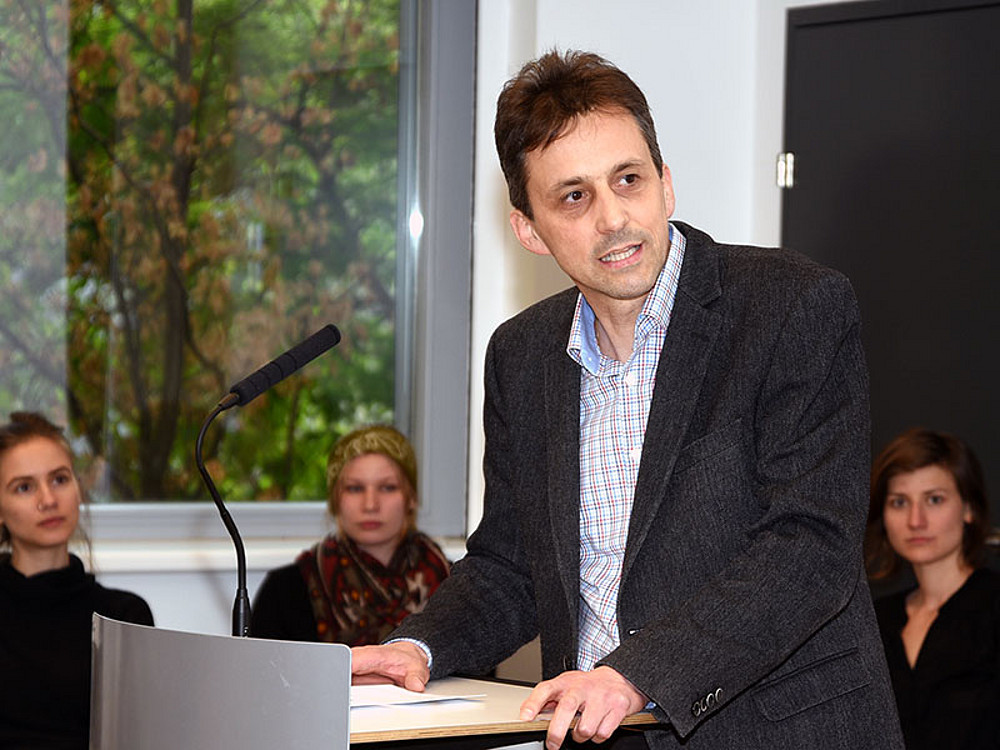
Dekan Reinhold Esterbauer begrüßte die Gäste bei der Buchpräsentation im Universitätszentrum Theologie.

Dekan Reinhold Esterbauer begrüßte die Gäste bei der Buchpräsentation im Universitätszentrum Theologie.

Kurt Remele entwirft in seinem jüngsten Buch eine neue christliche Tierethik

Der grausame Umgang mit Tieren in Mastbetrieben und Schlachthöfen sowie die Ausrottung ganzer Arten haben eine neue Diskussion über die Würde und den Wert von Tieren entfacht. Der Theologe Ao.Univ.-Prof. Dr. Kurt Remele befasst sich seit vielen Jahren in Forschung und Lehre mit Fragen der Tierethik. Am 14. April 2016 präsentierte er am Universitätszentrum Theologie der Uni Graz vor zahlreichen Interessierten sein jüngstes Buch: „Die Würde des Tieres ist unantastbar – Eine neue christliche Tierethik“.

In der klassischen, ausschließlich auf den Menschen und sein Wohl bezogenen christlichen Ethik spielten Tiere eine untergeordnete Rolle. Sie hatten keinen moralischen Status, keinen Eigenwert, keine Rechte. Im Dialog mit der zeitgenössischen philosophischen und theologischen Tierethik vor allem des angloamerikanischen Raumes entwickelt Kurt Remele eine neue christliche Tierethik. Diese versteht Tiere als empfindungsfähige Mitgeschöpfe des Menschen und zieht daraus entsprechende Konsequenzen für Ernährung, Forschung und andere traditionelle Nutzungsformen von Tieren. Dabei knüpft der Autor an Einstellungen von VertreterInnen des Christentums an – von tierliebenden Heiligen und der Bewegung gegen Tierversuche im viktorianischen England über die tierfreundlichen Theologen Albert Schweitzer (1875-1965) und Johannes Ude (1874-1965) bis hin zu Papst Franziskus und seiner Enzyklika Laudato Sí.

Nach der Buchvorstellung kam in einem Gespräch mit dem Autor auch der Tierrechtsaktivist und Obmann des Vereins gegen Tierfabriken (VGT), DDr. Martin Balluch, zu Wort. Gemeinsam mit Remele stellte er sich anschließend einer angeregten Diskussion mit dem Publikum.

Kurt Remele lehrt Ethik und christliche Gesellschaftslehre an der Katholisch-Theologischen Fakultät der Karl-Franzens-Universität Graz. Er war Gastprofessor an der Catholic University of America, der University of Minnesota und der Gonzaga University und ist Fellow des Oxford Centre for Animal Ethics.

Publikation:
Kurt Remele: Die Würde des Tieres ist unantastbar – Eine neue christliche Tierethik, Butzon & Bercker 2016

created by Gudrun Pichler

Related news

"Mathematics explains the world"

How can life be quantified? And what can science reveal that remains hidden from the naked eye? The 14th European Conference on Mathematical and Theoretical Biology at the University of Graz is dedicated to these questions. From 13 to 17 July, around 1,300 researchers from all over the world will gather on campus to discuss models, biological processes and the future of data-driven medicine. Klemens Fellner, Dean of the Faculty of Natural Sciences and Mathematics and a mathematician, talks about the language that explains the world

Internationally up-to-date: University of Graz offers new degree programmes in art studies

From the Old Masters to AI art – three newly designed degree programmes offer students at the University of Graz fresh perspectives on artistic production. In addition to historical art, the programmes place a greater emphasis on contemporary and global developments. The registration period is open.

The Nazi elite school Napola: Historian seeks memories and personal documents

They were to be brought up to become the future elite of National Socialism: boys and girls aged ten and over who, following the ‘Anschluss’ of Austria to the German Reich, attended a so-called Napola (short for Nationalpolitische Lehranstalt; also known as NPEA, Nationalpolitische Erziehungsanstalt). There were nine such institutions in what is now Austria between 1939 and 1945.

Heat-resistant: Eva Preinfalk explains how cities can protect their residents

Certain demographic and some occupational groups are particularly vulnerable to high temperatures. A range of measures is needed to provide relief for everyone, explains climate economist Eva Preinfalk.

Begin of page section:
Additional information:

University of Graz
Universitaetsplatz 3
8010 Graz
Austria
  • Contact
  • Web Editors
  • Moodle
  • UNIGRAZonline
  • Imprint
  • Data Protection Declaration
  • Accessibility Declaration
Weatherstation
Uni Graz

End of this page section. Go to overview of page sections

End of this page section. Go to overview of page sections

Begin of page section:

End of this page section. Go to overview of page sections