Begin of page section:
Page sections:

  • Go to contents (Accesskey 1)
  • Go to position marker (Accesskey 2)
  • Go to main navigation (Accesskey 3)
  • Go to sub navigation (Accesskey 4)
  • Go to additional information (Accesskey 5)
  • Go to page settings (user/language) (Accesskey 8)
  • Go to search (Accesskey 9)

End of this page section. Go to overview of page sections

Begin of page section:
Page settings:

English en
Deutsch de
Search
Login

End of this page section. Go to overview of page sections

Begin of page section:
Search:

Search for details about Uni Graz
Close

End of this page section. Go to overview of page sections


Search

Begin of page section:
Main navigation:

Page navigation:

  • University

    University
    • About the University
    • Organisation
    • Faculties
    • Library
    • Working at University of Graz
    • Campus
    Developing solutions for the world of tomorrow - that is our mission. Our students and our researchers take on the great challenges of society and carry the knowledge out.
  • Research Profile

    Research Profile
    • Our Expertise
    • Research Questions
    • Research Portal
    • Promoting Research
    • Research Transfer
    • Ethics in Research
    Scientific excellence and the courage to break new ground. Research at the University of Graz creates the foundations for making the future worth living.
  • Studies

    Studies
    • Prospective Students
    • Students
  • Community

    Community
    • International
    • Location
    • Research and Business
    • Alumni
    The University of Graz is a hub for international research and brings together scientists and business experts. Moreover, it fosters the exchange and cooperation in study and teaching.
  • Spotlight
Topics
  • Our digital Advent calendar
  • Sustainable University
  • Researchers answer
  • Work for us
Close menu

End of this page section. Go to overview of page sections

Begin of page section:
You are here:

University of Graz News Zur besseren Weltraumwetter-Prognose

End of this page section. Go to overview of page sections

Wednesday, 27 May 2015

Zur besseren Weltraumwetter-Prognose

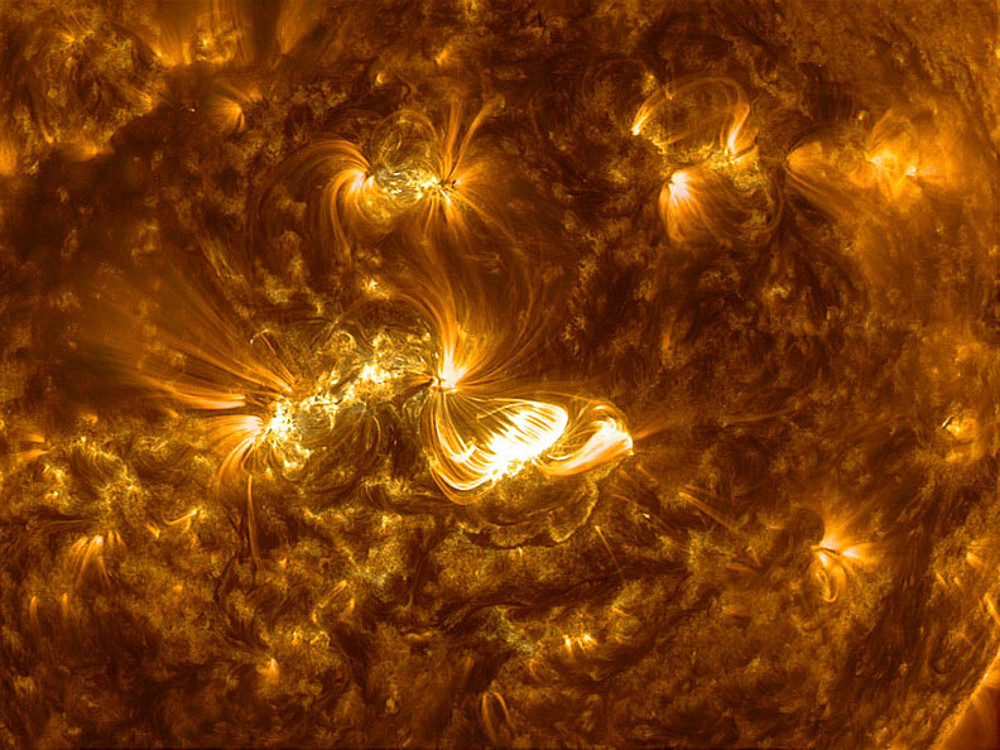
Der Sonnensturm vom 7. Jänner 2014 entstand aus einem koronalen Massenauswurf in Richtung Erde, wurde aber offenbar abgelenkt. Foto: Solar Dynamics Observatory, NASA

Der Sonnensturm vom 7. Jänner 2014 entstand aus einem koronalen Massenauswurf in Richtung Erde, wurde aber offenbar abgelenkt. Foto: Solar Dynamics Observatory, NASA

Studie liefert neue Erkenntnisse über die Ausbreitung von Sonnenstürmen

Im Jänner 2014 sorgte ein gewaltiger Sonnensturm für Überraschung. Obwohl er genau auf die Erde gerichtet zu sein schien, kam er hier offenbar nicht an, da keinerlei Auswirkungen zu spüren waren. Ein internationales Team von WissenschafterInnen unter der Leitung des Grazer Instituts für Weltraumforschung (IWF) der Österreichischen Akademie der Wissenschaften machte sich daraufhin auf die Suche nach den Ursachen. Unter ihnen Dr. Christian Möstl, Priv.-Doz. Dr. Manuela Temmer und Dissertant Martin Reiß, MSc, AstrophysikerInnen am IWF und an der Karl-Franzens-Universität Graz. Ihre Studie, die soeben in Nature Communications veröffentlicht wurde, brachte neue Erkenntnisse über die Entstehung und Entwicklung von Sonnenstürmen. Diese tragen dazu bei, Weltraumwetter-Prognosen zu verbessern, um möglichen Gefahren und Schäden in Folge von Sonnenstürmen vorbeugen zu können.

„Bei unseren Forschungen haben wir überraschender Weise festgestellt, dass Magnetfelder in der Nähe der Entstehungsregion von Sonnenstürmen solche ,Unwetterfronten‘ stärker ablenken können, als bisher bekannt war“, fasst Christian Möstl die zentrale Erkenntnis der aktuellen Studie zusammen. Das war auch im Jänner 2014 der Fall, wie die WissenschafterInnen anhand von Daten sieben verschiedener Raumsonden zeigen konnten.

Sonnenstürme entstehen alle paar Tage durch so genannte koronale Massenauswürfe. Das sind Ausbrüche von Sonnen-Plasma – mehrere Millionen Grad Celsius heißes, gasförmiges Material aus geladenen Teilchen –, bei denen Wolken aus Plasma mit Millionen von Stundenkilometern in den Weltraum geschleudert werden. Trifft ein solcher Sonnensturm auf das Magnetfeld der Erde, können nicht nur Polarlichter entstehen. Auch Störungen von Satelliten, Behinderungen des Flugverkehrs sowie weiträumige Stromausfälle sind mögliche Folgen.
Aus diesem Grund haben exakte Prognosen über die Ausbreitung von Sonnenstürmen große Bedeutung. Die vorliegende Studie liefert wesentliche Grundlagen dafür.

Publikation:
Möstl C., T. Rollett, R.A. Frahm, Y.D. Liu, D.M. Long, R.C. Colaninno, M.A. Reiss, M. Temmer, C.J. Farrugia, A. Posner, M. Dumbović, M. Janvier, P. Démoulin, P. Boakes, A. Devos, E. Kraaikamp, M.L. Mays, B. Vršnak: Strong coronal channeling and interplanetary evolution of a solar storm up to Earth and Mars, Nat. Comm., 7, 7135, doi:10.1038/ncomms8135, 2015.

created by Gudrun Pichler

Related news

Chemical Christmas show at the University of Graz: An explosive evening at the Schauspielh

At the beginning of December, the University of Graz transformed the theater into a laboratory: as part of “Chemical Life,” teacher training students staged a chemical Christmas show for Styrian school classes—complete with ethanol rockets, nitrogen snow, and glowing effects. An evening designed to inspire interest in studying chemistry.

Train by train: Koralm railway accelerates exchange between the Universities

Lectures at the University of Klagenfurt in the morning, seminars at the University of Graz in the afternoon: Austria's longest tunnel and a journey time of around 45 minutes make it easy. The Koralm railway increases the speed of networking between the two university locations. The collaboration builds on existing cooperation - for example in the areas of teacher training, Slavic studies and as employers, the universities are well coordinated.

On the trail of the Big Bang: University of Graz receives 1.5 million euros for doctoral programmes

The Austrian Science Fund FWF has selected the Doctoral Programme in Theoretical Particle Physics at the University of Graz for funding from the Doc.funds. Six young scientists will be funded for 3.5 years. They will gain fundamentally new insights into the origins of the world.

From trans women and knee prostheses: sports science prizes awarded

Walking better with a prosthesis, successfully getting rid of excess weight, training more effectively, more fairness for trans people in sport: these were the topics addressed by the students at the University of Graz who were awarded the sports science prizes for their Master's theses on 3 December 2025.

Begin of page section:
Additional information:

University of Graz
Universitaetsplatz 3
8010 Graz
Austria
  • Contact
  • Web Editors
  • Moodle
  • UNIGRAZonline
  • Imprint
  • Data Protection Declaration
  • Accessibility Declaration
Weatherstation
Uni Graz

End of this page section. Go to overview of page sections

End of this page section. Go to overview of page sections

Begin of page section:

End of this page section. Go to overview of page sections