Begin of page section:
Page sections:

  • Go to contents (Accesskey 1)
  • Go to position marker (Accesskey 2)
  • Go to main navigation (Accesskey 3)
  • Go to sub navigation (Accesskey 4)
  • Go to additional information (Accesskey 5)
  • Go to page settings (user/language) (Accesskey 8)
  • Go to search (Accesskey 9)

End of this page section. Go to overview of page sections

Begin of page section:
Page settings:

English en
Deutsch de
Search
Login

End of this page section. Go to overview of page sections

Begin of page section:
Search:

Search for details about Uni Graz
Close

End of this page section. Go to overview of page sections


Search

Begin of page section:
Main navigation:

Page navigation:

  • University

    University
    • About the University
    • Organisation
    • Faculties
    • Library
    • Working at University of Graz
    • Campus
    Developing solutions for the world of tomorrow - that is our mission. Our students and our researchers take on the great challenges of society and carry the knowledge out.
  • Research Profile

    Research Profile
    • Our Expertise
    • Research Questions
    • Research Portal
    • Promoting Research
    • Research Transfer
    • Ethics in Research
    Scientific excellence and the courage to break new ground. Research at the University of Graz creates the foundations for making the future worth living.
  • Studies

    Studies
    • Prospective Students
    • Students
  • Community

    Community
    • International
    • Location
    • Research and Business
    • Alumni
    The University of Graz is a hub for international research and brings together scientists and business experts. Moreover, it fosters the exchange and cooperation in study and teaching.
  • Spotlight
Topics
  • Sustainable University
  • Researchers answer
  • Work for us
Close menu

End of this page section. Go to overview of page sections

Begin of page section:
You are here:

University of Graz News Wundersame Wüstenblume

End of this page section. Go to overview of page sections

Monday, 13 May 2013

Wundersame Wüstenblume
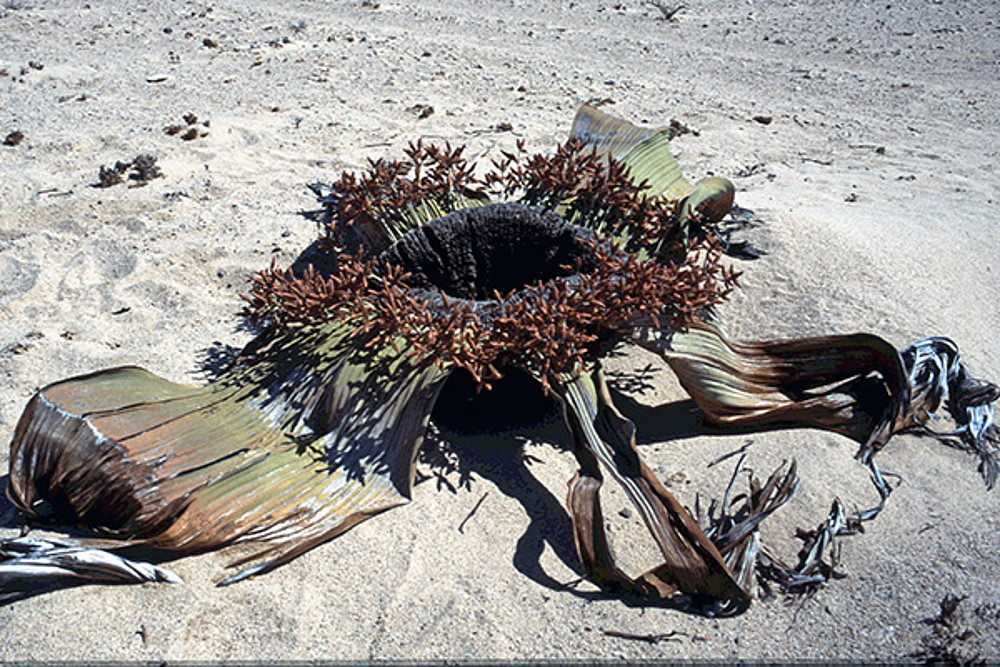
Die sonderbare Wüstenpflanze welwitschia mirabilis steht im Mittelpunkt einer Ausstellung an der Uni Graz.

Die sonderbare Wüstenpflanze welwitschia mirabilis steht im Mittelpunkt einer Ausstellung an der Uni Graz. Foto: Wolfgang Wetschnig

Die hässlichste Pflanze der Welt an der Uni Graz

Eine Besonderheit zeigt der Botanische Garten der Uni Graz ab 16. Mai 2013: Der Welwitschie – botanisch Welwitschia mirabilis – und ihrem Namensgeber Friedrich Welwitsch ist eine kleine Ausstellung gewidmet. Die Pflanze gedeiht in der Natur ausschließlich in der afrikanischen Wüste Namib. Sie wird mehrere hundert Jahre alt, besitzt aber nur ein einziges Blattpaar, das länger als fünf Meter werden kann. Welwitsch, ein österreichischer Arzt und Botaniker (1806-1872), entdeckte das seltsame Lebewesen auf einer Forschungsreise in Angola und schickte ein Exemplar in die berühmten Londoner Royal Botanic Gardens Kew. Dort wurde sie vor exakt 150 Jahren erstmals wissenschaftlich klassifziert und als „die wunderbarste Pflanze, die je in dieses Land gebracht wurde, und eine der hässlichsten“ bezeichnet.
Die Ausstellung wird am 16. Mai um 17 Uhr mit drei Vorträgen im Hörsaal des Instituts für Pflanzenwissenschaften (Holteigasse 6) eröffnet. Der Historiker der Uni Klagenfurt Roland Baeck referiert über den Botaniker Friedrich Welwitsch, dessen Biografie bis vor kurzem unbekannt war. Michael Pinter und Wolfgang Wetschnig vom Institut für Pflanzenwissenschaften der Uni Graz berichten über die Besonderheiten der Welwitschie. Die Vorträge sind öffentlich zugänglich und kostenfrei.
Die Ausstellung selbst zeigt lebende und getrocknete Exemplare der Welwitschie sowie zwei Modelle. Außerdem ist auf Info-Tafeln Wissenswertes über die Besonderheiten der Pflanze und das Leben ihres Entdeckers zu erfahren. Die Schau im Botanischen Garten, Schubertstraße 59, ist bis einschließlich 5. Juli 2013 täglich von 10 bis 14 Uhr zu besichtigen, der Eintritt ist frei.

created by Dagmar Eklaude

Related news

Diversity buddies at the University of Graz: Support on equal terms

The University of Graz is strengthening its commitment to equal opportunities with its new Diversity Buddies. University members can find easily accessible contact persons here for questions relating to equality and diversity. All employees can get involved and take action.

When parents find it difficult to have a say

In her dissertation, translation scholar Marie Tschurtschenthaler examines how communication between compulsory schools and parents whose first language is not German works – and what role professional language mediation plays in this. Initial insights show that it is not just about language, but also about resources, responsibilities and the institutional framework.

AI in schools: Maria Bertel drafts legal guidelines for teachers

The legal expert and her team analysed the legal situation regarding the use of artificial intelligence in education as part of an EU project and answered open questions from practice.

Cosmetics in the environment: University of Graz proves danger to ants

Titanium dioxide, which is found in cosmetics, for example, is increasingly entering the environment in the form of nanoparticles. This could also put insects at risk. If ants ingest the substance in combination with the pesticide glyphosate, it disturbs the development of their offspring. Scientists at the University of Graz are drawing attention to the negative consequences of this toxic cocktail.

Begin of page section:
Additional information:

University of Graz
Universitaetsplatz 3
8010 Graz
Austria
  • Contact
  • Web Editors
  • Moodle
  • UNIGRAZonline
  • Imprint
  • Data Protection Declaration
  • Accessibility Declaration
Weatherstation
Uni Graz

End of this page section. Go to overview of page sections

End of this page section. Go to overview of page sections

Begin of page section:

End of this page section. Go to overview of page sections