



Begin of page section:
Page sections:

  • Go to contents (Accesskey 1)
  • Go to position marker (Accesskey 2)
  • Go to main navigation (Accesskey 3)
  • Go to sub navigation (Accesskey 4)
  • Go to additional information (Accesskey 5)
  • Go to page settings (user/language) (Accesskey 8)
  • Go to search (Accesskey 9)

End of this page section. Go to overview of page sections

Begin of page section:
Page settings:

English en
Deutsch de
Search
Login

End of this page section. Go to overview of page sections

Begin of page section:
Search:

Search for details about Uni Graz
Close

End of this page section. Go to overview of page sections


Search

Begin of page section:
Main navigation:

Page navigation:

  • University

    University
    • About the University
    • Organisation
    • Faculties
    • Library
    • Working at University of Graz
    • Campus
    Developing solutions for the world of tomorrow - that is our mission. Our students and our researchers take on the great challenges of society and carry the knowledge out.
  • Research Profile

    Research Profile
    • Our Expertise
    • Research Questions
    • Research Portal
    • Promoting Research
    • Research Transfer
    • Ethics in Research
    • Commission for Scientific Integrity
    Scientific excellence and the courage to break new ground. Research at the University of Graz creates the foundations for making the future worth living.
  • Studies

    Studies
    • Prospective Students
    • Students
  • Community

    Community
    • International
    • Location
    • Research and Business
    • Alumni
    The University of Graz is a hub for international research and brings together scientists and business experts. Moreover, it fosters the exchange and cooperation in study and teaching.
Topics
  • Sustainable University
  • Researchers answer
  • Work for us
Close menu

End of this page section. Go to overview of page sections

Begin of page section:
You are here:

University of Graz News Women forward! Mireille van Poppel and Sarah Zapusek on the success and goals of equality

End of this page section. Go to overview of page sections

Wednesday, 05 March 2025

Women forward! Mireille van Poppel and Sarah Zapusek on the success and goals of equality

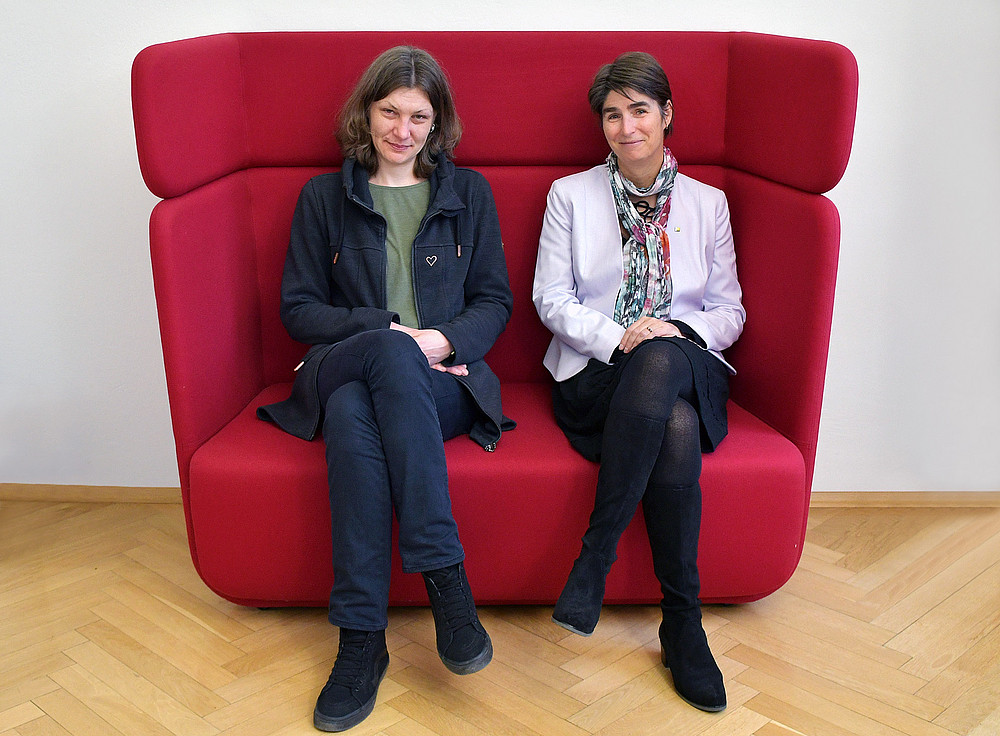
Sarah Zapusek and Mireille van Poppel sitting next to each other on a red couch with high backrests ©University of Graz/Pichler

Vice-Rector Mireille van Poppel (r.) and Sarah Zapusek are working to continuously improve the conditions for equal opportunities at the University of Graz. Photo: University of Graz/Pichler

What do Catholic Theology, Law, and Environmental, Regional and Educational Sciences have in common at the University of Graz? Each of these three faculties is headed by a female dean. This means that, for the first time in the university's history, 50 per cent of the deans of the six faculties are women. Mireille van Poppel, Vice-Rector for Internationalisation and Equal Opportunities, is delighted with this development. Together with Sarah Zapusek, who recently took up the position of head of the Coordination Centre for Gender Studies and Equal Opportunities, van Poppel explains how this positive development can be further promoted. The International Women's Day, celebrated annually on 8 March, is a good opportunity to highlight the achievements of the University of Graz in this field.


Since 1 October last year, there has been an equal number of men and women at the dean level for the first time. What does that mean for the University of Graz?

Mireille Van Poppel: I think it's an important signal that we, as a university, are also putting women in leadership positions. Five years ago, we offered a special training programme for female employees as a pilot project with exactly this goal in mind. Perhaps this is one result of that.

Last year, the percentage of female professors at the University of Graz was 36 per cent. In 2000, it was still at six per cent – an enormous increase. Do you think the university has achieved its goal?

Van Poppel: The significant increase in the percentage of female professors is encouraging, but of course there is still room for improvement. Fifty-two per cent of the scientific staff at the University of Graz are female, so the percentage of female professors is lagging behind.

What would be the most efficient way to further increase the proportion of female professors in your opinion?

Van Poppel: In the scientific field, much more targeted headhunting is needed, both nationally and internationally. The experts should know where to find competent female colleagues. They should get in touch with them in good time and encourage them to apply. Women are often less self-confident than men. If they feel unsure about whether they meet the requirements for a position exactly, they may not even apply. Even in the job advertisements, you have to make sure that the wording is female-friendly. That is not always the case. At the Faculty of Natural Sciences, we are already specifically looking for women to fill professorial positions and are obviously successful in doing so.

What is the role of the Coordination Centre for Gender Studies and Equal Opportunities?

Sarah Zapusek: In addition to our many existing offers and measures, we are currently developing content for the integration of gender competence into the UNISTART programme for managers at the university, together with the Working Group for Equal Opportunities. We want to raise awareness of the topic and question stereotypes. Awareness-raising measures are very important because in the long term it is also about changing the organisational culture. And that is only possible with constant, tireless commitment.

What are the goals of the University of Graz in the area of equality for the coming years?

Van Poppel: In addition to further increasing the proportion of women, we want to promote diversity at the university in general. It is fundamentally important to recognise that women are not a homogenous group. They are in different life situations and phases, have different desires and needs. The aspect of diversity encompasses all of this.

What specifically is planned in this context?

Zapusek: We want to recruit employees from all areas of the university to serve as diversity buddies. They will be the first point of contact for questions and concerns related to equality and diversity, as well as serving as multipliers for gender and diversity skills and referring people to the many existing support services within and outside the university. Those interested will receive the knowledge and skills needed for these tasks in special workshops.

Van Poppel: Especially in view of current political developments, we as a university must stand up for the value of diversity in society and raise awareness of it.

Ms Zapusek, you have been head of the Coordination Centre for Gender Studies and Equal Opportunities since 1 November 2024. What would you like to achieve in this role?

Zapusek: I feel it is a great privilege to be able to lead this institution. The Coordination Center has existed for more than 30 years. During this time incredibly committed people have done very successful work. Some of the services we offer have been developed over decades, such as the career programme for female scientists at the four universities in Graz. It is very important to me to maintain and continue these important services at a high level of quality. Changing the organisational culture takes continuity. In addition, we are always developing new things. One example is the "Potenziale Fokus" programme. This is a small, flexible, largely individually customisable further education package for female scientists that has been very well received. It helps women acquire some of the skills and strategies necessary for their careers and establish helpful networks. This combination of proven services and new ones designed to meet current challenges is what characterises our work.

Proportion of women at the University of Graz
Female employees: 56%
Female scientists: 52%
Female professors: 36%
Female students: 62%
Female graduates: 67%

created by Gudrun Pichler

Related news

World literature from Austria: Anne-Kathrin Reulecke on Ingeborg Bachmann

On 25 June, Ingeborg Bachmann would have turned 100. To this day, she remains one of the most important German-language authors. Anne-Kathrin Reulecke, Professor of Modern German Literature at the Institute of German Studies, has conducted extensive research into the writer, who died in 1973. The academic explains why Bachmann continues to be influential and what makes her work so special. In addition to her literary analysis, Anne-Kathrin Reulecke shares some reading recommendations.

What matters in the end: moral theologian takes stock of assisted suicide

Since 1 January 2022, assisted suicide has been legal in Austria under certain conditions. This was made possible by a ruling of the Constitutional Court, which overturned the blanket ban on assisting in suicide. Four years on, it is clear that: “Although the legal framework is in place, many pressing questions remain unanswered when it comes to its practical implementation,” says Johann Platzer, a moral theologian at the University of Graz.

Noise is the signal: new simulation method enables secure communication

Researchers from Graz, Vienna and Munich have developed a new simulation method that makes it possible to calculate quantum light using classical software – a step towards secure quantum communication.

Massacre and Memory: University of Graz addresses the wounds of history

A conference on 12 and 13 June 2026 at the Jesuit Refectory will focus on trauma in Eastern and South-Eastern Europe.

Begin of page section:
Additional information:

University of Graz
Universitaetsplatz 3
8010 Graz
Austria
  • Contact
  • Web Editors
  • Moodle
  • UNIGRAZonline
  • Imprint
  • Data Protection Declaration
  • Accessibility Declaration
Weatherstation
Uni Graz

End of this page section. Go to overview of page sections

End of this page section. Go to overview of page sections

Begin of page section:

End of this page section. Go to overview of page sections