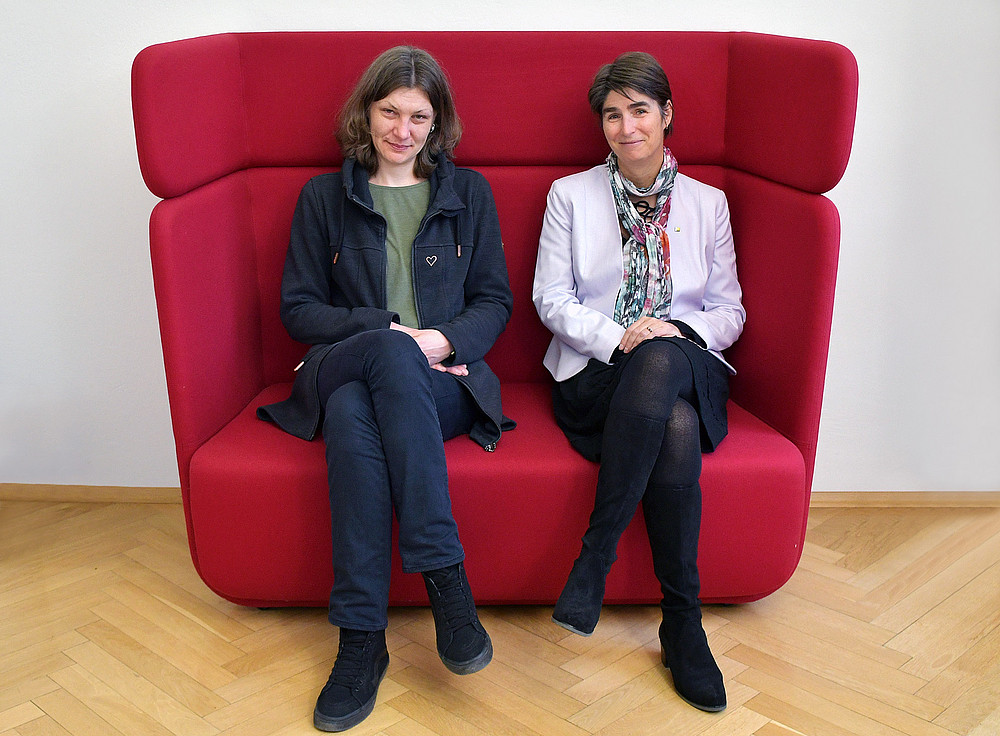
Since 1 October last year, there has been an equal number of men and women at the dean level for the first time. What does that mean for the University of Graz?
Mireille Van Poppel: I think it's an important signal that we, as a university, are also putting women in leadership positions. Five years ago, we offered a special training programme for female employees as a pilot project with exactly this goal in mind. Perhaps this is one result of that.
Last year, the percentage of female professors at the University of Graz was 36 per cent. In 2000, it was still at six per cent – an enormous increase. Do you think the university has achieved its goal?
Van Poppel: The significant increase in the percentage of female professors is encouraging, but of course there is still room for improvement. Fifty-two per cent of the scientific staff at the University of Graz are female, so the percentage of female professors is lagging behind.
What would be the most efficient way to further increase the proportion of female professors in your opinion?
Van Poppel: In the scientific field, much more targeted headhunting is needed, both nationally and internationally. The experts should know where to find competent female colleagues. They should get in touch with them in good time and encourage them to apply. Women are often less self-confident than men. If they feel unsure about whether they meet the requirements for a position exactly, they may not even apply. Even in the job advertisements, you have to make sure that the wording is female-friendly. That is not always the case. At the Faculty of Natural Sciences, we are already specifically looking for women to fill professorial positions and are obviously successful in doing so.
What is the role of the Coordination Centre for Gender Studies and Equal Opportunities?
Sarah Zapusek: In addition to our many existing offers and measures, we are currently developing content for the integration of gender competence into the UNISTART programme for managers at the university, together with the Working Group for Equal Opportunities. We want to raise awareness of the topic and question stereotypes. Awareness-raising measures are very important because in the long term it is also about changing the organisational culture. And that is only possible with constant, tireless commitment.
What are the goals of the University of Graz in the area of equality for the coming years?
Van Poppel: In addition to further increasing the proportion of women, we want to promote diversity at the university in general. It is fundamentally important to recognise that women are not a homogenous group. They are in different life situations and phases, have different desires and needs. The aspect of diversity encompasses all of this.
What specifically is planned in this context?
Zapusek: We want to recruit employees from all areas of the university to serve as diversity buddies. They will be the first point of contact for questions and concerns related to equality and diversity, as well as serving as multipliers for gender and diversity skills and referring people to the many existing support services within and outside the university. Those interested will receive the knowledge and skills needed for these tasks in special workshops.
Van Poppel: Especially in view of current political developments, we as a university must stand up for the value of diversity in society and raise awareness of it.
Ms Zapusek, you have been head of the Coordination Centre for Gender Studies and Equal Opportunities since 1 November 2024. What would you like to achieve in this role?
Zapusek: I feel it is a great privilege to be able to lead this institution. The Coordination Center has existed for more than 30 years. During this time incredibly committed people have done very successful work. Some of the services we offer have been developed over decades, such as the career programme for female scientists at the four universities in Graz. It is very important to me to maintain and continue these important services at a high level of quality. Changing the organisational culture takes continuity. In addition, we are always developing new things. One example is the "Potenziale Fokus" programme. This is a small, flexible, largely individually customisable further education package for female scientists that has been very well received. It helps women acquire some of the skills and strategies necessary for their careers and establish helpful networks. This combination of proven services and new ones designed to meet current challenges is what characterises our work.
Proportion of women at the University of Graz
Female employees: 56%
Female scientists: 52%
Female professors: 36%
Female students: 62%
Female graduates: 67%