



Begin of page section:
Page sections:

  • Go to contents (Accesskey 1)
  • Go to position marker (Accesskey 2)
  • Go to main navigation (Accesskey 3)
  • Go to sub navigation (Accesskey 4)
  • Go to additional information (Accesskey 5)
  • Go to page settings (user/language) (Accesskey 8)
  • Go to search (Accesskey 9)

End of this page section. Go to overview of page sections

Begin of page section:
Page settings:

English en
Deutsch de
Search
Login

End of this page section. Go to overview of page sections

Begin of page section:
Search:

Search for details about Uni Graz
Close

End of this page section. Go to overview of page sections


Search

Begin of page section:
Main navigation:

Page navigation:

  • University

    University
    • About the University
    • Organisation
    • Faculties
    • Library
    • Working at University of Graz
    • Campus
    Developing solutions for the world of tomorrow - that is our mission. Our students and our researchers take on the great challenges of society and carry the knowledge out.
  • Research Profile

    Research Profile
    • Our Expertise
    • Research Questions
    • Research Portal
    • Promoting Research
    • Research Transfer
    • Ethics in Research
    • Commission for Scientific Integrity
    Scientific excellence and the courage to break new ground. Research at the University of Graz creates the foundations for making the future worth living.
  • Studies

    Studies
    • Prospective Students
    • Students
  • Community

    Community
    • International
    • Location
    • Research and Business
    • Alumni
    The University of Graz is a hub for international research and brings together scientists and business experts. Moreover, it fosters the exchange and cooperation in study and teaching.
  • Spotlight
Topics
  • Sustainable University
  • Researchers answer
  • Work for us
Close menu

End of this page section. Go to overview of page sections

Begin of page section:
You are here:

University of Graz News Wo Wissen wächst

End of this page section. Go to overview of page sections

Thursday, 19 September 2019

Wo Wissen wächst

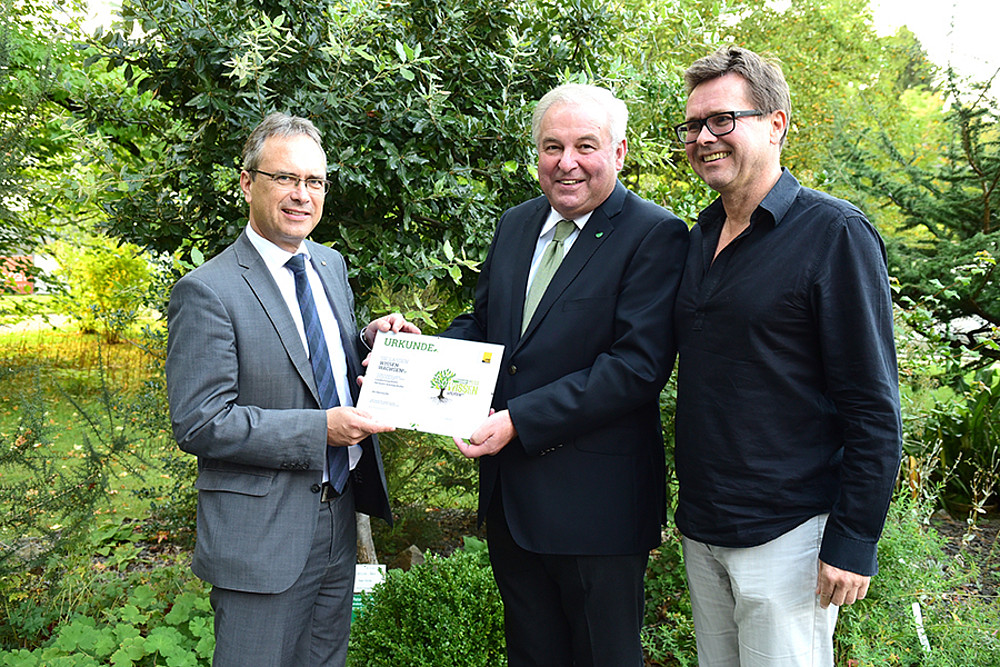
LH Hermann Schützenhöfer (Mitte) ist Pate der Steineiche. Vizerektor Peter Riedler (links) und der designierte Rektor Martin Polaschek dankten für die Unterstützung. Foto: Uni Graz/Schweiger

LH Hermann Schützenhöfer (Mitte) ist Pate der Steineiche. Vizerektor Peter Riedler (links) und der designierte Rektor Martin Polaschek dankten für die Unterstützung. Foto: Uni Graz/Schweiger

Universität Graz dankt Pflanzen-PatInnen im Botanischen Garten

Die „Science Busters“ tun es mit der Aasblume. Unternehmerin Waltraud Schinko-Neuroth fördert die Königinnenpalme. Und Landeshauptmann Hermann Schützenhöfer ist Schirmherr der Steineiche. Diese und viele weitere Persönlichkeiten unterstützen im Rahmen der Aktion „Lass Wissen wachsen“ den Botanischen Garten. Am 18. September 2019 bedankte sich die Universität Graz bei den Pflanzen-PatInnen. 

„Lass Wissen wachsen“ trägt Früchte: Unter diesem Motto wurde beim Empfang eine erfolgreiche Zwischenbilanz des Sponsoring-Projekts gezogen. Die Initiative war im Vorjahr anlässlich des 130-Jahr-Jubiläums des Botanischen Gartens in der Schubertstraße ins Leben gerufen worden, um die Anlage noch attraktiver zu gestalten. 
Vizerektor Peter Riedler unterstrich mit seinen Dankesworten die gesellschaftliche Relevanz des Areals, das jährlich von 20.000 Menschen besucht wird: „Mit den auf 28.000 Quadratmeter vereinten 7.400 Pflanzenarten leistet der Garten nicht nur einen wesentlichen Beitrag zum Erhalt der biologischen Vielfalt. Die reiche Pflanzenwelt ist auch Grundlage für erstklassige Forschungen an der Universität Graz.“ 
Neben vielen SpenderInnen wurden mittlerweile knapp 70 Patenschaften für Pflanzen übernommen, vier SponsorInnen fördern sogenannte Quartiere. 

Landeshauptmann Hermann Schützenhöfer zeigt sich von diesem Projekt der Universität Graz begeistert: „Die Steiermark ist das Forschungsland Nummer 1 und ein Land der Talente mit vielen hellen Köpfen. Ich unterstütze das Projekt ‚Lass Wissen wachsen‘ daher aus voller Überzeugung, denn es trägt dazu bei, das Forschungsland Steiermark zu stärken. Forschung und Entwicklung schaffen die Arbeitsplätze der Zukunft und neue Perspektiven für unser Land.“
Schützenhöfer stellte zudem im Rahmen der Veranstaltung in Aussicht, dass das Land Steiermark und die Stadt Graz die lange gewünschte Sanierung des historischen Gewächshauses finanziell unterstützen werden. 

Wer ebenso dem Aufruf „Lass Wissen wachsen“ folgen möchte, hat dazu noch Gelegenheit. Mangobaum, Ceylon Zimt, australischer Taschenfarn und andere Exoten sind noch zu haben. Mit einem Beitrag von 500 Euro erwirbt man eine Patenschaft für fünf Jahre. Die Namen der PatInnen werden direkt bei den pflanzlichen Unikaten sowie auf der Kampagnen-Website lasswissenwachsen.at veröffentlicht. 

created by Andreas Schweiger

Related news

Greenery on the rise: over 500 new flowers, perennials and shrubs on campus

Bright blooms and fresh greenery make our hearts beat faster in spring. But it is not just us humans who delight in this colourful growth. For many animals, this splendour provides, above all, food and habitat. There has recently been an increase in this on the University of Graz campus. More than 500 native flowers, perennials and shrubs have been planted on strips of fallow land around Universitätsplatz 2.

Around the world in eight stops: the Long Night of Research at the University of Graz

On 24 April from 5 pm, you can take a short trip around the globe at the University of Graz, discovering pecularities of foreign countries or new local features in the entrance hall of the University Library. The itinerary takes you through introduced animal species, political attitudes and the omnipotence of algorithms. There will also be a programme in the historic reading hall, as well as at the UniGraz@Museum and the University Archive.

Building biological bridges: Chemist discovers an ecological tool for the pharmaceutical industry

Building a relationship on a solid foundation is also important in chemistry. To produce medicines, disinfectants or plant protection products, stable bonds between carbon atoms must be formed. Conventional chemical methods rely on environmentally harmful reagents and solvents to carry out the desired reaction. This process also produces unusable by-products. Chemist Lilla Gal has discovered an enzyme that enables the same process to take place efficiently and sustainably. The results of her research were recently published in the prestigious journal Angewandte Chemie.

Higher Education Strategy 2040: Austria’s universities on course for the future

Austria has 77 higher education institutions, which is above the EU average – but does this really make sense? The new Higher Education Strategy 2040 focuses on cooperation rather than mergers. As one of the six largest universities in Austria, the University of Graz plays a central role in this.

Begin of page section:
Additional information:

University of Graz
Universitaetsplatz 3
8010 Graz
Austria
  • Contact
  • Web Editors
  • Moodle
  • UNIGRAZonline
  • Imprint
  • Data Protection Declaration
  • Accessibility Declaration
Weatherstation
Uni Graz

End of this page section. Go to overview of page sections

End of this page section. Go to overview of page sections

Begin of page section:

End of this page section. Go to overview of page sections


