
Begin of page section:
Page sections:

  • Go to contents (Accesskey 1)
  • Go to position marker (Accesskey 2)
  • Go to main navigation (Accesskey 3)
  • Go to sub navigation (Accesskey 4)
  • Go to additional information (Accesskey 5)
  • Go to page settings (user/language) (Accesskey 8)
  • Go to search (Accesskey 9)

End of this page section. Go to overview of page sections

Begin of page section:
Page settings:

English en
Deutsch de
Search
Login

End of this page section. Go to overview of page sections

Begin of page section:
Search:

Search for details about Uni Graz
Close

End of this page section. Go to overview of page sections


Search

Begin of page section:
Main navigation:

Page navigation:

  • University

    University
    • About the University
    • Organisation
    • Faculties
    • Library
    • Working at University of Graz
    • Campus
    Developing solutions for the world of tomorrow - that is our mission. Our students and our researchers take on the great challenges of society and carry the knowledge out.
  • Research Profile

    Research Profile
    • Our Expertise
    • Research Questions
    • Research Portal
    • Promoting Research
    • Research Transfer
    • Ethics in Research
    Scientific excellence and the courage to break new ground. Research at the University of Graz creates the foundations for making the future worth living.
  • Studies

    Studies
    • Prospective Students
    • Students
  • Community

    Community
    • International
    • Location
    • Research and Business
    • Alumni
    The University of Graz is a hub for international research and brings together scientists and business experts. Moreover, it fosters the exchange and cooperation in study and teaching.
  • Spotlight
Topics
  • Sustainable University
  • Researchers answer
  • Work for us
Close menu

End of this page section. Go to overview of page sections

Begin of page section:
You are here:

University of Graz News Wissenschaft trifft Technik

End of this page section. Go to overview of page sections

Friday, 01 March 2013

Wissenschaft trifft Technik

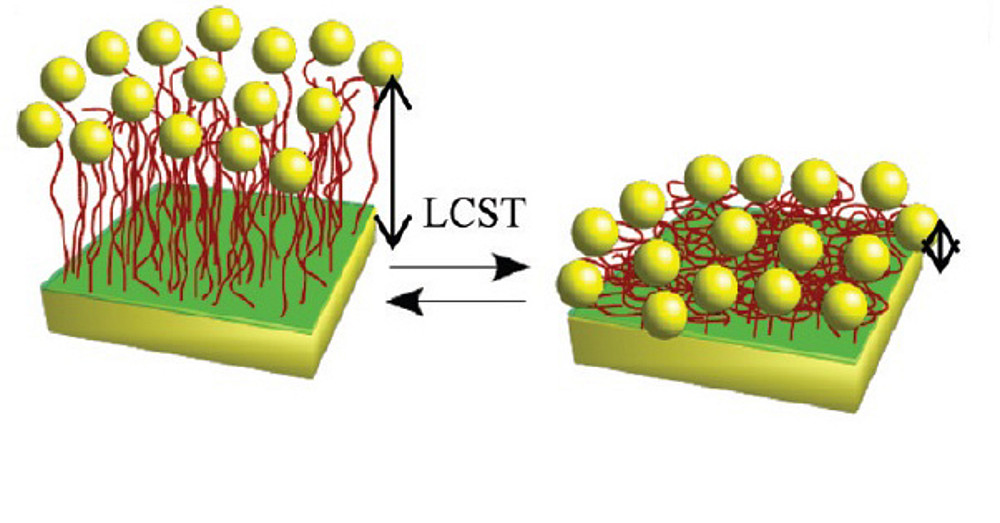
An eine Oberfläche gebundene, mit Gold-Nanopartikeln dekorierte p-NIPAM Polymere (rot markiert) in gequollenem (links) und kollabierten Zustand (rechts). Die Längenänderung verursacht eine messbare Veränderung der optischen Eigenschaften der Gold-Nano

An eine Oberfläche gebundene, mit Gold-Nanopartikeln dekorierte p-NIPAM Polymere (rot markiert) in gequollenem (links) und kollabierten Zustand (rechts). Die Längenänderung verursacht eine messbare Veränderung der optischen Eigenschaften der Gold-Nanopartikel.

Andreas Hohenau vom Institut für Physik der Uni Graz.

Andreas Hohenau vom Institut für Physik der Uni Graz.

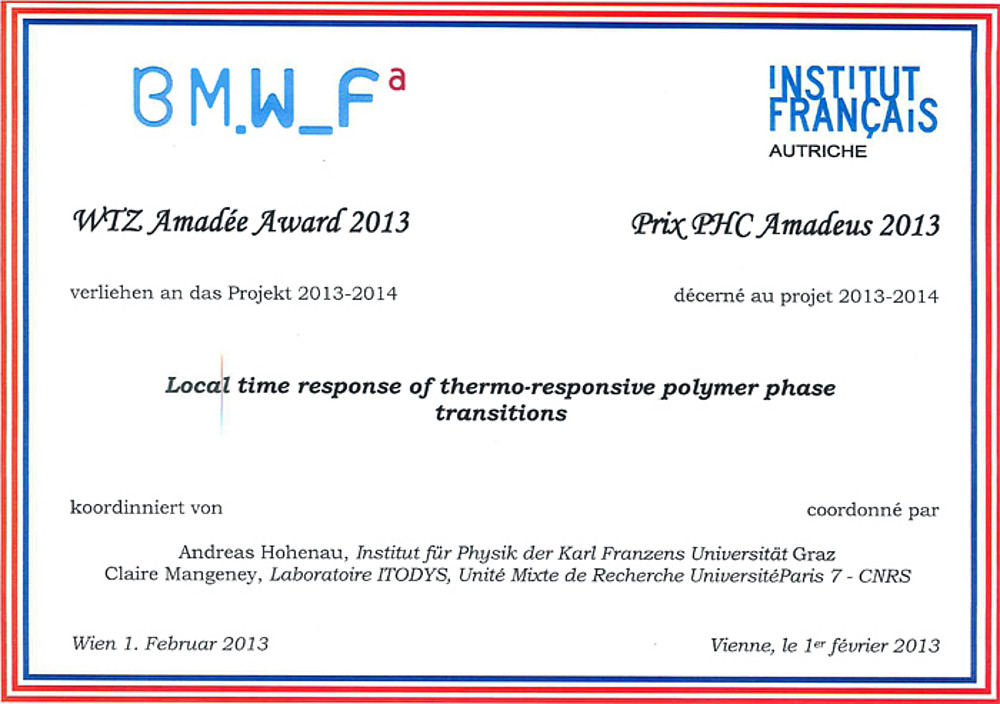
Die Amadee-Urkunde, die Andreas Hohenau und Claire Mangeney für ihr Projekt erhielten.

Die Amadee-Urkunde, die Andreas Hohenau und Claire Mangeney für ihr Projekt erhielten.

Prestigeträchtiger Preis für Physiker der Uni Graz

In der biologischen Messtechnik ist es wesentlich, zum Beispiel Proteine oder den Glucose-Gehalt im Blut einwandfrei bestimmen zu können. Dazu sind Biosensoren notwendig - also Bauteile zur qualitativen oder quantitativen Messung.


Einen Weg für völlig neuartige Systeme auf diesem Gebiet könnte ein Wissenschafter der Uni Graz gemeinsam mit einer französischen Kollegin gelegt haben: Assoz.-Prof. Dr. Andreas Hohenau vom Institut für Physik der Karl-Franzens-Universität Graz und Prof. Claire Mangeney von der Université  Diderot Paris VII koordinierten gemeinsam ein Projekt, das kürzlich mit einem der beiden für 2013 gestifteten Amadee-Preisen des BMWF ausgezeichnet wurde.


Ziel des Projekts ist es, durch Kombination aus Oberflächenchemie (Paris) und Nano-Optik (Graz) erstmals die Möglichkeit zu schaffen, das Kurzzeitverhalten von thermisch induzierten Phasenübergängen spezieller Polymere in sub-mikrometrischen Volumina zu untersuchen. In kleinen Volumina sollten die Phasenübergange wesentlich schneller ablaufen als es an makroskopischen Proben beobachtet wird. Die gewonnenen Erkenntnisse könnten sowohl für die Entwicklung neuer photonischer Elemente als auch für neuartige Biosensoren von Bedeutung sein.


Der Amadee-Preis wird seit 2009 ein Mal jährlich vom Bundesministerium für Wissenschaft und Forschung BMWF (über den ÖAD) und dem Institut Français in Wien für die zwei am besten evaluierten Projekte im Rahmen des WTZ-Programmes "Österreich-Frankreich" verliehen. WTZ steht für "Wissenschaftlich-Technische Zusammenarbeit". Das Programm finanziert ausschließlich Reisekosten für eine bilaterale Zusammenarbeit und soll die landes- und sprachenübergreifende Mobilität von ForscherInnen fördern.


Die Auszeichnung beinhaltet neben einem Preisgeld von 2000 Euro, das die Reisekosten französischer TeilnehmerInnen eines für September 2013 geplanten Workshops deckt, auch die Möglichkeit, die Räumlichkeiten des Palais Clam-Gallas in Wien dafür unentgeltlich zu nutzen.

Der zweite österreichische Preisträger 2013 ist Univ.-Prof. Dr. Norbert Müller vom Institut für Organische Chemie der Johannes Kepler Universität Linz.


created by Andreas Hohenau & Gerhild Kastrun

Related news

Diversity buddies at the University of Graz: Support on equal terms

The University of Graz is strengthening its commitment to equal opportunities with its new Diversity Buddies. University members can find easily accessible contact persons here for questions relating to equality and diversity. All employees can get involved and take action.

When parents find it difficult to have a say

In her dissertation, translation scholar Marie Tschurtschenthaler examines how communication between compulsory schools and parents whose first language is not German works – and what role professional language mediation plays in this. Initial insights show that it is not just about language, but also about resources, responsibilities and the institutional framework.

AI in schools: Maria Bertel drafts legal guidelines for teachers

The legal expert and her team analysed the legal situation regarding the use of artificial intelligence in education as part of an EU project and answered open questions from practice.

Cosmetics in the environment: University of Graz proves danger to ants

Titanium dioxide, which is found in cosmetics, for example, is increasingly entering the environment in the form of nanoparticles. This could also put insects at risk. If ants ingest the substance in combination with the pesticide glyphosate, it disturbs the development of their offspring. Scientists at the University of Graz are drawing attention to the negative consequences of this toxic cocktail.

Begin of page section:
Additional information:

University of Graz
Universitaetsplatz 3
8010 Graz
Austria
  • Contact
  • Web Editors
  • Moodle
  • UNIGRAZonline
  • Imprint
  • Data Protection Declaration
  • Accessibility Declaration
Weatherstation
Uni Graz

End of this page section. Go to overview of page sections

End of this page section. Go to overview of page sections

Begin of page section:

End of this page section. Go to overview of page sections