Begin of page section:
Page sections:

  • Go to contents (Accesskey 1)
  • Go to position marker (Accesskey 2)
  • Go to main navigation (Accesskey 3)
  • Go to sub navigation (Accesskey 4)
  • Go to additional information (Accesskey 5)
  • Go to page settings (user/language) (Accesskey 8)
  • Go to search (Accesskey 9)

End of this page section. Go to overview of page sections

Begin of page section:
Page settings:

English en
Deutsch de
Search
Login

End of this page section. Go to overview of page sections

Begin of page section:
Search:

Search for details about Uni Graz
Close

End of this page section. Go to overview of page sections


Search

Begin of page section:
Main navigation:

Page navigation:

  • University

    University
    • About the University
    • Organisation
    • Faculties
    • Library
    • Working at University of Graz
    • Campus
    Developing solutions for the world of tomorrow - that is our mission. Our students and our researchers take on the great challenges of society and carry the knowledge out.
  • Research Profile

    Research Profile
    • Our Expertise
    • Research Questions
    • Research Portal
    • Promoting Research
    • Research Transfer
    • Ethics in Research
    • Commission for Scientific Integrity
    Scientific excellence and the courage to break new ground. Research at the University of Graz creates the foundations for making the future worth living.
  • Studies

    Studies
    • Prospective Students
    • Students
  • Community

    Community
    • International
    • Location
    • Research and Business
    • Alumni
    The University of Graz is a hub for international research and brings together scientists and business experts. Moreover, it fosters the exchange and cooperation in study and teaching.
  • Spotlight
Topics
  • Sustainable University
  • Researchers answer
  • Work for us
Close menu

End of this page section. Go to overview of page sections

Begin of page section:
You are here:

University of Graz News How we deal with social developments: University of Graz in the focus of ageing and care research

End of this page section. Go to overview of page sections

Monday, 02 October 2023

How we deal with social developments: University of Graz in the focus of ageing and care research

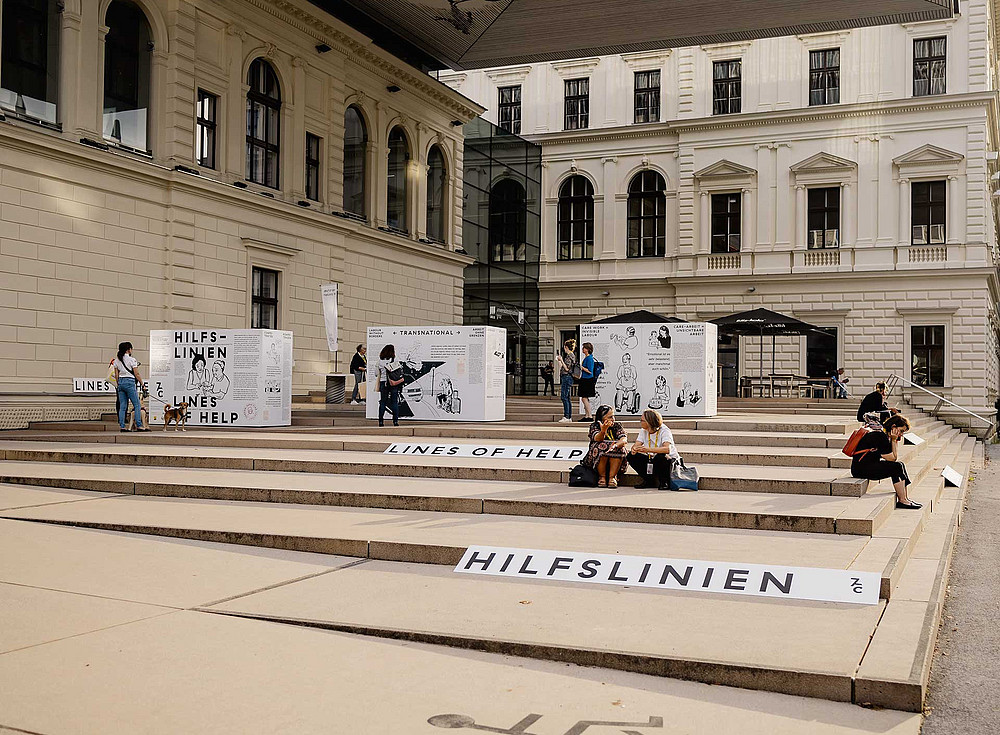
During the conference, the campus also served as an exhibition space. ©Michael Koerbler

During the conference, the campus also served as an exhibition space. Photo: Uni Graz/Vilgut

We are getting older. While today just under 20 percent of the people living in Austria are over 65, this share will grow to 28 percent in 2050. Older people shape this phase of life in many different ways. How do we deal with socio-demographic change and challenges such as dementia, migration and violence in old age? How can intergenerational cooperation and the good life in old age be promoted? These were the topics of the inaugural conference of the Centre for Interdisciplinary Research on Ageing and Care (CIRAC) at the University of Graz.

The pandemic had postponed the inaugural conference of CIRAC - founded in 2020 - to this year from 20 to 22 September 2023. 160 participants from 20 nations came together to discuss issues related to ageing in caring societies. In 20 discussion panels, researchers presented their findings and exchanged ideas with their peers and partners from the field.
Highlights were the four high-profile keynotes by US political scientist Joan Tronto, Kelli Stajduhar (Professor at the School of Nursing and the Institute on Aging & Lifelong Health at the University of Victoria, Canada), Canadian sociologist Stephen Katz and British literary scholar Amelia DeFalco. Topics ranged from the difficulties of caring for people with dementia to the democratisation of elder care and futuristic concepts of ageing.
Kelli Stajduhar, for example, also spoke about the problems of marginalised social classes and homelessness in old age. The Canadian researcher brought numerous examples from Victoria, British Columbia, which show that discrimination due to poverty, ethnicity or addiction does not end even in the dying process.

In addition, the University of Graz researchers Anna-Christina Kainradl, Klaus Wegleitner, Annette Sprung, Dzenana Pupic and Brigitte Kukovetz reported in a panel on their experience with the Caring Living Labs, a project of the University of Graz with regional partners. The research work ranges from active participation in suburban districts of Graz to further education offers for older persons with migration history to ethical questions in work in old people's homes.
During the conference, the campus also served as an exhibition space. On display boards, the projects "HILFSLINIEN/LINES OF HELP" and "HALT: Keine Gewalt! Stop Violence Against Older People" on the one hand addressed the connection between migration and 24-hour care and on the other hand tried to break the taboo of domestic violence in old age.

>> Center for Interdisciplinary Research on Aging and Care (CIRAC)
created by Roman Vilgut

Related news

Around the world in eight stops: the Long Night of Research at the University of Graz

On 24 April from 5 pm, you can take a short trip around the globe at the University of Graz, discovering pecularities of foreign countries or new local features in the entrance hall of the University Library. The itinerary takes you through introduced animal species, political attitudes and the omnipotence of algorithms. There will also be a programme in the historic reading hall, as well as at the UniGraz@Museum and the University Archive.

Studying at the University of Graz: How to enrol

Ready for a new chapter in your life with the start of your studies at the University of Graz in the winter semester 2026/27? Here you will find information on deadlines, admission procedures, registration, and everything else you need to successfully start your studies in the fall.

Interpreting data: Why studies sometimes get it wrong

Hilmar Brohmer and Ziva Korda from the Institute of Psychology, together with 500 international colleagues, have re-evaluated a hundred scientific publications and have often come to different conclusions.

Crystal-clear: AI method revolutionises solar observation

The Sun makes life on Earth possible. However, its magnetic fields can also cause massive disruption. This makes it all the more important to gain a better understanding of the processes taking place on our nearest star. A research team from the University of Graz and the High Altitude Observatory in Boulder (USA) has succeeded in doing just that. The astrophysicists have developed an AI-supported method that makes even the smallest structures on the Sun visible. The scientists are convinced that this will bring about a lasting change in solar observation and that the new method can be used for the planned European Solar Telescope.

Begin of page section:
Additional information:

University of Graz
Universitaetsplatz 3
8010 Graz
Austria
  • Contact
  • Web Editors
  • Moodle
  • UNIGRAZonline
  • Imprint
  • Data Protection Declaration
  • Accessibility Declaration
Weatherstation
Uni Graz

End of this page section. Go to overview of page sections

End of this page section. Go to overview of page sections

Begin of page section:

End of this page section. Go to overview of page sections