



Begin of page section:
Page sections:

  • Go to contents (Accesskey 1)
  • Go to position marker (Accesskey 2)
  • Go to main navigation (Accesskey 3)
  • Go to sub navigation (Accesskey 4)
  • Go to additional information (Accesskey 5)
  • Go to page settings (user/language) (Accesskey 8)
  • Go to search (Accesskey 9)

End of this page section. Go to overview of page sections

Begin of page section:
Page settings:

English en
Deutsch de
Search
Login

End of this page section. Go to overview of page sections

Begin of page section:
Search:

Search for details about Uni Graz
Close

End of this page section. Go to overview of page sections


Search

Begin of page section:
Main navigation:

Page navigation:

  • University

    University
    • About the University
    • Organisation
    • Faculties
    • Library
    • Working at University of Graz
    • Campus
    Developing solutions for the world of tomorrow - that is our mission. Our students and our researchers take on the great challenges of society and carry the knowledge out.
  • Research Profile

    Research Profile
    • Our Expertise
    • Research Questions
    • Research Portal
    • Promoting Research
    • Research Transfer
    • Ethics in Research
    • Commission for Scientific Integrity
    Scientific excellence and the courage to break new ground. Research at the University of Graz creates the foundations for making the future worth living.
  • Studies

    Studies
    • Prospective Students
    • Students
  • Community

    Community
    • International
    • Location
    • Research and Business
    • Alumni
    The University of Graz is a hub for international research and brings together scientists and business experts. Moreover, it fosters the exchange and cooperation in study and teaching.
Topics
  • Sustainable University
  • Researchers answer
  • Work for us
Close menu

End of this page section. Go to overview of page sections

Begin of page section:
You are here:

University of Graz News Wie schütze ich mein Know-how?

End of this page section. Go to overview of page sections

Friday, 29 April 2016

Wie schütze ich mein Know-how?

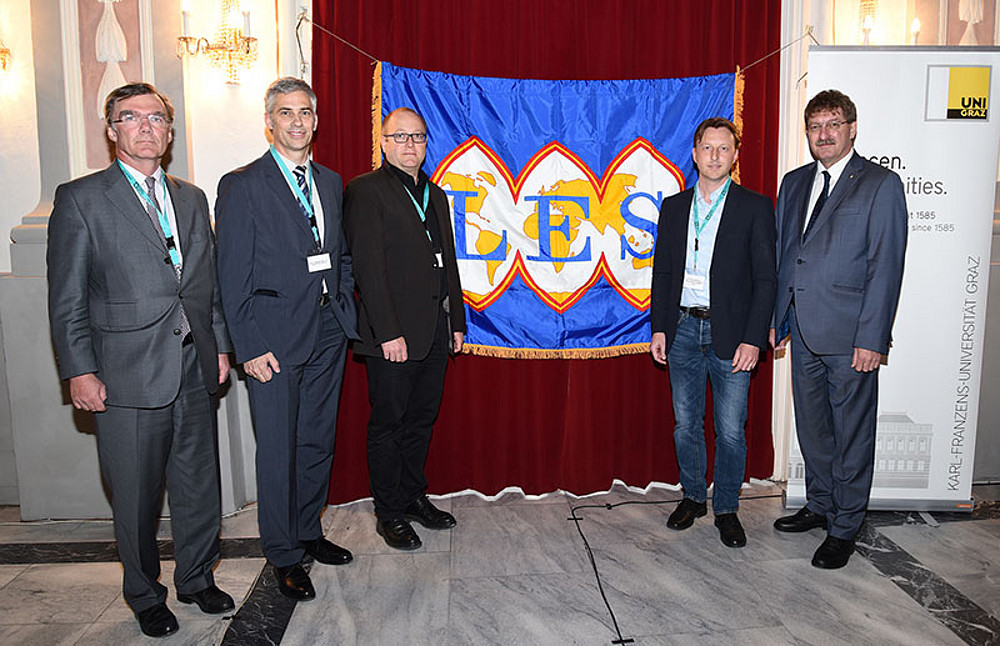
Christian Gassauer-Fleissner, Alexander Cizek, Hannes Voraberger, Helmut Aschbacher und Vizerektor Peter Scherrer. ©Uni Graz/Kastrun

Christian Gassauer-Fleissner, Alexander Cizek, Hannes Voraberger, Helmut Aschbacher und Vizerektor Peter Scherrer. Foto: Uni Graz/Kastrun.

Verschlüsselungstechnologien und elektronische Zertifikate sollen mehr Sicherheit im Web gewährleisten

Zum diesjährigen World IP Day, der am 26. April 2016 stattfand, organisierte die LES („Licensing Executives Society“) Austria gemeinsam mit der Karl-Franzens-Universität Graz im Meerscheinschlössl eine Veranstaltung unter dem Motto „Cyber Security – Wie schütze ich mein Know-how?“. Zu diesem Anlass konnten hochkarätige Referenten aus der Wirtschaft gewonnen werden, die sowohl über rechtliche und technische Aspekte zum Know-how-Schutz als auch über dessen praktische Umsetzung in Unternehmen vortrugen.


Dr. Christian Gassauer-Fleissner von der gleichnamigen Wiener Rechtsanwaltskanzlei sprach dabei über die wesentlichen Inhalte der vor zwei Wochen beschlossenen Know-how-Richtlinie der Europäischen Union und deren mögliche Auswirkungen auf die Rechtslage in Österreich. Im Anschluss daran gab Dr. Helmut Aschbacher von der Grazer Firma XiTrust Secure Technologies GmbH Einblick in Verschlüsselungstechnologien und elektronische Zertifikate, die Datenintegrität und Vertraulichkeit gewährleisten. Anwendungmöglichkeiten sind abgesicherte Cloudlösungen ebenso wie eine gesicherte Kommunikation zwischen Aussendienstmitarbeitern und der Firmenzentrale. DI Hannes Voraberger von der Firma AT & S Austria Technologie & Systemtechnik AG berichtete über den Umgang mit Know-how und Innovationen bei einem der weltweit größten Leiterplattenhersteller.

Bei der folgenden Podiumsdiskussion mit den Referenten und vor allem beim abschließenden Get-together bei Speis und Trank konnten die zahlreichen TeilnehmerInnen der Veranstaltung das Thema des Know-how Schutzes eingehender diskutieren.  


LES Austria („Licensing Executives Society“)
LES Austria ist die österreichische Landesorganisation der LES International und besteht seit 1979 als gemeinnütziger Verein. Die LES Austria befasst sich mit den technischen, ökonomischen, wissenschaftlichen und juristischen Aspekten des Lizenzwesens und des Transfers von Immaterialgütern und Technologien.  Darüber hinaus werden ein praxisorientierter Erfahrungsaustausch, die Weiterbildung sowie die Vernetzung zwischen Akteuren ermöglicht.


created by Andreas Pföstl & Gerhild Kastrun

Related news

Protest against budget cuts: universities send a united message in Graz

On 28 May, thousands of students, researchers and staff from all Styrian universities demonstrated in Graz against the announced budget cuts. University management and student representatives warned of severe consequences for research, teaching and the region’s standing as a centre of academic excellence.

Uni Vibes: The University of Graz opens its campus on May 29

On 29 May 2026, the University of Graz and La Strada Graz will once again transform the campus into an open-air festival site. ‘Uni Vibes – the festival that breaks down barriers’ brings together science, art and society, with free admission for all ages.

Overcoming boundaries: Can we manage without prisons and camps?

The US immigration agency ICE has sparked fear and horror. Not only are migrants criminalised and brutally persecuted, but earlier this year, ICE officers killed two US citizens in Minneapolis. Against the backdrop of these dramatic events, the University of Graz is shedding light on the role of deportation and detention centres as part of the international conference ‘Camps, Belonging, and Abolition Democracy’. Researchers aim to develop scenarios for how a future without prisons and the death penalty can become a reality.

From one to many: Uni Graz researchers identify a mechanism for the origin of species

When a habitat changes, animals, plants and even humans must adapt to the new environmental conditions. Those who manage this fastest and best will prevail. Over time, new species that are specialised for specific habitats also develop. Zoologist Christian Sturmbauer and his research group at the University of Graz, together with international partners, have now demonstrated that the molecular biological process of “alternative splicing” – contrary to previous assumptions – contributes highly effectively to the formation of new species. Different combinations of parts of the same gene give rise to various, structurally slightly different variants of functional proteins. This leads very rapidly to significant changes. The research findings were published in the renowned journal Proceedings of the National Academy of Sciences.

Begin of page section:
Additional information:

University of Graz
Universitaetsplatz 3
8010 Graz
Austria
  • Contact
  • Web Editors
  • Moodle
  • UNIGRAZonline
  • Imprint
  • Data Protection Declaration
  • Accessibility Declaration
Weatherstation
Uni Graz

End of this page section. Go to overview of page sections

End of this page section. Go to overview of page sections

Begin of page section:

End of this page section. Go to overview of page sections