Begin of page section:
Page sections:

  • Go to contents (Accesskey 1)
  • Go to position marker (Accesskey 2)
  • Go to main navigation (Accesskey 3)
  • Go to sub navigation (Accesskey 4)
  • Go to additional information (Accesskey 5)
  • Go to page settings (user/language) (Accesskey 8)
  • Go to search (Accesskey 9)

End of this page section. Go to overview of page sections

Begin of page section:
Page settings:

English en
Deutsch de
Search
Login

End of this page section. Go to overview of page sections

Begin of page section:
Search:

Search for details about Uni Graz
Close

End of this page section. Go to overview of page sections


Search

Begin of page section:
Main navigation:

Page navigation:

  • University

    University
    • About the University
    • Organisation
    • Faculties
    • Library
    • Working at University of Graz
    • Campus
    Developing solutions for the world of tomorrow - that is our mission. Our students and our researchers take on the great challenges of society and carry the knowledge out.
  • Research Profile

    Research Profile
    • Our Expertise
    • Research Questions
    • Research Portal
    • Promoting Research
    • Research Transfer
    • Ethics in Research
    Scientific excellence and the courage to break new ground. Research at the University of Graz creates the foundations for making the future worth living.
  • Studies

    Studies
    • Prospective Students
    • Students
    • Welcome Weeks for First Year Students
  • Community

    Community
    • International
    • Location
    • Research and Business
    • Alumni
    The University of Graz is a hub for international research and brings together scientists and business experts. Moreover, it fosters the exchange and cooperation in study and teaching.
  • Spotlight
Topics
  • Sustainable University
  • Researchers answer
  • Work for us
Close menu

End of this page section. Go to overview of page sections

Begin of page section:
You are here:

University of Graz News How does peace succeed? Maximilian Lakitsch drives research forward

End of this page section. Go to overview of page sections

Monday, 12 January 2026

How does peace succeed? Maximilian Lakitsch drives research forward

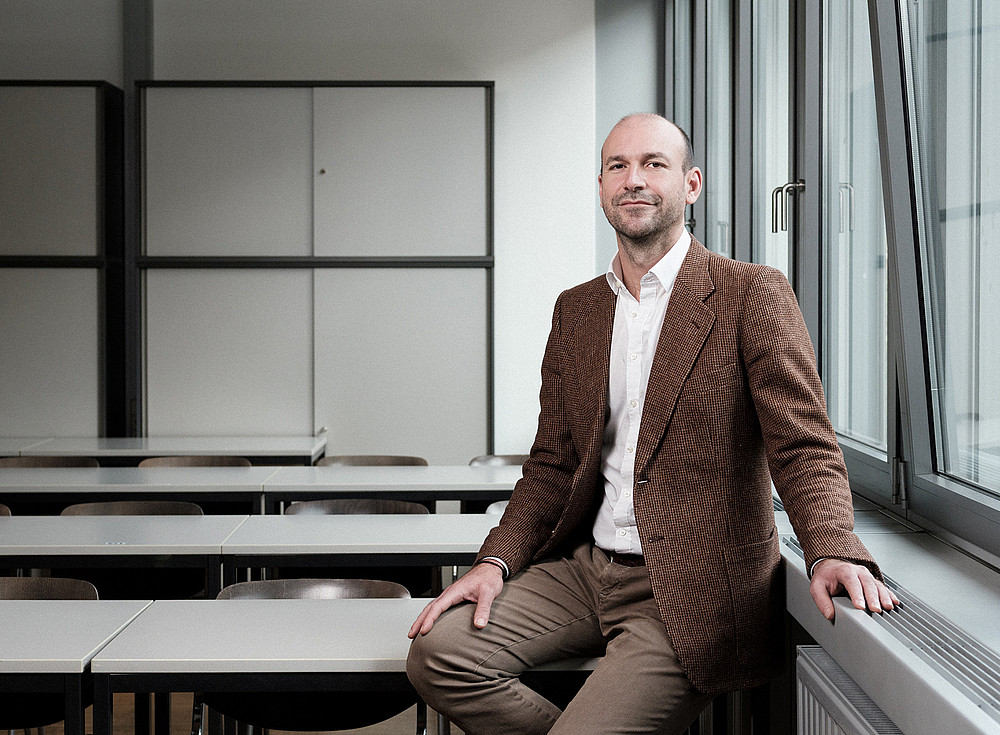
Peace researcher Maximilian Lakitsch sitting in an empty lecture hall

In great demand across the EU: Maximilian Lakitsch is driving forward peace research in the Union. In UNIZEIT, he advocates a return to diplomacy. Photo: University of Graz/Schaffernak

Donald Trump is rattling his proverbial sabre ever louder, unrest in the Middle East is escalating and the war in Ukraine continues to rage. Maximilian Lakitsch knows what political measures could contribute to reconciliation. He is the coordinator of an EU-wide initiative to strengthen peace research.

In view of the war in Ukraine and the threat of possible further expansion plans by Russia, Europe is arming itself for the first time in decades. Voices that speak out against increasing militarisation are described as unworldly and naive. Maximilian Lakitsch considers this trend to be dangerous. In the current issue of UNIZEIT, he argues in favour of a return to diplomacy.

Trump's attack on Venezuela and his threats against Greenland make it clear once again that previous political strategies are no longer sufficient for peaceful coexistence. Research is needed as a basis for sustainable new solutions. The Austrian Federal Minister for Women, Science and Research Eva-Maria Holzleitner initiated a kick-off meeting with political and scientific representatives from 16 EU member states in December. In the coming months, they will develop concrete project proposals. Holzleitner appointed Lakitsch as coordinator of this process.


created by Dagmar Eklaude

Related news

Simon Benal completes a voluntary environmental year at the University of Graz

Committing to the planet, getting to know exciting fields of activity and discovering possible paths for your own future – these are the opportunities offered by the Freiwilliges Umweltjahr (FUJ), a voluntary environmental year. One person who has chosen this option is Simon Benal. He has been working in the environmental management team at the University of Graz since September 2025.

From Iowa to Graz: US researcher puts “angry” algorithms to the test

Researcher Hussam Habib is investigating how social media platforms use algorithms to evoke emotions, capture attention, and disseminate content in a targeted manner. Born in Pakistan, he came to the University of Graz on an APART-USA scholarship from the Austrian Academy of Sciences. Thanks to new EU regulations, the scientist hopes to gain deeper insight into the mechanisms behind YouTube, Instagram, Reddit, and other platforms.

Lightbulb moments: How two young physicists are working for tomorrow

They shed light on unresolved questions – and use it in their work in physics. Diana Shakirova is using light to distinguish different chiral molecules, which can have both healing and toxic effects. Christoph Stockinger, on the other hand, uses light to develop high-precision sensors. But it is not only light that connects the two physicists. The doctoral students took part in the NanoGraz Careers & Ideas Days to prepare themselves in good time for the next steps in their careers as young scientists.

Rector Peter Riedler: Starting the year with confidence

In 2026, we will continue to work consistently on positioning the University of Graz as a relevant player in Europe, while at the same time focusing on a modern, sustainable and climate-friendly university campus. When new digital applications are rolled out in January, we will not only create a stable and secure IT environment, but also modern working and studying conditions for future generations. Peter Rielder, Rector of the University of Graz

Begin of page section:
Additional information:

University of Graz
Universitaetsplatz 3
8010 Graz
Austria
  • Contact
  • Web Editors
  • Moodle
  • UNIGRAZonline
  • Imprint
  • Data Protection Declaration
  • Accessibility Declaration
Weatherstation
Uni Graz

End of this page section. Go to overview of page sections

End of this page section. Go to overview of page sections

Begin of page section:

End of this page section. Go to overview of page sections