



Begin of page section:
Page sections:

  • Go to contents (Accesskey 1)
  • Go to position marker (Accesskey 2)
  • Go to main navigation (Accesskey 3)
  • Go to sub navigation (Accesskey 4)
  • Go to additional information (Accesskey 5)
  • Go to page settings (user/language) (Accesskey 8)
  • Go to search (Accesskey 9)

End of this page section. Go to overview of page sections

Begin of page section:
Page settings:

English en
Deutsch de
Search
Login

End of this page section. Go to overview of page sections

Begin of page section:
Search:

Search for details about Uni Graz
Close

End of this page section. Go to overview of page sections


Search

Begin of page section:
Main navigation:

Page navigation:

  • University

    University
    • About the University
    • Organisation
    • Faculties
    • Library
    • Working at University of Graz
    • Campus
    Developing solutions for the world of tomorrow - that is our mission. Our students and our researchers take on the great challenges of society and carry the knowledge out.
  • Research Profile

    Research Profile
    • Our Expertise
    • Research Questions
    • Research Portal
    • Promoting Research
    • Research Transfer
    • Ethics in Research
    • Commission for Scientific Integrity
    Scientific excellence and the courage to break new ground. Research at the University of Graz creates the foundations for making the future worth living.
  • Studies

    Studies
    • Prospective Students
    • Students
    • Registration for Study Programme (Winter semester 2026/27)
  • Community

    Community
    • International
    • Location
    • Research and Business
    • Alumni
    The University of Graz is a hub for international research and brings together scientists and business experts. Moreover, it fosters the exchange and cooperation in study and teaching.
Topics
  • Sustainable University
  • Researchers answer
  • Work for us
Close menu

End of this page section. Go to overview of page sections

Begin of page section:
You are here:

University of Graz News Wenn Glaube verletzt

End of this page section. Go to overview of page sections

Monday, 18 January 2016

Wenn Glaube verletzt

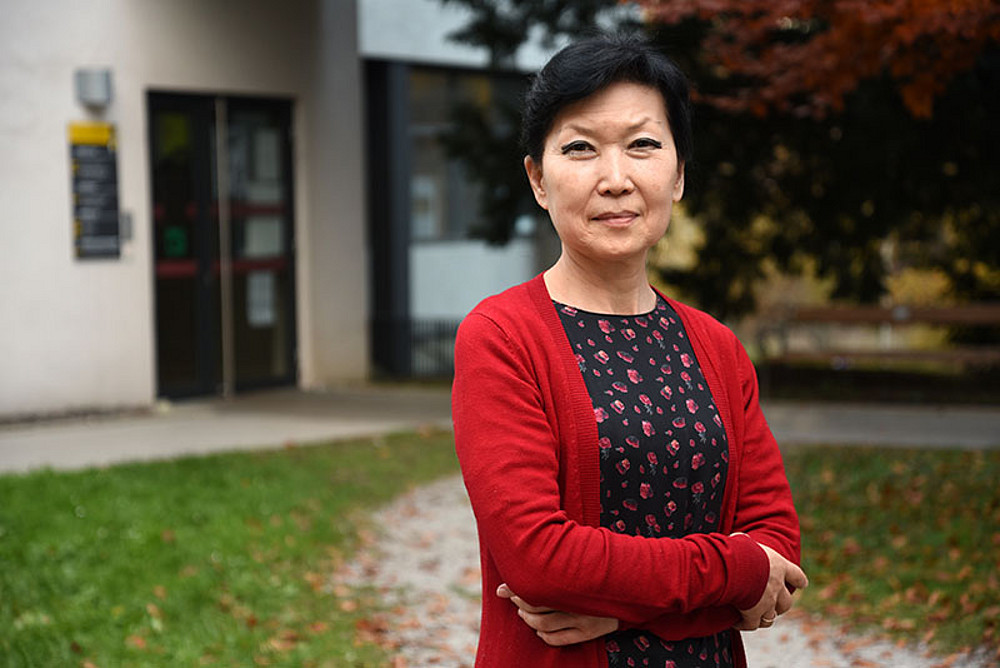
Gulmiza Seitalieva wird bis März 2016 Gastforscherin an der Uni Graz sein. Foto: Uni Graz/Kastrun.

Gulmiza Seitalieva wird bis März 2016 Gastforscherin an der Uni Graz sein. Foto: Uni Graz/Kastrun.

Vorlesung an der Uni Graz thematisiert Frauenrechte in islamischen Gesellschaften

Sexuelle Übergriffe, Diebstahl, Beleidigungen und Drohungen: Die Geschehnisse der Silvesternacht 2015 am Kölner Hauptbahnhof schockierten zu Jahresbeginn die Öffentlichkeit. Die Angriffe verdeutlichen, dass der öffentliche Raum für Frauen zum gefährlichen Pflaster werden kann. Dies sei dann der Fall, wenn religiöse Überzeugungen Frauen auf den Privatbereich beschränken wollen und jene, die sich nicht daran halten, als ‚Freiwild‘ betrachtet werden, bestätigt Univ.-Prof. Dr. Irmtraud Fischer, Theologin und Koordinatorin des Clusters „Gender“ an der Karl-Franzens-Universität Graz. Tendenzen dazu gäbe es vor allem in einigen islamischen Richtungen: „Nicht selten werden in islamisch geprägten Kulturen frei zugängliche Plätze als den Männern vorbehalten gesehen. Frauen werden bewusst in die eigenen vier Wände verdrängt und verlieren – sollten sie diesem ungeschriebenen Gesetz nicht Folge leisten – den postulierten männlichen Schutz“, stellt die Leiterin einer neuen Vortragsreihe fest, die sich mit geschlechterspezifischen Aspekten von Flucht, Asyl und Integration auseinandersetzt. Der nächste Termin am Donnerstag, 21. Jänner 2016, wird sich mit der Frage befassen, unter welchen Umständen Religion Frauenrechte verletzen kann und geht dabei speziell auf das Beispiel Kirgisistan ein, wo derzeit intensive islamische Missionierung betrieben wird.


Die Vortragende, Gulmiza Seitalieva, PhD, ist Professorin an der Universität in Bischkek in Kirgisistan und verbringt noch bis März 2016 einen insgesamt halbjährigen Forschungsaufenthalt im Rahmen des Erasmus Mundus SILKROUTE-Programms, das die Mobilität zwischen Zentralasien und Europa fördert, an der Uni Graz. Die vom Cluster „Gender“ des Forschungsschwerpunkts „Heterogenität und Kohäsion“ veranstaltete Vortragsreihe wendet sich an eine breite Öffentlichkeit und problematisiert in Vorträgen und Podiumsdiskussionen die gesellschaftliche Aufgabe der Integration von Flüchtlingen und Asylsuchenden aus anderen Kulturkreisen in eine Genderdemokratie westlichen Zuschnitts. Es finden zwei Veranstaltungen pro Semester statt, der Eintritt ist frei.


Vortrag: „Behind a safe wall? Women in patriarchal Muslim societies” (in englischer Sprache)
Zeit: Donnerstag, 21. Jänner 2016, 19 Uhr
Ort: RESOWI-Zentrum, HS 15.01, Bauteil B, EG, Universitätsstraße 15, 8010 Graz

created by Gerhild Kastrun

Related news

"Mathematics explains the world"

How can life be quantified? And what can science reveal that remains hidden from the naked eye? The 14th European Conference on Mathematical and Theoretical Biology at the University of Graz is dedicated to these questions. From 13 to 17 July, around 1,300 researchers from all over the world will gather on campus to discuss models, biological processes and the future of data-driven medicine. Klemens Fellner, Dean of the Faculty of Natural Sciences and Mathematics and a mathematician, talks about the language that explains the world

Internationally up-to-date: University of Graz offers new degree programmes in art studies

From the Old Masters to AI art – three newly designed degree programmes offer students at the University of Graz fresh perspectives on artistic production. In addition to historical art, the programmes place a greater emphasis on contemporary and global developments. The registration period is open.

The Nazi elite school Napola: Historian seeks memories and personal documents

They were to be brought up to become the future elite of National Socialism: boys and girls aged ten and over who, following the ‘Anschluss’ of Austria to the German Reich, attended a so-called Napola (short for Nationalpolitische Lehranstalt; also known as NPEA, Nationalpolitische Erziehungsanstalt). There were nine such institutions in what is now Austria between 1939 and 1945.

Heat-resistant: Eva Preinfalk explains how cities can protect their residents

Certain demographic and some occupational groups are particularly vulnerable to high temperatures. A range of measures is needed to provide relief for everyone, explains climate economist Eva Preinfalk.

Begin of page section:
Additional information:

University of Graz
Universitaetsplatz 3
8010 Graz
Austria
  • Contact
  • Web Editors
  • Moodle
  • UNIGRAZonline
  • Imprint
  • Data Protection Declaration
  • Accessibility Declaration
Weatherstation
Uni Graz

End of this page section. Go to overview of page sections

End of this page section. Go to overview of page sections

Begin of page section:

End of this page section. Go to overview of page sections