



Begin of page section:
Page sections:

  • Go to contents (Accesskey 1)
  • Go to position marker (Accesskey 2)
  • Go to main navigation (Accesskey 3)
  • Go to sub navigation (Accesskey 4)
  • Go to additional information (Accesskey 5)
  • Go to page settings (user/language) (Accesskey 8)
  • Go to search (Accesskey 9)

End of this page section. Go to overview of page sections

Begin of page section:
Page settings:

English en
Deutsch de
Search
Login

End of this page section. Go to overview of page sections

Begin of page section:
Search:

Search for details about Uni Graz
Close

End of this page section. Go to overview of page sections


Search

Begin of page section:
Main navigation:

Page navigation:

  • University

    University
    • About the University
    • Organisation
    • Faculties
    • Library
    • Working at University of Graz
    • Campus
    Developing solutions for the world of tomorrow - that is our mission. Our students and our researchers take on the great challenges of society and carry the knowledge out.
  • Research Profile

    Research Profile
    • Our Expertise
    • Research Questions
    • Research Portal
    • Promoting Research
    • Research Transfer
    • Ethics in Research
    • Commission for Scientific Integrity
    Scientific excellence and the courage to break new ground. Research at the University of Graz creates the foundations for making the future worth living.
  • Studies

    Studies
    • Prospective Students
    • Students
  • Community

    Community
    • International
    • Location
    • Research and Business
    • Alumni
    The University of Graz is a hub for international research and brings together scientists and business experts. Moreover, it fosters the exchange and cooperation in study and teaching.
Topics
  • Sustainable University
  • Researchers answer
  • Work for us
Close menu

End of this page section. Go to overview of page sections

Begin of page section:
You are here:

University of Graz News Wenn braunes Fettgewebe weiß wird

End of this page section. Go to overview of page sections

Friday, 27 July 2018

Wenn braunes Fettgewebe weiß wird

Bei Menschen mit Adipositas finden sowohl im weißen als auch im braunen Fettgewebe Veränderungen statt. Foto: istockphoto.com/Ugurhan
Bei Menschen mit Adipositas finden sowohl im weißen als auch im braunen Fettgewebe Veränderungen statt. Foto: istockphoto.com/Ugurhan

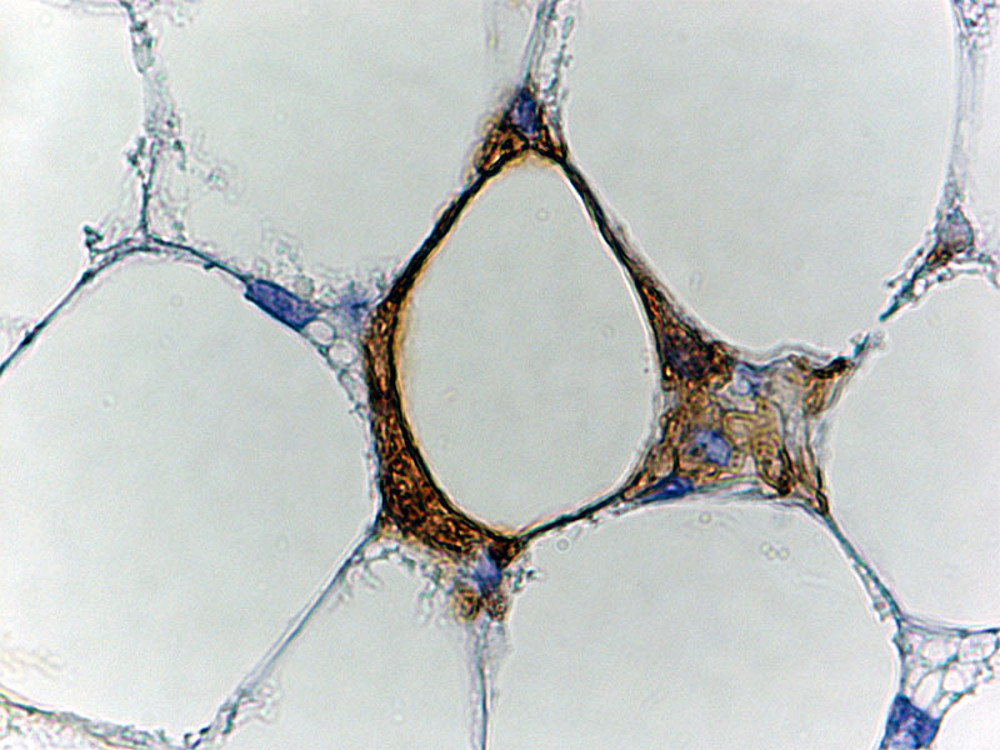
Eine weiß gewordene, ursprünglich braune Fettzelle (im Zentrum) stirbt und wird von Immunzellen (braune umgebende Struktur) aufgefressen. Foto: Uni Graz

Eine weiß gewordene, ursprünglich braune Fettzelle (im Zentrum) stirbt und wird von Immunzellen (braune umgebende Struktur) aufgefressen. Foto: Uni Graz

Grazer ForscherInnen entdecken wesentlichen Faktor bei der Entstehung von Adipositas-assoziierten Entzündungen

Adipositas ist eine der am weitesten verbreiteten Stoffwechselkrankheiten, charakterisiert durch eine massive Zunahme an Körperfett. WissenschafterInnen der Universität Graz haben in einem internationalen Team bei der Erforschung der molekularen Ursachen einen bisher unbekannten Mechanismus entdeckt: Die für Adipositas typischen Entzündungen entstehen zu einem wesentlichen Teil als Folge der Umwandlung von braunem in weißes Fettgewebe. Die Arbeit wurde im renommierten Journal of Lipid Research publiziert. Sie erweitert das Wissen über die komplexen Wechselwirkungen als Voraussetzung für neue Therapieansätze.

Menschen und Säugetiere haben grundsätzlich mindestens zwei verschiedene Arten von Fettgewebe: weißes und braunes. Ersteres speichert Fett – vorzugsweise in den wohlbekannten Polstern an Bauch und Oberschenkeln. Benötigt der Körper Energie, kann er auf diese Depots zurückgreifen. Braunes Fettgewebe hingegen ist essentiell zur Wärmeerzeugung. Deshalb haben Babys ebenso wie Tiere, die Winterschlaf halten, dementsprechend viel davon. Aber auch erwachsene Menschen besitzen kleinere Ansammlungen braunen Fettgewebes. Welche Rolle es im Zusammenhang mit Adipositas-assoziierten Entzündungen spielt, konnte nun erstmals im Mausmodell gezeigt werden.

„Bei adipösen Individuen finden neben den bekannten Veränderungen des weißen auch grundlegende Veränderungen des braunen Fettgewebes statt“, berichtet Petra Kotzbeck, Erstautorin der genannten Publikation. „Die braunen Fettzellen, die eigentlich viele kleine Lipidtröpfchen besitzen, werden in ihrem Aussehen den weißen Fettzellen ähnlich und nehmen an Größe zu. Wenn die Speicherkapazität dieser weiß gewordenen Fettzellen überschritten ist, sterben sie ab und lösen Entzündungsreaktionen aus, die wesentlich stärker ausfallen als jene im klassischen weißen Fettgewebe“, erklärt die Molekularbiologin.

Mit ihrer Arbeit haben die ForscherInnen erstmals aufgezeigt, dass das Weißwerden von braunem Fettgewebe unter anderem bei Adipositas zu beobachten ist und wesentlich für die typischen Entzündungen mitverantwortlich sein kann. „Unsere neuen Erkenntnisse lassen vermuten, dass dieser Prozess auch bei Diabetes und Herz-Kreislauferkrankungen eine Rolle spielen könnte“, so Kotzbeck.

Die Publikation ist ein Ergebnis der Arbeit von Petra Kotzbeck im Rahmen ihrer Dissertation am Institut für Molekulare Biowissenschaften der Universität Graz. Nach einem Forschungsaufenthalt in New York ist Kotzbeck nun an der Medizinischen Universität Graz tätig. Sie wirkt unter anderem am BioTechMed-Graz-Leuchtturmprojekt „EPIAge“ mit, das die molekularen Mechanismen des periodischen Fastens untersucht.

Publikation
Brown adipose tissue whitening leads to brown adipocyte death and adipose tissue inflammation
Petra Kotzbeck, Guenter Haemmerle, Rudolf Zechner, Maria Paola Cecchini, Erin E. Kershaw
Journal of Lipid Research, Vol. 59, Issue 5, 784-794, May, 2018
doi: 10.1194/jlr.M079665

created by Gudrun Pichler

Related news

Complying with the norm: Why Do Standards Shape Our Lives, Elisabeth Staudegger?

Standards determine whether a sheet of paper fits in a printer or whether a charging plug can power multiple devices. These standards shape our everyday lives. But who actually sets these standards? Where are the weaknesses, and how could science help to improve them? Elisabeth Staudegger, Head of the ‘Law and IT’ Department at the Institute for Legal Foundations at the University of Graz, host the Academic Standards Day on 16 June. Here she relays how sciences can contribute to the topic of standardisation and reveals her personal favourite standard.

More body awareness than a culture war

In Italy, sex education lessons will in future only be permitted with parental consent, and will be banned entirely in nurseries and primary schools. At the same time, Pride Month highlights why knowledge about the body, relationships, boundaries and diversity is important for young people. A study by the University of Graz shows how important knowledge about the body, contraception, relationship skills and protection against violence is

Will Austria win the World Cup? Mathematician reveals calculation method

Michael Fischer uses the football tournament as a practical example for highschool lessons.

Survival strategies: How plants respond to drought

According to Geosphere Austria, this spring was the driest in Austria since records began around 170 years ago. The low rainfall put particular pressure on the agricultural sector. And climate change is set to make the situation even worse in the coming decades. We asked Johannes Liesche, a professor at the Department of Biology at the University of Graz, how plants react to water shortages and how they survive periods of drought.

Begin of page section:
Additional information:

University of Graz
Universitaetsplatz 3
8010 Graz
Austria
  • Contact
  • Web Editors
  • Moodle
  • UNIGRAZonline
  • Imprint
  • Data Protection Declaration
  • Accessibility Declaration
Weatherstation
Uni Graz

End of this page section. Go to overview of page sections

End of this page section. Go to overview of page sections

Begin of page section:

End of this page section. Go to overview of page sections


