Begin of page section:
Page sections:

  • Go to contents (Accesskey 1)
  • Go to position marker (Accesskey 2)
  • Go to main navigation (Accesskey 3)
  • Go to sub navigation (Accesskey 4)
  • Go to additional information (Accesskey 5)
  • Go to page settings (user/language) (Accesskey 8)
  • Go to search (Accesskey 9)

End of this page section. Go to overview of page sections

Begin of page section:
Page settings:

English en
Deutsch de
Search
Login

End of this page section. Go to overview of page sections

Begin of page section:
Search:

Search for details about Uni Graz
Close

End of this page section. Go to overview of page sections


Search

Begin of page section:
Main navigation:

Page navigation:

  • University

    University
    • About the University
    • Organisation
    • Faculties
    • Library
    • Working at University of Graz
    • Campus
    Developing solutions for the world of tomorrow - that is our mission. Our students and our researchers take on the great challenges of society and carry the knowledge out.
  • Research Profile

    Research Profile
    • Our Expertise
    • Research Questions
    • Research Portal
    • Promoting Research
    • Research Transfer
    • Ethics in Research
    Scientific excellence and the courage to break new ground. Research at the University of Graz creates the foundations for making the future worth living.
  • Studies

    Studies
    • Prospective Students
    • Students
  • Community

    Community
    • International
    • Location
    • Research and Business
    • Alumni
    The University of Graz is a hub for international research and brings together scientists and business experts. Moreover, it fosters the exchange and cooperation in study and teaching.
  • Spotlight
Topics
  • Our digital Advent calendar
  • Sustainable University
  • Researchers answer
  • Work for us
Close menu

End of this page section. Go to overview of page sections

Begin of page section:
You are here:

University of Graz News Weniger Verluste

End of this page section. Go to overview of page sections

Thursday, 05 June 2014

Weniger Verluste

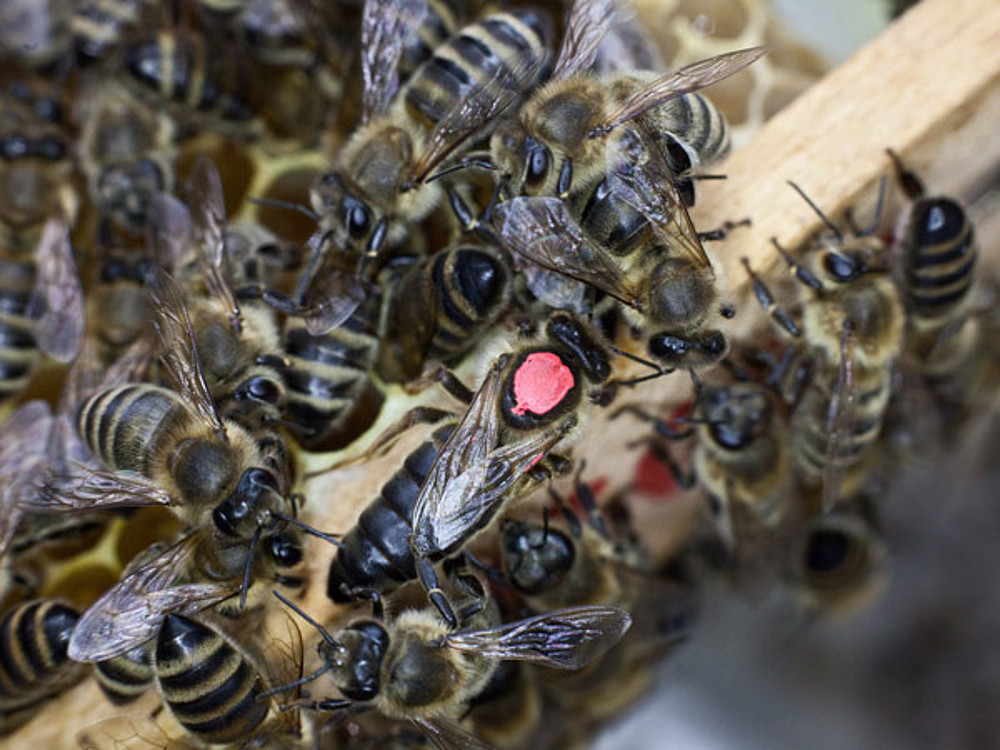
Etwa 12,5 % der österreichischen Bienenvölker verendeten im vergangenen Winter. Foto: Nikola Milatovic

Etwa 12,5 % der österreichischen Bienenvölker verendeten im vergangenen Winter. Foto: Nikola Milatovic

Uni Graz untersucht Wintersterblichkeit von Bienenvölkern

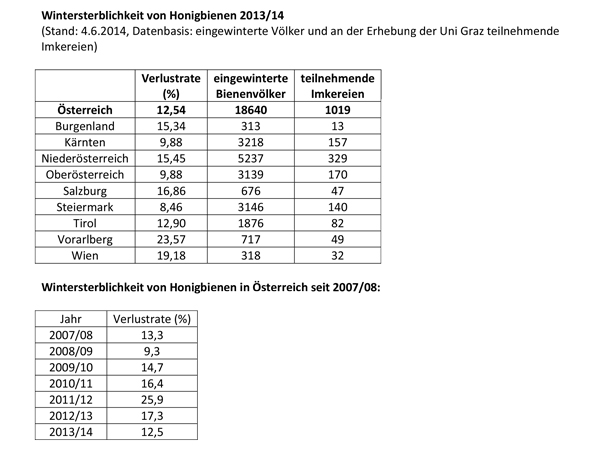
Der milde Winter 2013/2014 war auch mild zu den Honigbienen Österreichs. Die bundesweite Verlustrate lag mit rund 12,5 Prozent deutlich niedriger als in den Wintern davor – allerdings leicht über einer als normal angesehenen Sterblichkeit. Zu diesem Ergebnis kommen Univ.-Prof. Dr. Karl Crailsheim und Dr. Robert Brodschneider vom Institut für Zoologie der Uni Graz nach der Auswertung der aktuellen Daten. Die beiden sammeln seit sieben Jahren Angaben von Imkereien. „Wir haben bisher mehr als 5200 Datensätze erhalten, die wir für weitere epidemiologische Untersuchungen nutzen und als Datenbank auf www.Bienenstand.at auch der Öffentlichkeit zur Verfügung stellen“, erklärt Robert Brodschneider.

Dass etwa zehn Prozent der Bienenvölker in einem Winter in Österreich verenden, wird von vielen Fachleuten als normal angesehen. Im letzten Jahr lagen die Verlustraten in manchen Bundesländern allerdings über den Durchschnittswerten (siehe Tabelle). Um diese regionalen Unterschiede besser zu verstehen und vor allem eine hohe Sterblichkeit – wie im Winter 2011/12 – zu verhindern, forschen die Grazer ZoologInnen im Rahmen des mit 2,4 Millionen Euro dotierten Projekts „Zukunft Biene“ an den genauen Ursachen. „Wir haben die finanziellen Mittel, um in den nächsten Jahren genaue Untersuchungen mit großräumigen Probenahmen sowie Grundlagenforschung durchzuführen“, erklärt Projektleiter Karl Crailsheim. Sein Team arbeitet dabei mit der Agentur für Gesundheit und Ernährungssicherheit (AGES) und dem Wegener Center für Klima und Globalen Wandel der Karl-Franzens-Universität zusammen. Während der Flugsaison wird auch untersucht werden, wie stark die Bienenvölker dem Einfluss von Pflanzenschutzmitteln ausgesetzt sind.
Nähere Infos:
www.zukunft-biene.at
www.coloss.org: Die Untersuchung wird im Rahmen der Vereinigung COLOSS (Prevention of honey bee colony losses) durchgeführt.
Die internationalen Ergebnisse des vorigen Winters (2012/13) wurden im Journal of Apicultural Research publiziert (van der Zee et  al., 2014):  http://www.ibra.org.uk/downloads/20140221_1/download

created by Dagmar Eklaude

Related news

Chemical Christmas show at the University of Graz: An explosive evening at the Schauspielh

At the beginning of December, the University of Graz transformed the theater into a laboratory: as part of “Chemical Life,” teacher training students staged a chemical Christmas show for Styrian school classes—complete with ethanol rockets, nitrogen snow, and glowing effects. An evening designed to inspire interest in studying chemistry.

Train by train: Koralm railway accelerates exchange between the Universities

Lectures at the University of Klagenfurt in the morning, seminars at the University of Graz in the afternoon: Austria's longest tunnel and a journey time of around 45 minutes make it easy. The Koralm railway increases the speed of networking between the two university locations. The collaboration builds on existing cooperation - for example in the areas of teacher training, Slavic studies and as employers, the universities are well coordinated.

On the trail of the Big Bang: University of Graz receives 1.5 million euros for doctoral programmes

The Austrian Science Fund FWF has selected the Doctoral Programme in Theoretical Particle Physics at the University of Graz for funding from the Doc.funds. Six young scientists will be funded for 3.5 years. They will gain fundamentally new insights into the origins of the world.

From trans women and knee prostheses: sports science prizes awarded

Walking better with a prosthesis, successfully getting rid of excess weight, training more effectively, more fairness for trans people in sport: these were the topics addressed by the students at the University of Graz who were awarded the sports science prizes for their Master's theses on 3 December 2025.

Begin of page section:
Additional information:

University of Graz
Universitaetsplatz 3
8010 Graz
Austria
  • Contact
  • Web Editors
  • Moodle
  • UNIGRAZonline
  • Imprint
  • Data Protection Declaration
  • Accessibility Declaration
Weatherstation
Uni Graz

End of this page section. Go to overview of page sections

End of this page section. Go to overview of page sections

Begin of page section:

End of this page section. Go to overview of page sections