Begin of page section:
Page sections:

  • Go to contents (Accesskey 1)
  • Go to position marker (Accesskey 2)
  • Go to main navigation (Accesskey 3)
  • Go to sub navigation (Accesskey 4)
  • Go to additional information (Accesskey 5)
  • Go to page settings (user/language) (Accesskey 8)
  • Go to search (Accesskey 9)

End of this page section. Go to overview of page sections

Begin of page section:
Page settings:

English en
Deutsch de
Search
Login

End of this page section. Go to overview of page sections

Begin of page section:
Search:

Search for details about Uni Graz
Close

End of this page section. Go to overview of page sections


Search

Begin of page section:
Main navigation:

Page navigation:

  • University

    University
    • About the University
    • Organisation
    • Faculties
    • Library
    • Working at University of Graz
    • Campus
    Developing solutions for the world of tomorrow - that is our mission. Our students and our researchers take on the great challenges of society and carry the knowledge out.
  • Research Profile

    Research Profile
    • Our Expertise
    • Research Questions
    • Research Portal
    • Promoting Research
    • Research Transfer
    • Ethics in Research
    Scientific excellence and the courage to break new ground. Research at the University of Graz creates the foundations for making the future worth living.
  • Studies

    Studies
    • Prospective Students
    • Students
  • Community

    Community
    • International
    • Location
    • Research and Business
    • Alumni
    The University of Graz is a hub for international research and brings together scientists and business experts. Moreover, it fosters the exchange and cooperation in study and teaching.
  • Spotlight
Topics
  • Our digital Advent calendar
  • Sustainable University
  • Researchers answer
  • Work for us
Close menu

End of this page section. Go to overview of page sections

Begin of page section:
You are here:

University of Graz News Space weather and satellite security: TU Graz and the University of Graz supply new forecasting service for the ESA's Space Safety Programme

End of this page section. Go to overview of page sections

Thursday, 10 August 2023

Space weather and satellite security: TU Graz and the University of Graz supply new forecasting service for the ESA's Space Safety Programme

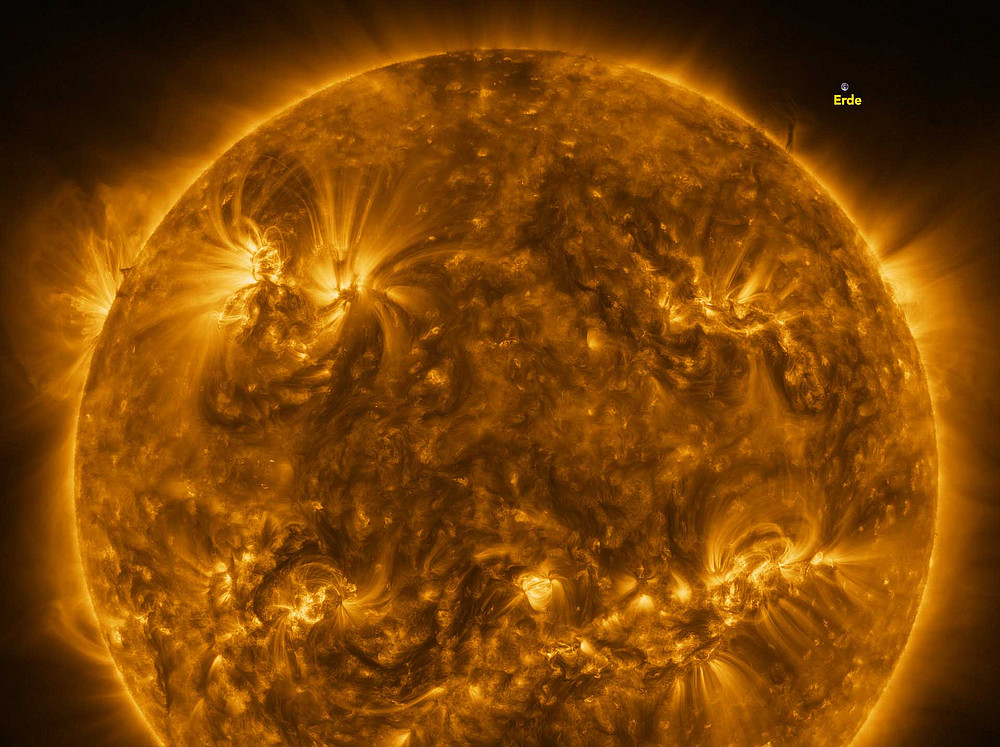
Image of the sun from the ESA/NASA Solar Orbiter mission

Image of the sun from the ESA/NASA Solar Orbiter mission. Activity on the giant sun - Earth at the top right of the image for size comparison - will reach its maximum in the next two years. Photo: ESA & NASA/Solar Orbiter/EUI team

The effects of solar storms on the Earth's atmosphere can cause satellites to crash. To prevent this from happening, the European Space Agency (ESA) is now using SODA, a forecasting service developed in Graz.

After a successful test phase, the Satellite Orbit DecAy (SODA) service, which was jointly developed by TU Graz and the University of Graz, officially became part of the ESA’s Space Safety Programme in mid-July. SODA provides accurate forecasts of the effects of solar storms on low Earth orbiting satellites. This makes TU Graz only the third Austrian institution contributing to this ESA programme. Seibersdorf Laboratories, and the University of Graz, through the Kanzelhöhe Observatory and the Institute of Physics, have previously already been involved in the agency’s work.

The new forecast service is freely available via the ESA Space Weather Service and offers a warning with a lead time of around 15 hours. The commissioning of SODA is of particular interest at this stage since the solar activity is expected to reach its maximum within the next two years. The extent to which solar storms can affect satellite orbits has already been demonstrated in SWEETS, a project funded by the Austrian Research Promotion Agency (FFG), on whose findings SODA is based. For the SWEETS project, atmospheric density data was combined with real-time measurements of solar wind plasma and the interplanetary magnetic field to calculate the effects of solar events. This research has shown that large coronal mass ejections have the capability to trigger satellite orbit decays of up to 40 metres for satellites at an altitude of 490 kilometres. In early February 2022, 38 Starlink satellites were even lost shortly after launch at an altitude of 210 kilometres due to a solar storm.

Solar activity reaches its maximum

Such losses of altitude largely occur because the charged plasma particles emitted by the Sun strike the Earth's magnetic field and cause a heating and expansion of the upper layers of the Earth's atmosphere. As a result, the atmospheric drag increases and subsequently causes satellites to lose speed and altitude. In light of the upcoming solar maximum, the ESA has already increased the altitude of some of its satellites by a few kilometres to get through this period safely. Accordingly, the predictions provided by SODA are intended to add an additional level of security. TU Graz contributed its expertise in the processing of satellite data available at the Institute of Geodesy, while the University of Graz’s involvement was based on its experience in the field of solar and heliospheric physics as well as interplanetary magnetic field observation.

The team led by Sandro Krauss from the Institute of Geodesy at TU Graz reviewed atmospheric densities over a 20-year period. For this purpose, they processed data from several low Earth orbit satellite missions, including CHAMP, GRACE, GRACE Follow-on and Swarm. At the University of Graz, a group led by Manuela Temmer from the Institute of Physics analysed around 300 solar storms catalogued between 2002 and 2017 based on measurements of the interplanetary magnetic field by probes at the L1 Lagrange point, which is about 1.5 million kilometres from the Earth in the direction of the Sun. TU Graz afterwards used the information to relate the atmospheric density variations to these solar storms. The forecasting model SODA was developed from the joint analysis of these interdisciplinary datasets.

Space research – highly valued in Austria

"I am very pleased that, through SODA, TU Graz, together with Uni Graz and Seibersdorf Laboratories, is now the third Austrian institution to contribute to ESA's Space Safety Programme," says Sandro Krauss from the Institute of Geodesy at TU Graz. "Of the five Expert Service Centres that constitute the ESA Space Weather Service Network, Austria is now represented in four, with only the United Kingdom involved in all five. This clearly underscores just how highly valued space research is in Austria. The partnership with the University of Graz on this project also provides proof of how valuable interdisciplinary research work is. And we are already working together to further improve SODA."

Manuela Temmer from the Institute of Physics at the University of Graz explained: “For Uni Graz and TU Graz, supplying ESA with this service is a welcome recognition of our work. I am also pleased that our partnership will continue as we work to improve SODA together within the framework of the FFG-funded project CASPER. It will help us to gain a better understanding of more complex solar storms, such as situations where two storms overlap on their way to Earth. We would also like to calculate the atmospheric density at altitudes of 450 and 400 kilometres – 490 kilometres is the lowest altitude we can calculate the density for so far. Since the field of solar storm forecasting is not yet very well researched, we are looking forward to some interesting insights."

created by Falko Schoklitsch & Andreas Schweiger

Related news

Semester abroad without barriers: University of Graz wins award for promoting inclusion

The University of Graz has been awarded the Internationalization Award for its new inclusion initiative. Students with fewer opportunities now also receive financial support for their semester abroad outside Europe.

Fair distribution: Researchers determine just greenhouse gas budgets for all EU regions

Ten years ago, on 12 December 2015, the Paris Climate Agreement was signed at the UN Climate Conference. In order to limit global warming to well below two degrees, only a certain amount of CO2 may be emitted worldwide. While the focus was originally on national emission targets, more than 200 subnational regions and almost 300 cities have now adopted their own targets. But how many emissions are they fairly entitled to? Researchers at the University of Graz have now developed transparent criteria for fair distribution at the subnational level for the first time and determined corresponding greenhouse gas budgets for all European regions. The paper was published today in the scientific journal Nature Communications.

Chemical Christmas show at the University of Graz: An explosive evening at the Schauspielh

At the beginning of December, the University of Graz transformed the theater into a laboratory: as part of “Chemical Life,” teacher training students staged a chemical Christmas show for Styrian school classes—complete with ethanol rockets, nitrogen snow, and glowing effects. An evening designed to inspire interest in studying chemistry.

Train by train: Koralm railway accelerates exchange between the Universities

Lectures at the University of Klagenfurt in the morning, seminars at the University of Graz in the afternoon: Austria's longest tunnel and a journey time of around 45 minutes make it easy. The Koralm railway increases the speed of networking between the two university locations. The collaboration builds on existing cooperation - for example in the areas of teacher training, Slavic studies and as employers, the universities are well coordinated.

Begin of page section:
Additional information:

University of Graz
Universitaetsplatz 3
8010 Graz
Austria
  • Contact
  • Web Editors
  • Moodle
  • UNIGRAZonline
  • Imprint
  • Data Protection Declaration
  • Accessibility Declaration
Weatherstation
Uni Graz

End of this page section. Go to overview of page sections

End of this page section. Go to overview of page sections

Begin of page section:

End of this page section. Go to overview of page sections