Begin of page section:
Page sections:

  • Go to contents (Accesskey 1)
  • Go to position marker (Accesskey 2)
  • Go to main navigation (Accesskey 3)
  • Go to sub navigation (Accesskey 4)
  • Go to additional information (Accesskey 5)
  • Go to page settings (user/language) (Accesskey 8)
  • Go to search (Accesskey 9)

End of this page section. Go to overview of page sections

Begin of page section:
Page settings:

English en
Deutsch de
Search
Login

End of this page section. Go to overview of page sections

Begin of page section:
Search:

Search for details about Uni Graz
Close

End of this page section. Go to overview of page sections


Search

Begin of page section:
Main navigation:

Page navigation:

  • University

    University
    • About the University
    • Organisation
    • Faculties
    • Library
    • Working at University of Graz
    • Campus
    Developing solutions for the world of tomorrow - that is our mission. Our students and our researchers take on the great challenges of society and carry the knowledge out.
  • Research Profile

    Research Profile
    • Our Expertise
    • Research Questions
    • Research Portal
    • Promoting Research
    • Research Transfer
    • Ethics in Research
    • Commission for Scientific Integrity
    Scientific excellence and the courage to break new ground. Research at the University of Graz creates the foundations for making the future worth living.
  • Studies

    Studies
    • Prospective Students
    • Students
    • Welcome Weeks for First Year Students
  • Community

    Community
    • International
    • Location
    • Research and Business
    • Alumni
    The University of Graz is a hub for international research and brings together scientists and business experts. Moreover, it fosters the exchange and cooperation in study and teaching.
Topics
  • Sustainable University
  • Researchers answer
  • Work for us
Close menu

End of this page section. Go to overview of page sections

Begin of page section:
You are here:

University of Graz News Weiblicher Blick

End of this page section. Go to overview of page sections

Tuesday, 10 December 2019

Weiblicher Blick

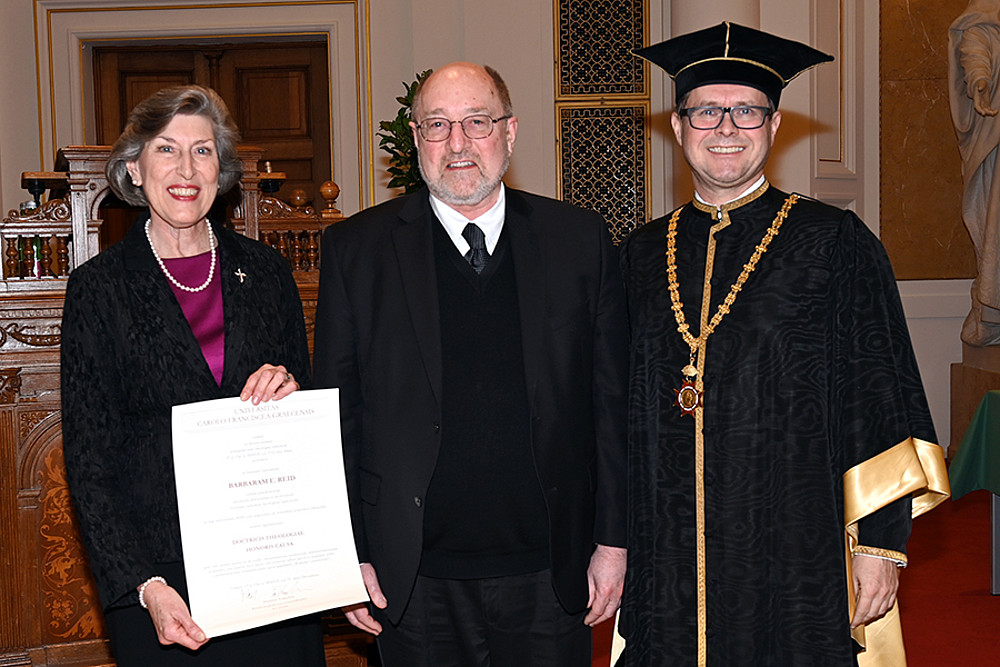
Prof. Barbara E. Reid mit Rev. Mark R. Francis, Präsident der CTU in Chicago, und Rektor Martin Polaschek bei der Ehrenpromotion. Foto: Uni Graz/Pichler ©Uni Graz/Pichler
©Uni Graz/Pichler

Prof. Barbara E. Reid mit Rev. Mark R. Francis, Präsident der CTU in Chicago, und Rektor Martin Polaschek bei der Ehrenpromotion. Foto: Uni Graz/Pichler

Bibelwissenschafterin Barbara E. Reid erhält Theologie-Ehrendoktorat der Universität Graz

Vor 25 Jahren wurde an der Universität Graz der Schwerpunkt „Theologische Frauen- und Geschlechterforschung“ begründet. Damit übernahm die Katholisch-Theologische Fakultät im deutschsprachigen Raum eine Vorreiterrolle. Anlässlich dieses Jubiläums verlieh die Universität Graz am 10. Dezember 2019 das Ehrendoktorat der Theologie an Barbara E. Reid, Professorin für Neues Testament an der Catholic Theological Union in Chicago. Reid ist Begründerin und Hauptherausgeberin des Wisdom Commentary, der weltweit bisher einzigartigen wissenschaftlichen Kommentierung aller biblischen Bücher aus feministischer und geschlechtersensibler Perspektive.

„Die Gleichstellung der Geschlechter in allen Lebensbereichen ist der Universität Graz ein zentrales Anliegen. Genderforschung öffnet den Blick, um tradierte Stereotype überwinden zu können, und trägt damit wesentlich zur Weiterentwicklung der Gesellschaft bei“, betont Rektor Polaschek. „Mit der Verleihung des Ehrendoktorats der Theologie würdigt die Universität Graz die Pionierleistung von Prof. Barbara Reid für die geschlechtersensible Interpretation des Alten und Neuen Testaments“, so Polaschek.
„Mit der Begründung der Reihe Wisdom Commentary hat Prof. Reid einen Meilenstein in der feministischen Bibelauslegung gesetzt“, unterstreicht auch Christoph Heil, Dekan der Katholisch-Theologischen Fakultät. Im Lauf der Geschichte haben immer wieder auch Frauen Texte der Bibel gelesen und interpretiert. Durchgesetzt haben sich aber Auslegungen von Männern. „Wir wollen aus der feministischen Perspektive nicht nur die Frauen und den weiblichen Blickwinkel in der Bibel wieder sichtbar machen, sondern auch Geschlechterfragen neu stellen und die alten Texte diesbezüglich ausloten“, erklärt Irmtraud Fischer, Sprecherin des Fakultätsschwerpunkts Theologische Frauen- und Geschlechterforschung an der Universität Graz.

Prof. Dr. Barbara E. Reid gehört der Ordensgemeinschaft der Dominikanerinnen an. Sie war Lehrerin für Spanisch und Religion und ist seit 1988 Professorin für Neues Testament an der Catholic Theological Union (CTU) in Chicago. Die im Geiste des Zweiten Vatikanischen Konzils gegründete theologische Forschungs- und Ausbildungsstätte vereinte die bisherigen Ordenshochschulen vor Ort. An der CTU war Reid von 2009 bis 2018 Vizepräsidentin und Studiendekanin sowie Mitglied des Board of Directors. 2014/15 stand sie als Präsidentin der Catholic Biblical Association of America vor.
Reid ist Hauptherausgeberin des Wisdom Commentary, der eine vollständige wissenschaftliche Kommentierung aller biblischen Bücher in feministischer und geschlechtersensibler Hermeneutik bietet. Von den 58 geplanten Bänden sind bisher 20 erschienen. Derzeit arbeitet sie mit ihrer Kollegin Shelly Matthews an einem Kommentar zum Lukasevangelium in dieser Reihe.


Elisabeth-Gössmann-Preis
Vor 35 Jahren verlieh die Universität Graz das erste Ehrendoktorat an eine Frau. Elisabeth Gössmann, Pionierin der theologischen Frauenforschung, wurde Ehrendoktorin der Theologie. Mit einer nach ihr benannten Auszeichnung würdigt die Fakultät seit 2001 alle zwei Jahre Abschlussarbeiten aus der theologischen Frauen- und Geschlechterforschung. Der diesjährige Elisabeth-Gössmann-Preis wurde am 10. Dezember 2019 an Sabine Plonz für ihre Habilitationsschrift verliehen. Diese ist unter dem Titel „Wirklichkeit der Familie und protestantischer Diskurs. Ethik im Kontext von Re-Produktionsverhältnissen, Geschlechterkultur und Moralregime“ 2018 im Verlag Nomos erschienen. 
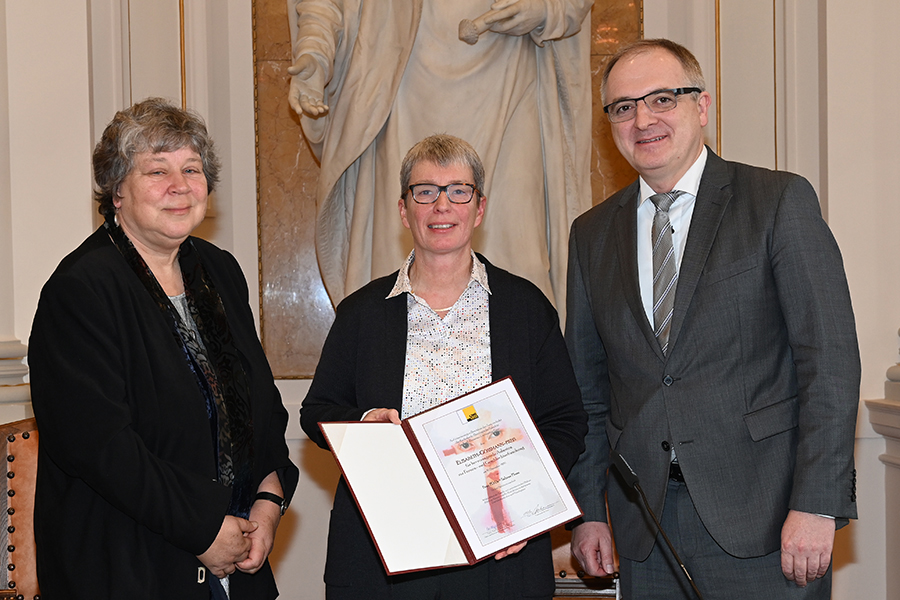
Sabine Plonz (Mitte), ausgezeichnet mit dem Elisabeth-Gössmann-Preis, Dekan Christoph Heil und Religionswissenschafterin Ulrike Bechmann. Foto: Uni Graz/Pichler
created by Gudrun Pichler

Related news

Jurassic Sounds: Biologist reconstructs insect songs from 165 million years ago

It was apparently not just the roars of the dinosaurs that made up the soundscape of the animal world during the Jurassic period. Crickets and grasshoppers communicated through a variety of songs and high-pitched sounds, as Thorin Jonsson from the Institute of Biology at the University of Graz discovered together with colleagues from the universities of Lincoln, Bristol (UK), Beijing (China) and Tempe (USA). The findings on what are so far the oldest traces of sound on Earth have just been published in the journal PNAS.

EU funding boosts international exchange between universities

The University of Graz is further expanding its international study opportunities through the European university alliance Arqus and is taking the lead in two key projects. In future, students will benefit from even more joint degree programmes and from simplified recognition of academic achievements through the Joint European Degree Label.

Rescue and risks: Researchers have surveyed public perceptions of AI

The use of artificial intelligence has had to be made transparent since 2 August 2026. The EU’s AI Act, which has been in force since then, also sets out how risky an application is and which security measures apply as a result. However, the assessment of risks by the legislation differs in some cases significantly from the perceptions of the Austrian public. This is the finding of a representative study carried out by data scientist Stefan Thalmann from the University of Graz and his team.

The Healing Sea: Researchers discover new approaches to treating chronic inflammation in sponges

Chronic inflammation plays a key role in many diseases, ranging from metabolic disorders and cardiovascular diseases to tissue damage following injuries or infections. “Normally, the body is able to resolve inflammation on its own. If this process becomes unbalanced, immune cells remain permanently active and continue to drive negative changes in the tissue,” explains Andreas Koeberle, a pharmacist at the University of Graz.

Begin of page section:
Additional information:

University of Graz
Universitaetsplatz 3
8010 Graz
Austria
  • Contact
  • Web Editors
  • Moodle
  • UNIGRAZonline
  • Imprint
  • Data Protection Declaration
  • Accessibility Declaration
Weatherstation
Uni Graz

End of this page section. Go to overview of page sections

End of this page section. Go to overview of page sections

Begin of page section:

End of this page section. Go to overview of page sections