Begin of page section:
Page sections:

  • Go to contents (Accesskey 1)
  • Go to position marker (Accesskey 2)
  • Go to main navigation (Accesskey 3)
  • Go to sub navigation (Accesskey 4)
  • Go to additional information (Accesskey 5)
  • Go to page settings (user/language) (Accesskey 8)
  • Go to search (Accesskey 9)

End of this page section. Go to overview of page sections

Begin of page section:
Page settings:

English en
Deutsch de
Search
Login

End of this page section. Go to overview of page sections

Begin of page section:
Search:

Search for details about Uni Graz
Close

End of this page section. Go to overview of page sections


Search

Begin of page section:
Main navigation:

Page navigation:

  • University

    University
    • About the University
    • Organisation
    • Faculties
    • Library
    • Working at University of Graz
    • Campus
    Developing solutions for the world of tomorrow - that is our mission. Our students and our researchers take on the great challenges of society and carry the knowledge out.
  • Research Profile

    Research Profile
    • Our Expertise
    • Research Questions
    • Research Portal
    • Promoting Research
    • Research Transfer
    • Ethics in Research
    • Commission for Scientific Integrity
    Scientific excellence and the courage to break new ground. Research at the University of Graz creates the foundations for making the future worth living.
  • Studies

    Studies
    • Prospective Students
    • Students
  • Community

    Community
    • International
    • Location
    • Research and Business
    • Alumni
    The University of Graz is a hub for international research and brings together scientists and business experts. Moreover, it fosters the exchange and cooperation in study and teaching.
  • Spotlight
Topics
  • Sustainable University
  • Researchers answer
  • Work for us
Close menu

End of this page section. Go to overview of page sections

Begin of page section:
You are here:

University of Graz News Weg vom Krieg

End of this page section. Go to overview of page sections

Friday, 29 April 2022

Weg vom Krieg

Mit im Gepäck der Geflüchteten sind auch Erinnerungsstücke. Foto: Nikita Tikhomirov - unsplash

Mit im Gepäck der Geflüchteten sind auch Erinnerungsstücke. Foto: Nikita Tikhomirov - unsplash

Zeithistorikerin Barbara Stelzl-Marx über Menschen auf der Flucht

Wenn auch nicht immer endgültiges Ziel, Österreich ist oft ein Kreuzungspunkt für fliehende Menschen. Jetzt mitten im Ukraine-Krieg mit aktuell 64.000 Geflüchteten und regelmäßig in den vergangenen Jahrzehnten. Zeithistorikerin Barbara Stelzl-Marx wirft einen Blick auf Fluchtbewegungen der jüngeren Geschichte.

1,6 Millionen Menschen strandeten in Österreich 1945, am Ende des Zweiten Weltkrieges. „Bei einer damaligen Gesamtbevölkerung von 6,5 Millionen“, hält Barbara Stelzl-Marx fest. Und die Leiterin des Ludwig Boltzmann Instituts für Kriegsfolgenforschung nennt weitere Fakten: Unter den Vertriebenen, Geflüchteten und auch Gefangenen war etwa eine Million fremdsprachig. 400.000 waren sogenannte Volksdeutsche, von denen viele in Österreich blieben. „Sie waren unter anderem aus Südtirol, Jugoslawien und Tschechoslowakei vertrieben oder von Adolf Hitler ,heim ins Reich‘ geholt worden“, erklärt die Wissenschafterin.

Krisen beim Nachbarn
1956 flohen 180.000 Ungarn vor den sowjetischen Panzern ins rot-weiß-rote Nachbarland. Davon haben sich etwa 7000 hierzulande dauerhaft angesiedelt, weiß Stelzl-Marx.
Die nächste größere Fluchtbewegung folgte 1968. Nach der Niederschlagung der Reformbewegung in der Tschechoslowakei suchten 200.000 TschechInnen Zuflucht in Österreich – vorübergehend, denn nur 3000 fanden hier eine neue Heimat. 100.000 waren es schließlich in den 1990er-Jahren, die dem Krieg im ehemaligen Jugoslawien entkommen wollten und vielfach nicht zurückkehrten.

Erinnerungsstücke
Vertreibung und Flucht gehen häufig mit Solidarität der ÖsterreicherInnen einher. Insbesondere während der Krisen in Ungarn und der Tschechoslowakei. Die Zeithistorikerin begründet: „Die Bedrohung durch die Sowjetunion stand gleichsam vor der Haustür.“
Kaum verändert hat sich auch: das Wenige, das Menschen auf ihrer Flucht im Gepäck haben. „Es handelt sich vor allem um sehr persönliche Erinnerungsstücke“, schildert Stelzl-Marx. „Sie gehören zum Familiengedächtnis und zur Identität.“ Lediglich die Papier-Fotos wurden heute von Bildern auf Handys abgelöst.
Weitere Parallelen zeichnet die Forscherin rund um die strategische Kriegsführung: „Lügen und Desinformation waren und sind stets Teil einer militärischen Auseinandersetzung. Das hat System.“

Angriff auf Freiheit
Während Barbara Stelzl-Marx auf vergangene Kriege mit historischer Distanz blickt, gesteht sie aufgrund ihrer Kontakte sowohl in der Ukraine als auch in Russland sowie Begegnungen mit geflüchteten Ukrainerinnen eine tiefe persönliche Betroffenheit: „Dieser Krieg ist ein Angriff auf unsere demokratischen Werte, auf die Menschenrechte, auf die Freiheit.“
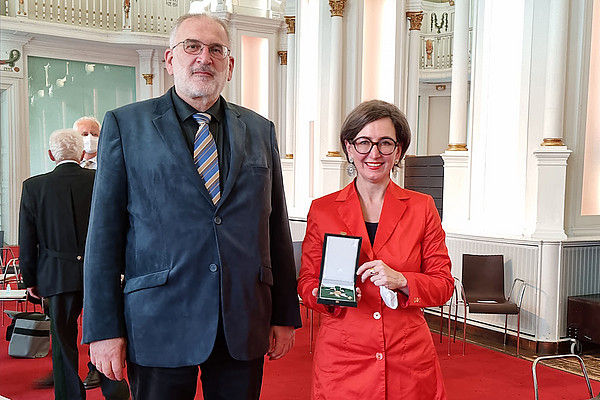
Barbara Stelzl-Marx erhielt kürzlich das Ehrenzeichen des Landes Steiermark. GEWI-Dekan Michael Walter gratulierte. Foto: BIK/Dolesch
created by Andreas Schweiger

Related news

Greenery on the rise: over 500 new flowers, perennials and shrubs on campus

Bright blooms and fresh greenery make our hearts beat faster in spring. But it is not just us humans who delight in this colourful growth. For many animals, this splendour provides, above all, food and habitat. There has recently been an increase in this on the University of Graz campus. More than 500 native flowers, perennials and shrubs have been planted on strips of fallow land around Universitätsplatz 2.

Around the world in eight stops: the Long Night of Research at the University of Graz

On 24 April from 5 pm, you can take a short trip around the globe at the University of Graz, discovering pecularities of foreign countries or new local features in the entrance hall of the University Library. The itinerary takes you through introduced animal species, political attitudes and the omnipotence of algorithms. There will also be a programme in the historic reading hall, as well as at the UniGraz@Museum and the University Archive.

Building biological bridges: Chemist discovers an ecological tool for the pharmaceutical industry

Building a relationship on a solid foundation is also important in chemistry. To produce medicines, disinfectants or plant protection products, stable bonds between carbon atoms must be formed. Conventional chemical methods rely on environmentally harmful reagents and solvents to carry out the desired reaction. This process also produces unusable by-products. Chemist Lilla Gal has discovered an enzyme that enables the same process to take place efficiently and sustainably. The results of her research were recently published in the prestigious journal Angewandte Chemie.

Higher Education Strategy 2040: Austria’s universities on course for the future

Austria has 77 higher education institutions, which is above the EU average – but does this really make sense? The new Higher Education Strategy 2040 focuses on cooperation rather than mergers. As one of the six largest universities in Austria, the University of Graz plays a central role in this.

Begin of page section:
Additional information:

University of Graz
Universitaetsplatz 3
8010 Graz
Austria
  • Contact
  • Web Editors
  • Moodle
  • UNIGRAZonline
  • Imprint
  • Data Protection Declaration
  • Accessibility Declaration
Weatherstation
Uni Graz

End of this page section. Go to overview of page sections

End of this page section. Go to overview of page sections

Begin of page section:

End of this page section. Go to overview of page sections