



Begin of page section:
Page sections:

  • Go to contents (Accesskey 1)
  • Go to position marker (Accesskey 2)
  • Go to main navigation (Accesskey 3)
  • Go to sub navigation (Accesskey 4)
  • Go to additional information (Accesskey 5)
  • Go to page settings (user/language) (Accesskey 8)
  • Go to search (Accesskey 9)

End of this page section. Go to overview of page sections

Begin of page section:
Page settings:

English en
Deutsch de
Search
Login

End of this page section. Go to overview of page sections

Begin of page section:
Search:

Search for details about Uni Graz
Close

End of this page section. Go to overview of page sections


Search

Begin of page section:
Main navigation:

Page navigation:

  • University

    University
    • About the University
    • Organisation
    • Faculties
    • Library
    • Working at University of Graz
    • Campus
    Developing solutions for the world of tomorrow - that is our mission. Our students and our researchers take on the great challenges of society and carry the knowledge out.
  • Research Profile

    Research Profile
    • Our Expertise
    • Research Questions
    • Research Portal
    • Promoting Research
    • Research Transfer
    • Ethics in Research
    • Commission for Scientific Integrity
    Scientific excellence and the courage to break new ground. Research at the University of Graz creates the foundations for making the future worth living.
  • Studies

    Studies
    • Prospective Students
    • Students
    • Welcome Weeks for First Year Students
  • Community

    Community
    • International
    • Location
    • Research and Business
    • Alumni
    The University of Graz is a hub for international research and brings together scientists and business experts. Moreover, it fosters the exchange and cooperation in study and teaching.
Topics
  • Sustainable University
  • Researchers answer
  • Work for us
Close menu

End of this page section. Go to overview of page sections

Begin of page section:
You are here:

University of Graz News Wahrnehmung des Todes

End of this page section. Go to overview of page sections

Wednesday, 30 January 2013

Wahrnehmung des Todes

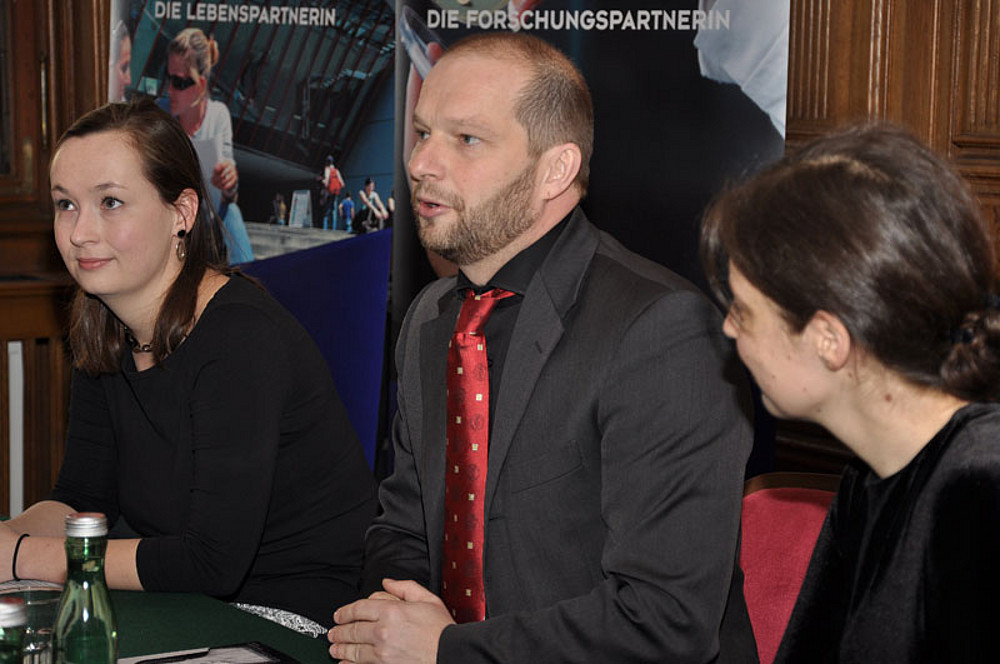
Elisabeth Klöckl-Stadler (Leykam), Evelyn Knappitsch, Sarah Bundschuh und Andrea Penz, Uni-Verlag (v.l.) präsentierten die Publikationen.

Elisabeth Klöckl-Stadler (Leykam), Evelyn Knappitsch, Sarah Bundschuh und Andrea Penz, Uni-Verlag (v.l.) präsentierten die Publikationen.

Der Historiker Johannes Gießauf moderierte die Veranstaltung.

Der Historiker Johannes Gießauf moderierte die Veranstaltung.

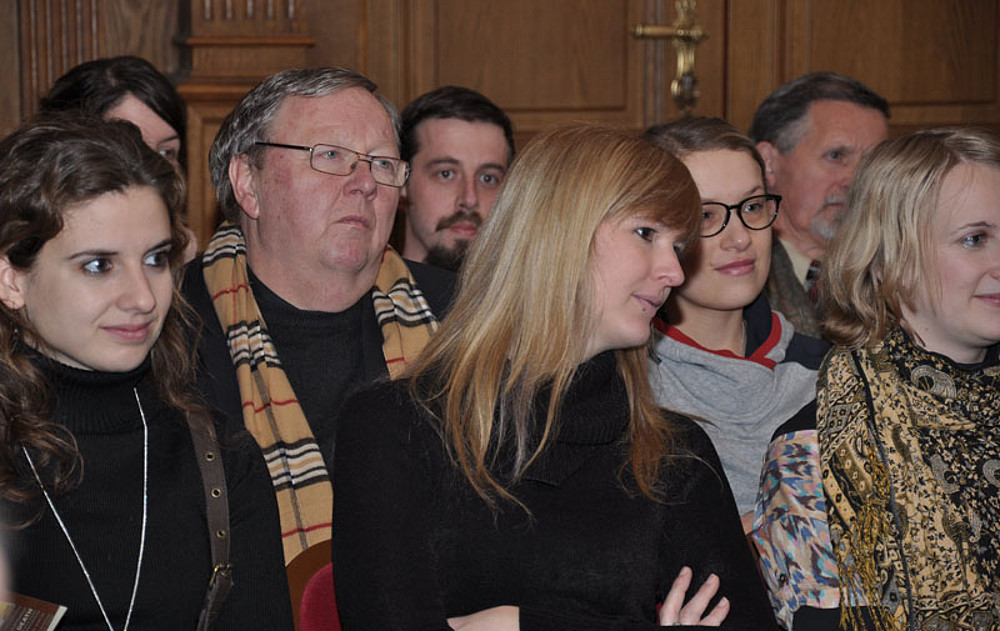
Interessiertes Publikum im Alten Senatssaal.

Interessiertes Publikum im Alten Senatssaal.

Publikationen zu Kaiserin Elisabeth und Anne Boleyn präsentiert

Sie bewegten sich zwischen abgöttischer Liebe und abgrundtiefem Hass, sie erlitten einen gewaltsamen Tod und hinterließen ein vielschichtiges Vermächtnis: Kaiserin Elisabeth von Österreich (1837-1898) und Anne Boleyn (1501?-1536), zweite Ehefrau Heinrich des Achten von England und Königin des Landes von 1533 bis 1536, sind die zentralen Figuren zweier Publikationen, die am 29. Jänner 2013 im Alten Senatssaal der Uni Graz präsentiert wurden.


Mag. Evenlyn Knappitsch, Autorin von "(Nach-)Blicke auf die Kaiserin" (Grazer Universitätsverlag), und Mag. Sarah Bundschuh, Autorin von "Ab mit dem Kopf! Die Wahrnehmung der Hinrichtung Anne Boleyns (1536) (Unipress Graz Verlag)", berichteten im Gespräch mit Moderator Johannes Gießauf vom Institut für Geschichte, wie sie die zeitgenössischen Wahrnehmungen der beiden Herrscherinnen wissenschaftliche untersuchten.


Während Knappitsch vor allem die Repräsentation der oft verniedlichten Kaiserin "Sisi" in den Wiener Zeitungen um 1900 zur Analyse heranzog, stützte sich Bundschuh auf die Korrespondenzen und Aufzeichnungen am Hofe König Heinrichs. In 73 Briefen fand Bundschuh 15 verschiedene Bezeichnungen für Anne Boleyn - "so genannte Königin", "Hure", "Sie-Teufel" oder einfach nur "diese Frau" herrschen dabei vor und machen die negative Haltung der Diplomaten und Höflinge gegenüber der zweiten Frau des Königs deutlich. Auch über Kaiserin Elisabeth kursierten in den Medien bereits zu ihren Lebzeiten verschiedene Wahrnehmungen, die im Lauf der Zeit allerdings  in einem für Knappitsch "eher klischeehaften" Bild mündeten. 


Am 10. September 1898 wurde Kaiserin Elisabeth in Genf von dem italienischen Anarchisten Luigi Lucheni mit einer Feile erstochen. Anne Boleyn wurde am 19. Mai 1536 wegen vorgeblichen Ehebruchs und Hochverrats enthauptet. Zurück bleibt die Frage, ob und wie sich aus den verschiedenen zeitgenössischen Wahrnehmungen der beiden Frauen ein heute noch nachvollziehbares Charakterbild erschließen lässt. 
 

>> Mehr über "(Nach-)Blicke auf die Kaiserin"

>> Mehr über "Ab mit dem Kopf!"

created by Gerhild Kastrun

Related news

Austria’s emissions rose in 2025: University of Graz researchers analyse the causes

The Environment Agency Austria has today published the figures for the country’s greenhouse gas emissions in 2025. While emissions fell sharply year on year from 2022 to 2024, they rose again by just under 0.7 per cent in 2025. Researchers at the University of Graz have analysed how much of this increase was due to structural changes in the economy and how much was attributable to external factors over which there is little control. “In 2025, the colder winter compared with 2024 increased emissions by 0.81 per cent, while the weak economy reduced them by 0.38 per cent. If we factor out these influences, we find an underlying increase of 0.26 per cent compared with the previous year,” reports economist Karl Steininger. “This clearly means that Austria is not on track to meet its climate targets, which require a substantial reduction in emissions by 2030.”

Electrifying: Researchers film the first moments on the way from light to electricity

Physicists at the University of Graz (Austria), in collaboration with colleagues from Marburg University and Forschungszentrum Jülich (Germany), have achieved a scientific breakthrough. For the first time, the generation of electrical energy from light has been filmed and described theoretically. This work is of far-reaching significance, not least for optimising sustainable energy production from photovoltaics. This is because it provides fundamental building blocks for understanding the physical processes that take place, for example, in organic solar cells. The paper was published in the journal Physical Review X, one of the world’s most prestigious physics journals.

University of Graz: Working together to make Styria a sustainable centre of learning

Round table calls for sustainable funding for the 2028–2030 performance agreement period between the five Styrian universities and the federal government.

How can we teach using YouTube and AI? The University of Graz is strengthening media education in schools

A journey through the blood vessels using VR headsets brings biology lessons to life. An interactive quiz brings physics to life. The YouTube video explains the First World War. Whilst mobile phones are increasingly being banned from the classroom, social media platforms, apps and AI are playing an ever-greater role in knowledge transfer at school. But how can teaching with media be made even more effective? What are the challenges in media-based teaching? At the University of Graz, researchers are discussing these issues at a conference being held in Austria for the first time.

Begin of page section:
Additional information:

University of Graz
Universitaetsplatz 3
8010 Graz
Austria
  • Contact
  • Web Editors
  • Moodle
  • UNIGRAZonline
  • Imprint
  • Data Protection Declaration
  • Accessibility Declaration
Weatherstation
Uni Graz

End of this page section. Go to overview of page sections

End of this page section. Go to overview of page sections

Begin of page section:

End of this page section. Go to overview of page sections


