Begin of page section:
Page sections:

  • Go to contents (Accesskey 1)
  • Go to position marker (Accesskey 2)
  • Go to main navigation (Accesskey 3)
  • Go to sub navigation (Accesskey 4)
  • Go to additional information (Accesskey 5)
  • Go to page settings (user/language) (Accesskey 8)
  • Go to search (Accesskey 9)

End of this page section. Go to overview of page sections

Begin of page section:
Page settings:

English en
Deutsch de
Search
Login

End of this page section. Go to overview of page sections

Begin of page section:
Search:

Search for details about Uni Graz
Close

End of this page section. Go to overview of page sections


Search

Begin of page section:
Main navigation:

Page navigation:

  • University

    University
    • About the University
    • Organisation
    • Faculties
    • Library
    • Working at University of Graz
    • Campus
    Developing solutions for the world of tomorrow - that is our mission. Our students and our researchers take on the great challenges of society and carry the knowledge out.
  • Research Profile

    Research Profile
    • Our Expertise
    • Research Questions
    • Research Portal
    • Promoting Research
    • Research Transfer
    • Ethics in Research
    • Commission for Scientific Integrity
    Scientific excellence and the courage to break new ground. Research at the University of Graz creates the foundations for making the future worth living.
  • Studies

    Studies
    • Prospective Students
    • Students
    • Registration for Study Programme (Winter semester 2026/27)
  • Community

    Community
    • International
    • Location
    • Research and Business
    • Alumni
    The University of Graz is a hub for international research and brings together scientists and business experts. Moreover, it fosters the exchange and cooperation in study and teaching.
Topics
  • Sustainable University
  • Researchers answer
  • Work for us
Close menu

End of this page section. Go to overview of page sections

Begin of page section:
You are here:

University of Graz News Von Medea bis Brundibár

End of this page section. Go to overview of page sections

Wednesday, 23 September 2015

Von Medea bis Brundibár

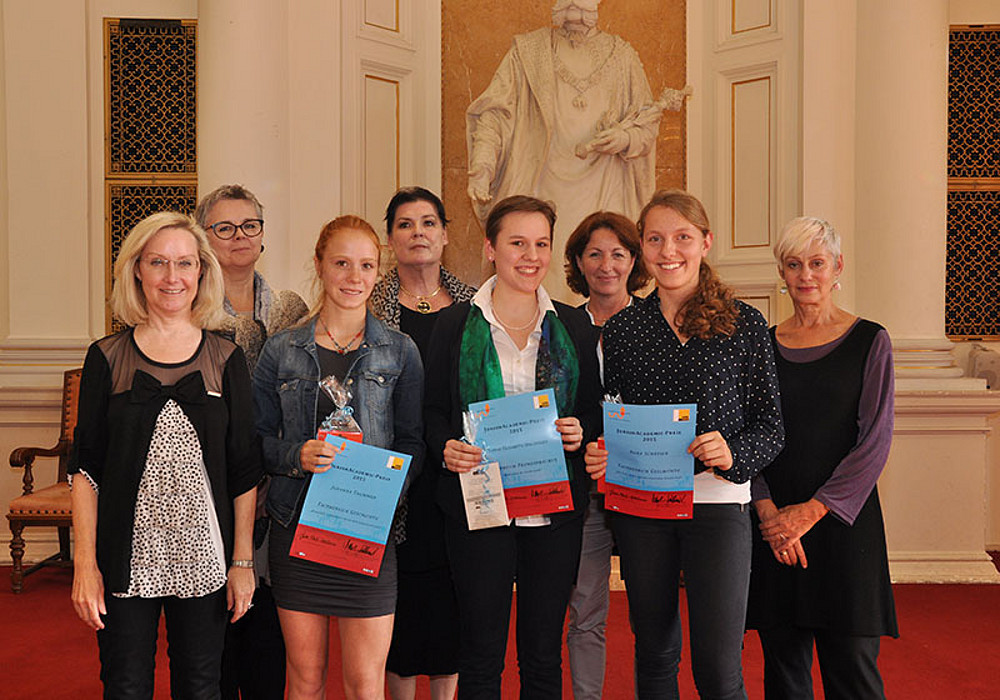
Laurie Murray, Renate Dworczak, Johanna Trummer, Sabine Tausend, Sophie Hollwöger, Hildegard Kribitz, Nora Schreier und Elisabeth Glavic (v.l.). Foto: Uni Graz/Tzivanopoulos

Betreuungslehrerin Laurie Murray, Vizerektorin Renate Dworczak, Preisträgerin Johanna Trummer, Laudatorin Sabine Tausend, Preisträgerin Sophie Hollwöger, Hildegard Kribitz, Direktion Akademisches Gymnasium Graz, Preisträgerin Nora Schreier und Betreuungslehrerin Elisabeth Glavic (v.l.). Foto: Uni Graz/Tzivanopoulos

Drei exzellente Maturantinnen erhielten den JuniorAcademic-Preis für vorwissenschaftliche Arbeiten in geisteswissenschaftlichen Fächern

Der despotische Leierkastenspieler Brundibár aus der gleichnamigen Oper von Hans Krása, die Mörderin Medea aus der griechischen Mythologie sowie die Frau in der römischen Antike: Das sind die Themen, mit denen drei Maturantinnen das Rennen um den diesjährigen JuniorAcademic-Preis der Uni Graz für sich entscheiden können. Analog zu den Dr. Hans Riegel-Fachpreisen, die die Privatstiftung Kaiserschild für herausragende vorwissenschaftliche Arbeiten in den Naturwissenschaften vergibt, ehrt der JuniorAcademic-Preis exzellente Arbeiten in den Bereichen Geschichte, Deutsch, Fremdsprachen, Philosophie und Musik.

Die Preisträgerinnen 2015 sind:


  • Sophie Elisabeth Hollwöger, für ihre Arbeit "Medea und der Kindermord - ein antiker Mythos und seine Rezeption in griechischer, lateinischer und deutscher Literatur an ausgewählten Beispielen". Gutachter: DDr. Gernot Krapinger
  • Nora Schreier, für ihre Arbeit "Die Frau in der römischen Antike". Gutachterin: Ao.Univ.-Prof. Dr. Sabine Tausend
  • Johanna Trummer, für ihre Arbeit "Brundibár, a Children's Opera that Influenced Lives". Gutachter: Assoz.-Prof. Dr. Gerald Lamprecht.


Die drei Preisträgerinnen erhielten jeweils einen Büchergutschein im Wert von 400 Euro; ihre Schulen - das Akademische Gymnasium Graz und das GIBS - bekamen jeweils einen Büchergutschein im Wert von 100 Euro.

Die Ausschreibung des JuniorAcademic-Preises richtet sich an SchülerInnen der AHS-Maturaklassen in der Steiermark.Die eingereichten vorwissenschaftlichen Arbeiten wurden von Lehrenden der Uni Graz begutachtet, bewertet und an die Jury weitergegeben, die die besten drei feststellte. Die Jury, deren Vorsitz Vizerektor Ao.Univ.-Prof. Mag. Dr. Martin Polaschek innehat, besteht aus einer/einem WissenschafterIn des Fachdidaktikzentrums der Geisteswissenschaftlichen Fakultät der Uni Graz, einer/einem SchulvertreterIn sowie einer Mitarbeiterin der KinderUniGraz.

created by Gerhild Kastrun

Related news

Sport beyond the World Cup: the TV channel “Welt der Wunder” features diabetes research from the University of Graz

Keeping blood sugar levels in check during physical exertion is a particular challenge for people with type 1 diabetes. Othmar Moser examines how those affected manage to balance physical activity, sport and their metabolic disorder.

"Mathematics explains the world"

How can life be quantified? And what can science reveal that remains hidden from the naked eye? The 14th European Conference on Mathematical and Theoretical Biology at the University of Graz is dedicated to these questions. From 13 to 17 July, around 1,300 researchers from all over the world will gather on campus to discuss models, biological processes and the future of data-driven medicine. Klemens Fellner, Dean of the Faculty of Natural Sciences and Mathematics and a mathematician, talks about the language that explains the world

Internationally up-to-date: University of Graz offers new degree programmes in art studies

From the Old Masters to AI art – three newly designed degree programmes offer students at the University of Graz fresh perspectives on artistic production. In addition to historical art, the programmes place a greater emphasis on contemporary and global developments. The registration period is open.

The Nazi elite school Napola: Historian seeks memories and personal documents

They were to be brought up to become the future elite of National Socialism: boys and girls aged ten and over who, following the ‘Anschluss’ of Austria to the German Reich, attended a so-called Napola (short for Nationalpolitische Lehranstalt; also known as NPEA, Nationalpolitische Erziehungsanstalt). There were nine such institutions in what is now Austria between 1939 and 1945.

Begin of page section:
Additional information:

University of Graz
Universitaetsplatz 3
8010 Graz
Austria
  • Contact
  • Web Editors
  • Moodle
  • UNIGRAZonline
  • Imprint
  • Data Protection Declaration
  • Accessibility Declaration
Weatherstation
Uni Graz

End of this page section. Go to overview of page sections

End of this page section. Go to overview of page sections

Begin of page section:

End of this page section. Go to overview of page sections