Begin of page section:
Page sections:

  • Go to contents (Accesskey 1)
  • Go to position marker (Accesskey 2)
  • Go to main navigation (Accesskey 3)
  • Go to sub navigation (Accesskey 4)
  • Go to additional information (Accesskey 5)
  • Go to page settings (user/language) (Accesskey 8)
  • Go to search (Accesskey 9)

End of this page section. Go to overview of page sections

Begin of page section:
Page settings:

English en
Deutsch de
Search
Login

End of this page section. Go to overview of page sections

Begin of page section:
Search:

Search for details about Uni Graz
Close

End of this page section. Go to overview of page sections


Search

Begin of page section:
Main navigation:

Page navigation:

  • University

    University
    • About the University
    • Organisation
    • Faculties
    • Library
    • Working at University of Graz
    • Campus
    Developing solutions for the world of tomorrow - that is our mission. Our students and our researchers take on the great challenges of society and carry the knowledge out.
  • Research Profile

    Research Profile
    • Our Expertise
    • Research Questions
    • Research Portal
    • Promoting Research
    • Research Transfer
    • Ethics in Research
    Scientific excellence and the courage to break new ground. Research at the University of Graz creates the foundations for making the future worth living.
  • Studies

    Studies
    • Prospective Students
    • Students
  • Community

    Community
    • International
    • Location
    • Research and Business
    • Alumni
    The University of Graz is a hub for international research and brings together scientists and business experts. Moreover, it fosters the exchange and cooperation in study and teaching.
  • Spotlight
Topics
  • Sustainable University
  • Researchers answer
  • Work for us
Close menu

End of this page section. Go to overview of page sections

Begin of page section:
You are here:

University of Graz News From Iowa to Graz: US researcher puts “angry” algorithms to the test

End of this page section. Go to overview of page sections

Thursday, 08 January 2026

From Iowa to Graz: US researcher puts “angry” algorithms to the test

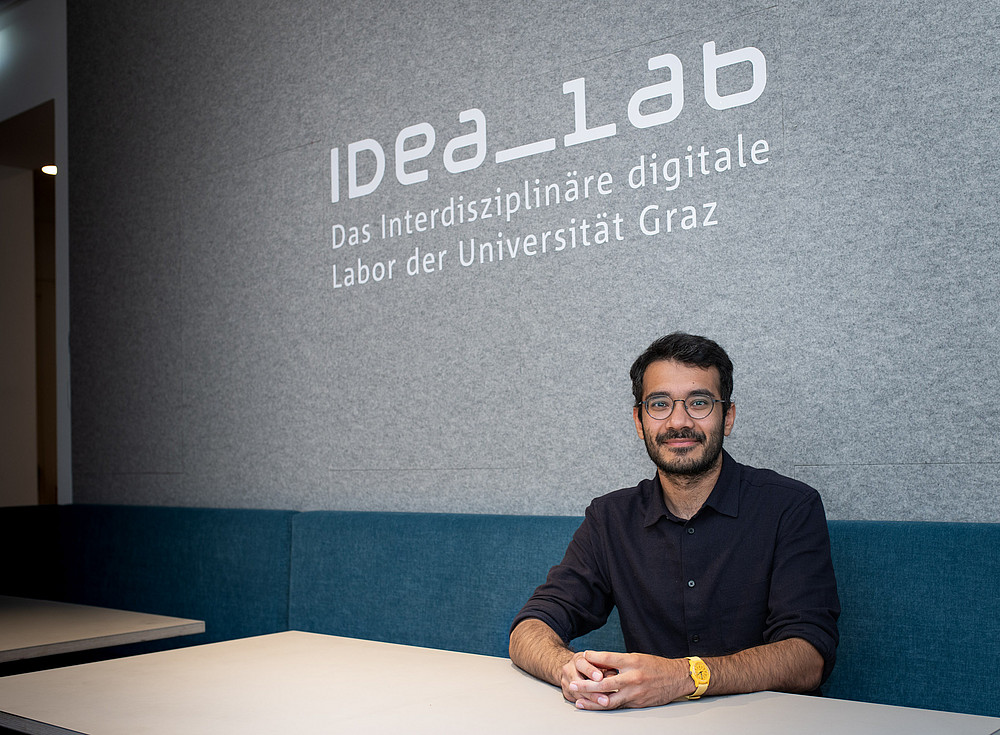
A person is sitting at a light-colored table in front of a gray wall with the inscription “IDEA_lab – The Interdisciplinary Digital Laboratory of the University of Graz.” The person is wearing a dark blue shirt and a yellow wristwatch. In the background, you can see upholstered benches in blue and part of a passageway.

Hussam Habib transferred from the University of Iowa to the University of Graz. Photo: University of Graz/Angele

Researcher Hussam Habib is investigating how social media platforms use algorithms to evoke emotions, capture attention, and disseminate content in a targeted manner. Born in Pakistan, he came to the University of Graz on an APART-USA scholarship from the Austrian Academy of Sciences. Thanks to new EU regulations, the scientist hopes to gain deeper insight into the mechanisms behind YouTube, Instagram, Reddit, and other platforms.

From human interactions to fashion, furniture, travel, and political debate, social media now permeates many areas of life. The various platforms all follow the same business model: they market their users' attention to advertisers, and the longer users scroll, the more revenue the companies generate.

Hussam Habib is researching the strategies they use and the consequences this has. His research at the University of Iowa has turned him into a veritable algorithm detective. Through the APART-USA program of the Austrian Academy of Sciences, he moved to the University of Graz in October. In addition to the difficult political situation for researchers in the United States, there was a second reason for him to come to Austria: thanks to stricter EU regulations, scientists in this country can keep a closer eye on the tech giants.

“In the US, a large part of my work involved understanding how the platforms' algorithms work,” explains Habib. But since these are secret, he could only research this using so-called sock puppet accounts, i.e., fake profiles. In Europe, however, the Digital Services Act obliges social media companies to give scientists access to the algorithms. “The tech companies will probably fight back, but here in Europe we at least have a legal basis.”

Social media personalities

Habib plans to build on his research in the US with his work at the IDea_Lab at the University of Graz. There, he took an unusual approach: he gave the different social media algorithms a kind of “personality” and found that YouTube has an aggressive and extremely reactive personality that responds very strongly to likes and views.

The microblogging service X, formerly Twitter, prioritizes building a network. Who follows whom often counts more than the individual post. The personality of the community platform Reddit, on the other hand, acts as a curator. What matters to the algorithm is which communities and subreddits users join.

Nevertheless, one thing in common emerged:

“Anger and negativity work best on all social networks,” says Habib. “People engage longer with content that excites them emotionally. That's why it's more successful for content creators to generate controversial or negative posts.” Habib now wants to use effective access to the secrets of algorithms in the EU to find out: Why does certain content get a lot of reach?

Which stories are played out to many users by the algorithms and which are not? “If we fundamentally understand how certain content spreads on the platforms, we can respond in a targeted manner,” explains the researcher. Perhaps his research will help policymakers and maybe even the developers of these platforms to improve social media offerings and enable more diversity in the content displayed.

Micro-degree

Incidentally, students at the University of Graz can gain a comprehensive insight into the function and challenges of AI systems with the micro-degree “AI and Society,” which is open to all bachelor's students. Those who want to delve deeper into this subject can enroll in the master's program in Data Science.

created by Roman Vilgut

Related news

Cosmetics in the environment: University of Graz proves danger to ants

Titanium dioxide, which is found in cosmetics, for example, is increasingly entering the environment in the form of nanoparticles. This could also put insects at risk. If ants ingest the substance in combination with the pesticide glyphosate, it disturbs the development of their offspring. Scientists at the University of Graz are drawing attention to the negative consequences of this toxic cocktail.

Varied and healthy: studies move

Exercise is the ideal way to balance out everyday stress, prevent illness and keep fit. Why this is the case, how to do it properly and what role human bodily functions and psychology play can be studied at the University of Graz.

Religious scholar Theresia Heimerl: Fasting as a spiritual boost

Fasting is not just a strategy for losing weight – it is a ritual dating back thousands of years with spiritual and evolutionary roots that has positive effects on the body. At the University of Graz, religious scholar Theresia Heimerl is investigating why fasting is a "spiritual boost".

Does fasting make us younger, Tobias Eisenberg?

Not eating is currently on everyone's lips. It's Lent, and the next swimming season is just around the corner. This phase is equated with weight and calorie reduction. Biochemist and molecular biologist Tobias Eisenberg is investigating how short-term food deprivation – a very common occurrence for our ancestors – affects the organism.

Begin of page section:
Additional information:

University of Graz
Universitaetsplatz 3
8010 Graz
Austria
  • Contact
  • Web Editors
  • Moodle
  • UNIGRAZonline
  • Imprint
  • Data Protection Declaration
  • Accessibility Declaration
Weatherstation
Uni Graz

End of this page section. Go to overview of page sections

End of this page section. Go to overview of page sections

Begin of page section:

End of this page section. Go to overview of page sections