



Begin of page section:
Page sections:

  • Go to contents (Accesskey 1)
  • Go to position marker (Accesskey 2)
  • Go to main navigation (Accesskey 3)
  • Go to sub navigation (Accesskey 4)
  • Go to additional information (Accesskey 5)
  • Go to page settings (user/language) (Accesskey 8)
  • Go to search (Accesskey 9)

End of this page section. Go to overview of page sections

Begin of page section:
Page settings:

English en
Deutsch de
Search
Login

End of this page section. Go to overview of page sections

Begin of page section:
Search:

Search for details about Uni Graz
Close

End of this page section. Go to overview of page sections


Search

Begin of page section:
Main navigation:

Page navigation:

  • University

    University
    • About the University
    • Organisation
    • Faculties
    • Library
    • Working at University of Graz
    • Campus
    Developing solutions for the world of tomorrow - that is our mission. Our students and our researchers take on the great challenges of society and carry the knowledge out.
  • Research Profile

    Research Profile
    • Our Expertise
    • Research Questions
    • Research Portal
    • Promoting Research
    • Research Transfer
    • Ethics in Research
    • Commission for Scientific Integrity
    Scientific excellence and the courage to break new ground. Research at the University of Graz creates the foundations for making the future worth living.
  • Studies

    Studies
    • Prospective Students
    • Students
    • Registration for Study Programme (Winter semester 2026/27)
  • Community

    Community
    • International
    • Location
    • Research and Business
    • Alumni
    The University of Graz is a hub for international research and brings together scientists and business experts. Moreover, it fosters the exchange and cooperation in study and teaching.
Topics
  • Sustainable University
  • Researchers answer
  • Work for us
Close menu

End of this page section. Go to overview of page sections

Begin of page section:
You are here:

University of Graz News Vibrierende Nanowelt

End of this page section. Go to overview of page sections

Thursday, 23 March 2017

Vibrierende Nanowelt

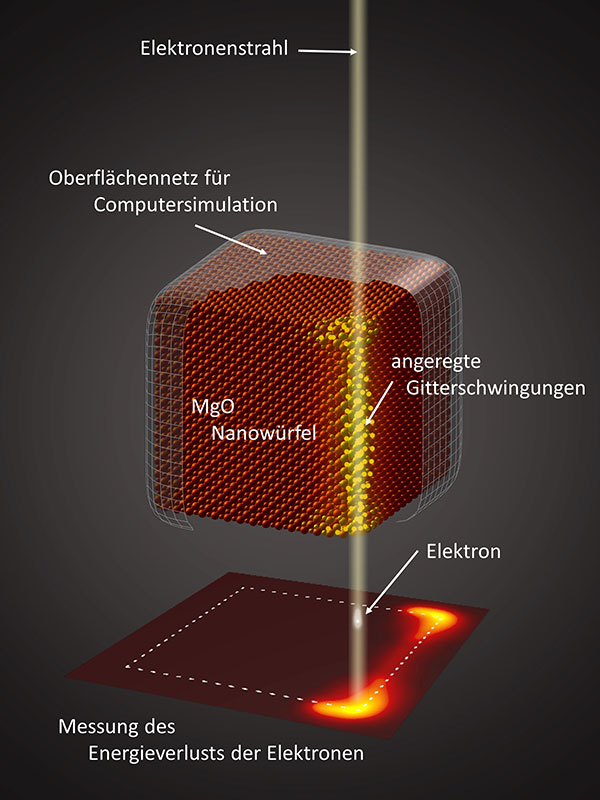
Durch den "Beschuss" mit Elektronen wird das Ionengitter in Schwingung versetzt. Aus dem gemessenen Energieverlust lassen sich die Schwingungsmoden bestimmen. Grafik: Trügler und Hohenester/Uni Graz

Durch den "Beschuss" mit Elektronen wird das Ionengitter in Schwingung versetzt. Aus dem gemessenen Energieverlust lassen sich die Schwingungsmoden bestimmen. Grafik: Trügler und Hohenester/Uni Graz

Physiker der Uni Graz und der Rutgers University bilden erstmals Schwingungsmuster von Ionen-Kristallen ab

Licht ist elektromagnetische Strahlung mit einer Frequenz, die das menschliche Auge wahrnehmen kann. Wenn Ionen – das sind elektrisch geladene Atome oder Moleküle – schwingen, tun sie das mit einer niedrigeren Frequenz im Infrarot-Bereich, jenseits des sichtbaren Spektrums. Physikern der Karl-Franzens-Universität Graz ist es in Kooperation mit Kollegen der Rutgers University in New Jersey/USA erstmals gelungen, die Schwingungen eines Ionengitters im Detail sichtbar zu machen und damit in einen bisher verborgenen Bereich der Physik vorzudringen. Möglich wurden diese Blicke in die Nanowelt durch eine neue Generation von Elektronenmikroskopen mit extrem hoher räumlicher und spektraler Auflösung. Auf Basis dieser Einsichten sind vielfältige innovative Anwendungen denkbar, von hauchdünnen Strukturen, die Räume schalldicht machen, bis hin zu thermoelektrischen Bauelementen, mit denen sich die Abwärme unseres Körpers zur Energieversorgung von tragbaren elektronischen Geräten nutzen lässt. Die aktuellen Erkenntnisse wurden in der jüngsten Ausgabe des Fachjournals „Nature“ publiziert.

Als Ionengitter oder auch Ionenkristall bezeichnet die Physik die regelmäßige räumliche Anordnung von positiv und negativ geladenen Ionen, die sich gegenseitig anziehen und auf diese Weise einen Verbund bilden. Salze und salzähnliche Verbindungen bestehen aus Ionengittern. Schwingungen dieser Kristalle sind unter anderem für den Wärmetransport und die Ausbreitung von Schall verantwortlich.

„Wir haben die Gitterschwingungen eines Nano-Würfels aus Magnesiumoxid untersucht“, berichtet Ao.Univ.-Prof. Dr. Ulrich Hohenester, der gemeinsam mit Dr. Andreas Trügler am Institut für Physik der Karl-Franzens-Universität Graz mittels Computersimulationen überprüfte, was die Projektpartner an der Rutgers University mit dem Elektronenmikroskop beobachteten.
Durch den „Beschuss“ mit Elektronen versetzten die Forscher das Ionengitter des Würfels in Schwingung. Je stärker die Anregung der Ionen, umso mehr Energie wird dem Elektronenstrahl entzogen. Somit können aus dem gemessenen Energieverlust die Schwingungsmoden bestimmt werden.

„Trifft ein Elektron eine bestimmte Stelle des Würfels, so kann es viele verschiedene Moden anregen. Indem der Elektronenstrahl über die Probe bewegt wird, lassen sich die Gitterschwingungen dank des neuartigen Mikroskops mit Nanometer-Ortsauflösung und Terahertz-Frequenzauflösung betrachten“, erklärt Hohenester. In anderen Worten: Es ergibt sich ein detailliertes Bild, wie die Ionen an den verschiedenen Stellen des Würfels schwingen. Diese präzise Charakterisierung ebnet den Weg für revolutionäre Entwicklungen zur gezielten Steuerung von Schall und Wärme mit bisher unerreichter Präzision.

Publikation
Mapping vibrational surface and bulk modes in a single nanocube
Maureen J. Lagos, Andreas Trügler, Ulrich Hohenester, Philip E. Batson
Nature, DOI: 10.1038/nature21699

created by Gudrun Pichler

Related news

Baby health: University of Graz is seeking study participants to investigate early risk factors

Why does the body composition of babies vary so much? Some children gain a significant amount of fat mass within a few weeks, whilst others show hardly any change over the same period. “At the same time, initial observations suggest that fat distribution in all babies may follow a similar pattern, regardless of their total body fat,” explains Marco Höfler from the Institute of Movement Sciences, Sport and Health at the University of Graz. He is coordinating the research project ‘Small Bodies – Big Questions’, for which participants are currently still being sought: pregnant women and babies up to four weeks old.

In hot water: New Report reveals record losses in glaciers, permafrost and snow cover

Climate change is driving up temperatures not only in summer. Winters are also getting warmer – with dramatic consequences for glaciers, permafrost, snow cover and the freezing of lakes. The recently published cryosphere report provides specific figures for Austria. “Our monitoring shows a clear trend with record losses of ice and snow,” says project leader Wolfgang Schöner from the University of Graz.

Theologian at the University of Graz: What the excommunication of the Society of St Pius X

Following the schism involving the Society of St Pius X, there is a need for discussion. Bernd Hillebrand from the University of Graz explains why the Vatican took this step, what role anti-democratic tendencies play, and why the Society’s sacraments are no longer recognised as valid under canon law for Catholics with immediate effect.

“HeinrichBiCool”: University of Graz demonstrates the effects of green facades and roofs

The University of Graz has launched a pioneering project at the University Centre for Theology. Its name, “HeinrichBiCool”, says it all: a comprehensive system of green facades and roof will cool the building at Heinrichstraße 80 during the summer. At the same time, this will create a new habitat for plants and animals, helping to increase biodiversity. The accompanying monitoring programme will provide detailed data on the impact of the measures on indoor climate, energy consumption and biodiversity. The findings will lay a scientifically sound foundation for further projects aimed at making cities sustainable, climate-resilient and liveable. The partners in this project, funded by the Austrian Research Promotion Agency (FFG), are AEE INTEC – Institute for Sustainable Technologies, Technisches Büro Siegfried Stark, the landscape architecture and urban planning firm “studio boden”, and Ökoteam Graz.

Begin of page section:
Additional information:

University of Graz
Universitaetsplatz 3
8010 Graz
Austria
  • Contact
  • Web Editors
  • Moodle
  • UNIGRAZonline
  • Imprint
  • Data Protection Declaration
  • Accessibility Declaration
Weatherstation
Uni Graz

End of this page section. Go to overview of page sections

End of this page section. Go to overview of page sections

Begin of page section:

End of this page section. Go to overview of page sections

