Begin of page section:
Page sections:

  • Go to contents (Accesskey 1)
  • Go to position marker (Accesskey 2)
  • Go to main navigation (Accesskey 3)
  • Go to sub navigation (Accesskey 4)
  • Go to additional information (Accesskey 5)
  • Go to page settings (user/language) (Accesskey 8)
  • Go to search (Accesskey 9)

End of this page section. Go to overview of page sections

Begin of page section:
Page settings:

English en
Deutsch de
Search
Login

End of this page section. Go to overview of page sections

Begin of page section:
Search:

Search for details about Uni Graz
Close

End of this page section. Go to overview of page sections


Search

Begin of page section:
Main navigation:

Page navigation:

  • University

    University
    • About the University
    • Organisation
    • Faculties
    • Library
    • Working at University of Graz
    • Campus
    Developing solutions for the world of tomorrow - that is our mission. Our students and our researchers take on the great challenges of society and carry the knowledge out.
  • Research Profile

    Research Profile
    • Our Expertise
    • Research Questions
    • Research Portal
    • Promoting Research
    • Research Transfer
    • Ethics in Research
    Scientific excellence and the courage to break new ground. Research at the University of Graz creates the foundations for making the future worth living.
  • Studies

    Studies
    • Prospective Students
    • Students
  • Community

    Community
    • International
    • Location
    • Research and Business
    • Alumni
    The University of Graz is a hub for international research and brings together scientists and business experts. Moreover, it fosters the exchange and cooperation in study and teaching.
  • Spotlight
Topics
  • Sustainable University
  • Researchers answer
  • Work for us
Close menu

End of this page section. Go to overview of page sections

Begin of page section:
You are here:

University of Graz News Versteckte Kraft

End of this page section. Go to overview of page sections

Tuesday, 18 June 2013

Versteckte Kraft

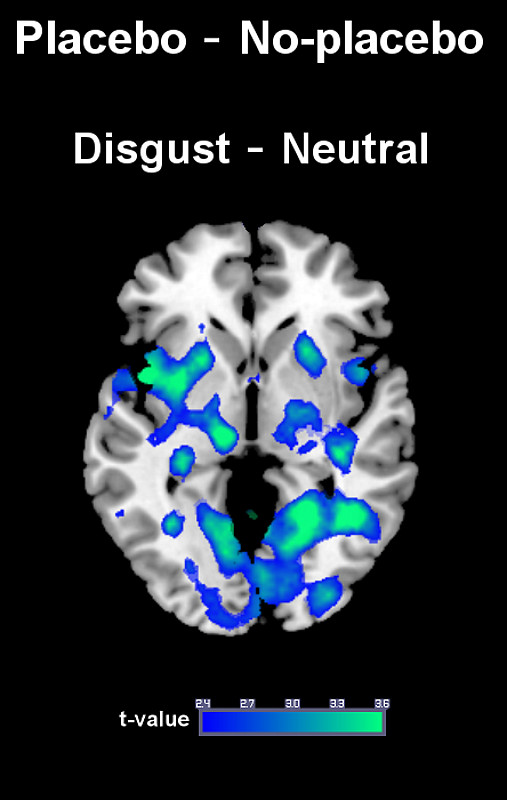
Durch den Placebo-Effekt nimmt die Aktivität in bestimmten Regionen des Hirns ab. Als Folge dieser positiven Suggestion zeigten sich Probandinnen weit weniger angeekelt als vor der vermeintlichen Therapie.

Durch den Placebo-Effekt nimmt die Aktivität in bestimmten Regionen des Hirns ab. Als Folge dieser positiven Suggestion zeigten sich Probandinnen weit weniger angeekelt als vor der vermeintlichen Therapie.

Psychologin der Uni Graz beweist Placebo-Wirkung gegen Ekel

Fäkalien, Spinnen, Blut: Abwehrreaktionen auf diese „Ekel-Top 3“ sind natürlich. Wenn sich die Abscheu aber mit Angst verbindet und exzessive Ausmaße annimmt, kann das zu einer verminderten Lebensqualität und mitunter auch zu psychischen Störungen führen. Eine aktuelle Studie des Instituts für Psychologie der Karl-Franzens-Universität Graz zeigt nun, dass der Schlüssel zur Überwindung von Angst und Ekel im Gehirn sitzt: „Der so genannte Placebo-Effekt sorgt für eine erstaunlich deutliche Abnahme des subjektiv empfundenen Ekels“, erklärt die klinische Psychologin Univ.-Prof. Dr. Anne Schienle. Die Ergebnisse ihrer Untersuchung könnten wichtige Ansätze für neue Therapiemöglichkeiten liefern.


Placebo ist vor allem in der Schmerzforschung ein probates Mittel, um negative Empfindungen unbewusst zu verändern. „Im emotionalen Bereich wurde diese positive Suggestion bislang kaum eingesetzt“, weiß Schienle. An ihrer Studie nahmen 34 Frauen mit überdurchschnittlicher Ekelempfindlichkeit teil. Ihnen wurde „offiziell“ Angostura, ein altes südamerikanisches Heilmittel gegen Ekelsymptome wie Übelkeit und Erbrechen, verabreicht – tatsächlich enthielten die Pillen aber Kieselerde.


Dennoch empfanden alle Teilnehmerinnen in den Testungen nur mehr halb so intensive Abscheu wie vor der vermeintlichen Angostura-Therapie. „Wir konnten eindeutige Veränderungen der Gehirnaktivität und des Zusammenspiels einzelner Gehirnareale feststellen“, berichtet die Psychologin. Auch visuelle Verarbeitungsregionen seien betroffen gewesen: „Die Probandinnen haben die vorgeführten Ekel-Bilder tatsächlich anders gesehen“, zeigt sich Schienle von dem Ausmaß des Placebo-Effekts beeindruckt.


Besondere Vertrauenswürdigkeit und Expertise der ÄrztInnen und PsychologInnen würden diesen noch zusätzlich verstärken. Schienle schließt daraus, dass präzise Placebos als erster Schritt in Psychotherapien eingesetzt werden können, da sie nach der entsprechenden Aufklärung den PatientInnen ihre Selbstheilungskräfte verdeutlichen.


Die Untersuchungen zu Ekel, Angst und Placebo sind im Forschungsschwerpunkt "Gehirn und Verhalten" der Karl-Franzens-Universität Graz verankert.


created by Gerhild Kastrun

Related news

Diversity buddies at the University of Graz: Support on equal terms

The University of Graz is strengthening its commitment to equal opportunities with its new Diversity Buddies. University members can find easily accessible contact persons here for questions relating to equality and diversity. All employees can get involved and take action.

When parents find it difficult to have a say

In her dissertation, translation scholar Marie Tschurtschenthaler examines how communication between compulsory schools and parents whose first language is not German works – and what role professional language mediation plays in this. Initial insights show that it is not just about language, but also about resources, responsibilities and the institutional framework.

AI in schools: Maria Bertel drafts legal guidelines for teachers

The legal expert and her team analysed the legal situation regarding the use of artificial intelligence in education as part of an EU project and answered open questions from practice.

Cosmetics in the environment: University of Graz proves danger to ants

Titanium dioxide, which is found in cosmetics, for example, is increasingly entering the environment in the form of nanoparticles. This could also put insects at risk. If ants ingest the substance in combination with the pesticide glyphosate, it disturbs the development of their offspring. Scientists at the University of Graz are drawing attention to the negative consequences of this toxic cocktail.

Begin of page section:
Additional information:

University of Graz
Universitaetsplatz 3
8010 Graz
Austria
  • Contact
  • Web Editors
  • Moodle
  • UNIGRAZonline
  • Imprint
  • Data Protection Declaration
  • Accessibility Declaration
Weatherstation
Uni Graz

End of this page section. Go to overview of page sections

End of this page section. Go to overview of page sections

Begin of page section:

End of this page section. Go to overview of page sections