Begin of page section:
Page sections:

  • Go to contents (Accesskey 1)
  • Go to position marker (Accesskey 2)
  • Go to main navigation (Accesskey 3)
  • Go to sub navigation (Accesskey 4)
  • Go to additional information (Accesskey 5)
  • Go to page settings (user/language) (Accesskey 8)
  • Go to search (Accesskey 9)

End of this page section. Go to overview of page sections

Begin of page section:
Page settings:

English en
Deutsch de
Search
Login

End of this page section. Go to overview of page sections

Begin of page section:
Search:

Search for details about Uni Graz
Close

End of this page section. Go to overview of page sections


Search

Begin of page section:
Main navigation:

Page navigation:

  • University

    University
    • About the University
    • Organisation
    • Faculties
    • Library
    • Working at University of Graz
    • Campus
    Developing solutions for the world of tomorrow - that is our mission. Our students and our researchers take on the great challenges of society and carry the knowledge out.
  • Research Profile

    Research Profile
    • Our Expertise
    • Research Questions
    • Research Portal
    • Promoting Research
    • Research Transfer
    • Ethics in Research
    • Commission for Scientific Integrity
    Scientific excellence and the courage to break new ground. Research at the University of Graz creates the foundations for making the future worth living.
  • Studies

    Studies
    • Prospective Students
    • Students
  • Community

    Community
    • International
    • Location
    • Research and Business
    • Alumni
    The University of Graz is a hub for international research and brings together scientists and business experts. Moreover, it fosters the exchange and cooperation in study and teaching.
Topics
  • Sustainable University
  • Researchers answer
  • Work for us
Close menu

End of this page section. Go to overview of page sections

Begin of page section:
You are here:

University of Graz News Hidden infestation: Why the American grapevine leafhopper threatens viticulture

End of this page section. Go to overview of page sections

Thursday, 31 July 2025

Hidden infestation: Why the American grapevine leafhopper threatens viticulture

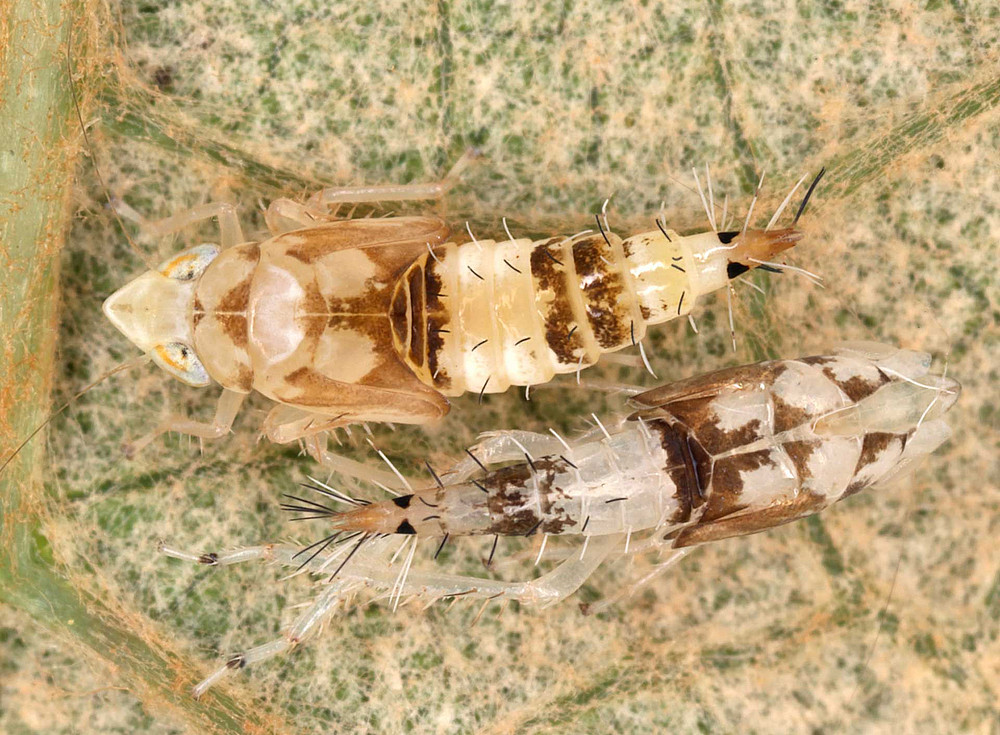
Two American grapevine leafhoppers on the underside of a vine leaf

The American leafhopper sucks on grapevines. This alone does not harm the plants. However, in doing so, they absorb and spread the pathogens that cause Flavescence doreé. Photo: Gernot Kunz

The spread of the American grapevine leafhopper is making headlines in Styria. The concerns of winegrowers are justified, says University of Graz biologist Gernot Kunz.

More and more vines in Styria are affected by Flavescence dorée. The leaves change colour and curl, the berries shrivel and do not ripen. "The only way to combat the disease is to grub the vines up," confirms biologist Gernot Kunz. The bacterial infection is spread exclusively by the American grapevine leafhopper, which is currently spreading in our region. "The animals pick up the pathogens when they suck on an infected vine and infect other vines after an incubation period of three to four weeks," explains the researcher. The tricky thing is that plants can carry the disease years before they show symptoms. The extent of the impending epidemic is therefore still difficult to estimate.

Old acquaintances
The five to six millimetre long leafhoppers are not new to Styria. They were already detected in Klöch in 2004. "It took around ten years for the first damage to occur there," reports Kunz. The biologist first spotted the animal in Graz in 2019. "The high density of individuals in private gardens and abandoned vineyards is definitely a problem here," he warns.

Remedy
Countermeasures exist, but are limited: "With expertise, the adults can be attracted and removed by artificial light sources on warm summer nights," the researcher explains. However, as the insects can cover long distances in flight, they keep coming back.


created by Dagmar Eklaude

Related news

Superti-Furga will becomefounding director of the CORI Institute in Graz

The Austrian Academy of Sciences (ÖAW) is establishing a new flagship centre for research into metabolic diseases in collaboration with the three universities in Graz. This innovative research approach combines mathematics and experimental biology with artificial intelligence

A match for life

Stem cell donations save lives. However, the only way to determine who is ultimately compatible with whom is through a testing process. Pharmacist Marion Mußbacher explains the mechanisms behind this. On 6 May 2026, the ÖH and the charity “Geben für Leben” are calling for people to come forward for typing at the University of Graz.

Mild Research Night: Around 750 visitors travelled around the world at the university

Lovely weather and a wide range of research topics drew visitors to the University of Graz last Friday. Highlights included a journey around the globe in eight stops, a ‘speed-dating’ session with books, insights into Alfred Wegener’s Greenland expedition, and guided tours of the democracy exhibition at the UniGraz@Museum.

Career Booster: How the Research Careers Campus supports researchers

They are innovative, creative and productive – researchers who have not yet been appointed to a professorship make a massive contribution to a university’s research output. To provide them with even better support on their career path, the University of Graz has established the Research Careers Campus. The official launch took place on 22 April 2026 with a ‘festival’.

Begin of page section:
Additional information:

University of Graz
Universitaetsplatz 3
8010 Graz
Austria
  • Contact
  • Web Editors
  • Moodle
  • UNIGRAZonline
  • Imprint
  • Data Protection Declaration
  • Accessibility Declaration
Weatherstation
Uni Graz

End of this page section. Go to overview of page sections

End of this page section. Go to overview of page sections

Begin of page section:

End of this page section. Go to overview of page sections