Begin of page section:
Page sections:

  • Go to contents (Accesskey 1)
  • Go to position marker (Accesskey 2)
  • Go to main navigation (Accesskey 3)
  • Go to sub navigation (Accesskey 4)
  • Go to additional information (Accesskey 5)
  • Go to page settings (user/language) (Accesskey 8)
  • Go to search (Accesskey 9)

End of this page section. Go to overview of page sections

Begin of page section:
Page settings:

English en
Deutsch de
Search
Login

End of this page section. Go to overview of page sections

Begin of page section:
Search:

Search for details about Uni Graz
Close

End of this page section. Go to overview of page sections


Search

Begin of page section:
Main navigation:

Page navigation:

  • University

    University
    • About the University
    • Organisation
    • Faculties
    • Library
    • Working at University of Graz
    • Campus
    Developing solutions for the world of tomorrow - that is our mission. Our students and our researchers take on the great challenges of society and carry the knowledge out.
  • Research Profile

    Research Profile
    • Our Expertise
    • Research Questions
    • Research Portal
    • Promoting Research
    • Research Transfer
    • Ethics in Research
    • Commission for Scientific Integrity
    Scientific excellence and the courage to break new ground. Research at the University of Graz creates the foundations for making the future worth living.
  • Studies

    Studies
    • Prospective Students
    • Students
    • Registration for Study Programme (Winter semester 2026/27)
  • Community

    Community
    • International
    • Location
    • Research and Business
    • Alumni
    The University of Graz is a hub for international research and brings together scientists and business experts. Moreover, it fosters the exchange and cooperation in study and teaching.
Topics
  • Sustainable University
  • Researchers answer
  • Work for us
Close menu

End of this page section. Go to overview of page sections

Begin of page section:
You are here:

University of Graz News Vernetzungstreffen zum Thema „Einführung in die Pädagogische Forschung“
End of this page section. Go to overview of page sections

Thursday, 25 October 2018

Vernetzungstreffen zum Thema „Einführung in die Pädagogische Forschung“

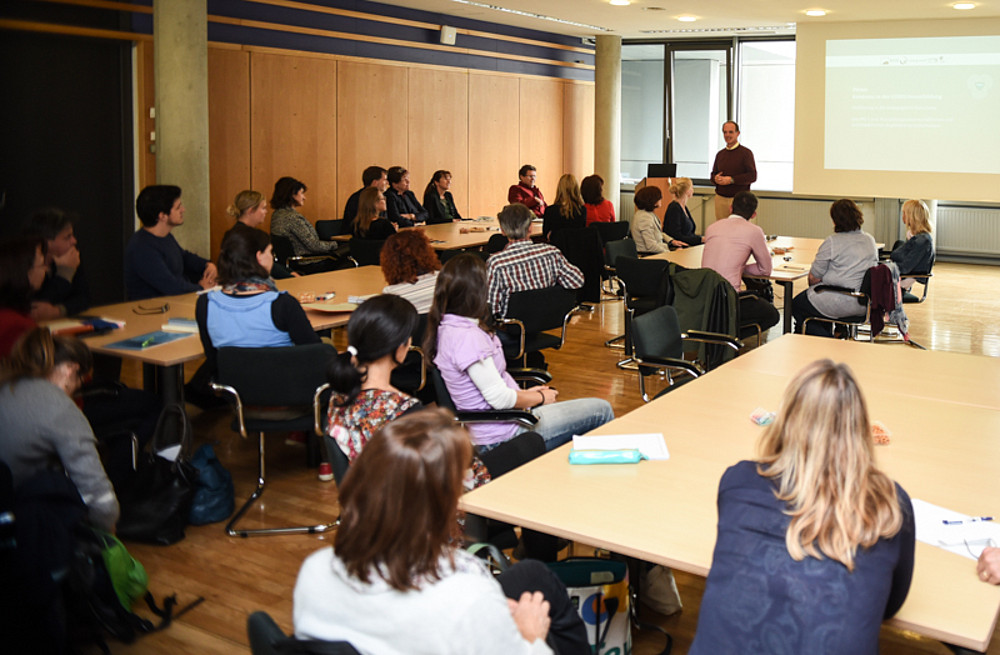
Erfahrungsaustausch und Wissenstransfer in Workshop-Gruppen liefern Anregungen für die eigene Lehrveranstaltung: Foto: Uni Graz/Tzivanopoulos
Erfahrungsaustausch und Wissenstransfer in Workshop-Gruppen liefern Anregungen für die eigene Lehrveranstaltung: Foto: Uni Graz/Tzivanopoulos

Im Rahmen des Projektes „PBNet – Kohärenz in der LEHRErInnenbildung“ startete für das aktuelle Studienjahr am 15. Oktober 2018 wieder die Workshopreihe zur Vernetzung der Lehrenden der bildungswissenschaftlichen und fachdidaktischen Begleitlehrveranstaltungen mit AkteurInnen der Pädagogisch-Praktischen Studien.

Das Schwerpunktthema „Einführung in die pädagogische Forschung, die PPS 1 und ihre bildungswissenschaftlichen und fachdidaktischen Begleitlehrveranstaltungen“ gestaltete bereits zum zweiten Mal den Workshop, so stand der Erfahrungsaustausch im Fokus dieser Veranstaltung. Eingeleitet wurde die Veranstaltung durch den Vortrag „Studierende beschreiten die Theorie – Praxis – Brücke. Einführung in die pädagogische Forschung, Fachdidaktik und Pädagogisch-Praktische Studien“ gemeinsam konzipiert und präsentiert von Lehrenden aus den drei Fachbereichen. Claudia Haagen-Schützenhöfer (Universität Graz), Gerda Kernbichler (PHSt), Daniela Moser (PHSt) und Erika Rottensteiner (PHSt) sprachen in ihren Inputs über den Theorie-Praxis-Transfer der Studierenden in den Pädagogisch-Praktischen Studien, der eine gute Gelegenheit bietet, um den Berufswunsch zu überprüfen und das erworbene Theoriewissen in ersten Praxiserfahrungen zu erproben. Die fachdidaktischen und bildungswissenschaftlichen Begleitlehrveranstaltungen bereiten auf die Pädagogisch-Praktischen Studien vor, vermitteln praktische Methoden und begleiten durch die Praktika, indem den Studierenden verschiedene Zugänge zur Unterrichtsbeobachtung, -planung und -reflexion vermittelt werden.
Im zweiten Teil des Workshop-Nachmittags diskutierten Lehrende der bildungswissenschaftlichen und fachdidaktischen Begleitlehrveranstaltungen sowie jene Personen, die die PPS 1 betreuen über ihre Erfahrungen in puncto Vernetzung von Theorie und Praxis  und tauschten sich über bewährte Strategien und Entwicklungspotentiale aus. Durch den Wissenstransfer und die Diskussion in den Workshop-Gruppen konnten viele Anregungen für die Gestaltung der eigenen Lehrveranstaltungen gewonnen werden.

created by Zentrum für PädagogInnenbildung

Related news

Desert sand, microplastics, cancer cells: David Clases awarded ERC grant for analytical method

Nanoparticles trapped in polar ice can reveal a great deal about the climate 100,000 years ago. Chemist David Clases is developing unique methods to analyse them in detail. He will now adapt these methods for use with larger particles in order to glean even more information about Earth’s history. The method can be used for a wide range of other purposes – for example, in medical diagnostics or the investigation of environmental pollution. Clases has been awarded a Proof-of-Concept Grant by the European Research Council (ERC) for this work.

Staying fit during the holidays: summer sports on the University of Graz campus

The Kleeblattlauf is not the end of the fitness term. Following last year’s successful launch, the University of Graz is once again offering summer sports on campus this year. From 30 June to 16 July 2026, there will be a free exercise programme in the open air. On the shady Südwiese (between the main building and Universitätsplatz 2), anyone interested can get in shape in the afternoons with body workouts, fascia training and yoga.

Getting even hotter: Researchers predict global warming of 1.7 degrees by 2027

While Europe is currently sweltering in the heat, global temperatures are also rising towards concerning record levels. In 2026, Earth’s surface air temperature is expected to reach 1.62 degrees, and in 2027 even 1.71 degrees Celsius above pre-industrial levels. The long-term temperature rise – an average over a 20-year period – is predicted to exceed the 1.5-degree threshold of the Paris Agreement as of 2026 already. For the first time, researchers at the University of Graz have been able to make such a forecast so far in advance. The intensifying El Niño climate event favors forecast skill and thereby facilitates a reliable computation.

Forest fire at Rosenhain: Volunteer fire brigade carried out an evacuation drill at the Jesuit refectory

Thick smoke in the stairwell, flames at the edge of the forest, people missing in the Jesuit refectory at the University of Graz: at Rosenhain, the Graz Volunteer Fire Brigade carried out a drill simulating a scenario that is becoming increasingly realistic given the heat and drought

Begin of page section:
Additional information:

University of Graz
Universitaetsplatz 3
8010 Graz
Austria
  • Contact
  • Web Editors
  • Moodle
  • UNIGRAZonline
  • Imprint
  • Data Protection Declaration
  • Accessibility Declaration
Weatherstation
Uni Graz

End of this page section. Go to overview of page sections

End of this page section. Go to overview of page sections

Begin of page section:

End of this page section. Go to overview of page sections