



Begin of page section:
Page sections:

  • Go to contents (Accesskey 1)
  • Go to position marker (Accesskey 2)
  • Go to main navigation (Accesskey 3)
  • Go to sub navigation (Accesskey 4)
  • Go to additional information (Accesskey 5)
  • Go to page settings (user/language) (Accesskey 8)
  • Go to search (Accesskey 9)

End of this page section. Go to overview of page sections

Begin of page section:
Page settings:

English en
Deutsch de
Search
Login

End of this page section. Go to overview of page sections

Begin of page section:
Search:

Search for details about Uni Graz
Close

End of this page section. Go to overview of page sections


Search

Begin of page section:
Main navigation:

Page navigation:

  • University

    University
    • About the University
    • Organisation
    • Faculties
    • Library
    • Working at University of Graz
    • Campus
    Developing solutions for the world of tomorrow - that is our mission. Our students and our researchers take on the great challenges of society and carry the knowledge out.
  • Research Profile

    Research Profile
    • Our Expertise
    • Research Questions
    • Research Portal
    • Promoting Research
    • Research Transfer
    • Ethics in Research
    • Commission for Scientific Integrity
    Scientific excellence and the courage to break new ground. Research at the University of Graz creates the foundations for making the future worth living.
  • Studies

    Studies
    • Prospective Students
    • Students
    • Welcome Weeks for First Year Students
  • Community

    Community
    • International
    • Location
    • Research and Business
    • Alumni
    The University of Graz is a hub for international research and brings together scientists and business experts. Moreover, it fosters the exchange and cooperation in study and teaching.
Topics
  • Sustainable University
  • Researchers answer
  • Work for us
Close menu

End of this page section. Go to overview of page sections

Begin of page section:
You are here:

University of Graz News Verdient verbunden

End of this page section. Go to overview of page sections

Thursday, 28 October 2021

Verdient verbunden

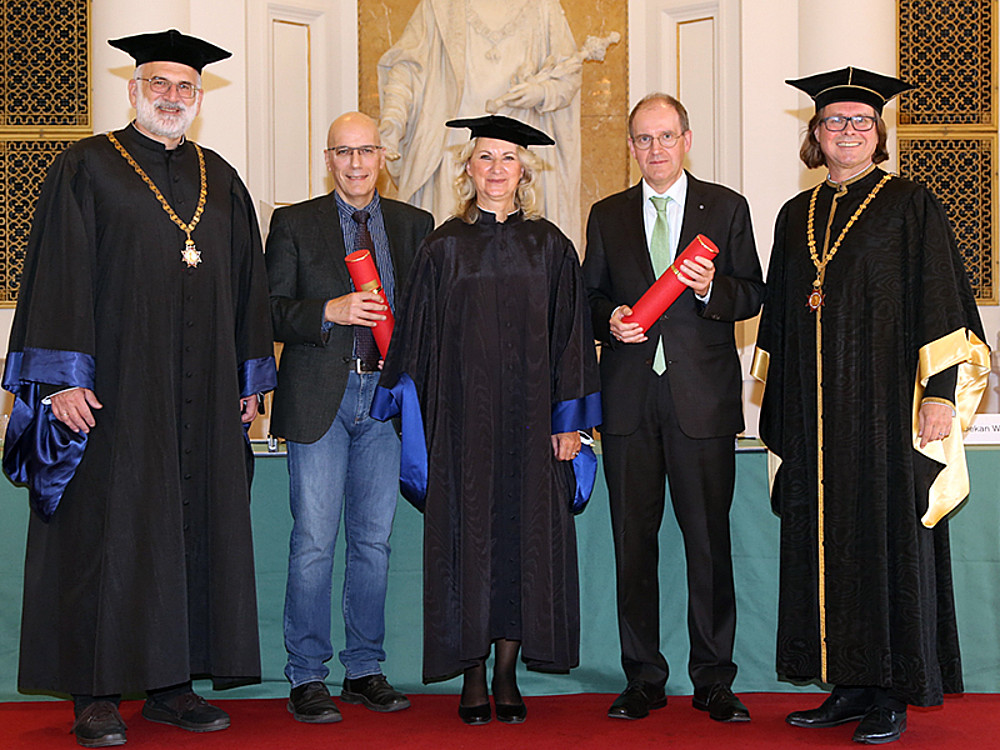
V.l.: Michael Walter, Dekan der Geisteswissenschaftlichen Fakultät, Ivan Parvev, Margit Reitbauer, Studiendekanin der Geisteswissenschaftlichen Fakultät, Jörg Rüpke, Rektor Martin Polaschek. Foto: Gasser

V.l.: Michael Walter, Dekan der Geisteswissenschaftlichen Fakultät, Ivan Parvev, Margit Reitbauer, Studiendekanin der Geisteswissenschaftlichen Fakultät, Jörg Rüpke, Rektor Martin Polaschek. Foto: Gasser

Uni Graz verleiht Ehrendoktorat an Historiker und Religionswissenschafter

Für herausragende Leistungen in ihrem Fachgebiet und ihre Verbundenheit mit der Universität Graz wurden am 27. Oktober 2021 zwei Wissenschafter besonders gewürdigt. Prof. Jörg Rüpke vom Max-Weber-Kolleg der Universität Erfurt und Prof. Ivan Parvev von der Kliment-Ohridski-Universität Sofia erhielten das Ehrendoktorat der Philosophie der Universität Graz.

Rektor Martin Polaschek begrüßte die Gäste in der Aula. „Die Verleihung des Ehrendoktorats ist nicht nur Zeichen des Respekts für die wissenschaftlichen Leistungen von Prof. Parvev und Prof. Rüpke, sondern auch Ausdruck der internationalen Verschränkung unserer Universität in Lehre, Forschung und darüber hinaus“, unterstrich Polaschek.

Ivan Parvev, Leiter des Instituts für Byzantinische und Balkanstudien der Kliment-Ohridski-Universität Sofia, ist dem Institut für Geschichte der Universität Graz in vielfacher Weise verbunden. Mit Harald Heppner ist er einer der Initiatoren des internationalen Joint-Degree-Masterstudiums für Südosteuropäische Geschichte, das ab 2009 gelaufen ist und kürzlich in das von der Uni Graz koordinierte Joint Programme „Southeastern European Studies“ übergeführt wurde. Darüber hinaus wirkt Parvev immer wieder am Doktoratsprogramm zu den Wissenskulturen im 18. Jahrhundert mit. Der Historiker, der seit 2011 die Universität Sofia in der International Society for Eighteenth Century Studies vertritt, genießt nicht nur in Bulgarien hohe Anerkennung. Seine Forschungen, die immer wieder zentraleuropäische Perspektiven aufwerfen, finden unter anderem auch in Österreich große Beachtung.

Jörg Rüpke, Professor für vergleichende Religionswissenschaft an der Universität Erfurt und stellvertretender Direktor des Max-Weber-Kollegs, arbeitet mit der Universität Graz über das Doktoratskolleg „Resonante Weltbeziehungen in sozio-religiösen Praktiken in Antike und Gegenwart“ eng zusammen. Er ist neben Wolfgang Spickermann einer der Sprecher der gemeinsamen Graduiertenschule der Universitäten Erfurt und Graz, die von der DFG (Deutschen Forschungsgemeinschaft) und dem Österreichischen Wissenschaftsfonds FWF finanziert wird. Rüpke hat als einer der InitiatorInnen und IdeengeberInnen maßgeblich zur Entstehung dieses Forschungsnetzwerkes beigetragen. Gleichzeitig ist der Wissenschafter einer der weltweit führenden ExpertInnen für die Geschichte der antiken römischen Religion.

created by Gudrun Pichler

Related news

Electrifying: Researchers film the first moments on the way from light to electricity

Physicists at the University of Graz (Austria), in collaboration with colleagues from Marburg University and Forschungszentrum Jülich (Germany), have achieved a scientific breakthrough. For the first time, the generation of electrical energy from light has been filmed and described theoretically. This work is of far-reaching significance, not least for optimising sustainable energy production from photovoltaics. This is because it provides fundamental building blocks for understanding the physical processes that take place, for example, in organic solar cells. The paper was published in the journal Physical Review X, one of the world’s most prestigious physics journals.

University of Graz: Working together to make Styria a sustainable centre of learning

Round table calls for sustainable funding for the 2028–2030 performance agreement period between the five Styrian universities and the federal government.

How can we teach using YouTube and AI? The University of Graz is strengthening media education in schools

A journey through the blood vessels using VR headsets brings biology lessons to life. An interactive quiz brings physics to life. The YouTube video explains the First World War. Whilst mobile phones are increasingly being banned from the classroom, social media platforms, apps and AI are playing an ever-greater role in knowledge transfer at school. But how can teaching with media be made even more effective? What are the challenges in media-based teaching? At the University of Graz, researchers are discussing these issues at a conference being held in Austria for the first time.

Jurassic Sounds: Biologist reconstructs insect songs from 165 million years ago

It was apparently not just the roars of the dinosaurs that made up the soundscape of the animal world during the Jurassic period. Crickets and grasshoppers communicated through a variety of songs and high-pitched sounds, as Thorin Jonsson from the Institute of Biology at the University of Graz discovered together with colleagues from the universities of Lincoln, Bristol (UK), Beijing (China) and Tempe (USA). The findings on what are so far the oldest traces of sound on Earth have just been published in the journal PNAS.

Begin of page section:
Additional information:

University of Graz
Universitaetsplatz 3
8010 Graz
Austria
  • Contact
  • Web Editors
  • Moodle
  • UNIGRAZonline
  • Imprint
  • Data Protection Declaration
  • Accessibility Declaration
Weatherstation
Uni Graz

End of this page section. Go to overview of page sections

End of this page section. Go to overview of page sections

Begin of page section:

End of this page section. Go to overview of page sections

