Begin of page section:
Page sections:

  • Go to contents (Accesskey 1)
  • Go to position marker (Accesskey 2)
  • Go to main navigation (Accesskey 3)
  • Go to sub navigation (Accesskey 4)
  • Go to additional information (Accesskey 5)
  • Go to page settings (user/language) (Accesskey 8)
  • Go to search (Accesskey 9)

End of this page section. Go to overview of page sections

Begin of page section:
Page settings:

English en
Deutsch de
Search
Login

End of this page section. Go to overview of page sections

Begin of page section:
Search:

Search for details about Uni Graz
Close

End of this page section. Go to overview of page sections


Search

Begin of page section:
Main navigation:

Page navigation:

  • University

    University
    • About the University
    • Organisation
    • Faculties
    • Library
    • Working at University of Graz
    • Campus
    Developing solutions for the world of tomorrow - that is our mission. Our students and our researchers take on the great challenges of society and carry the knowledge out.
  • Research Profile

    Research Profile
    • Our Expertise
    • Research Questions
    • Research Portal
    • Promoting Research
    • Research Transfer
    • Ethics in Research
    Scientific excellence and the courage to break new ground. Research at the University of Graz creates the foundations for making the future worth living.
  • Studies

    Studies
    • Prospective Students
    • Students
  • Community

    Community
    • International
    • Location
    • Research and Business
    • Alumni
    The University of Graz is a hub for international research and brings together scientists and business experts. Moreover, it fosters the exchange and cooperation in study and teaching.
  • Spotlight
Topics
  • Sustainable University
  • Researchers answer
  • Work for us
Close menu

End of this page section. Go to overview of page sections

Begin of page section:
You are here:

University of Graz News Universitäten sichtbar machen

End of this page section. Go to overview of page sections

Friday, 12 May 2017

Universitäten sichtbar machen

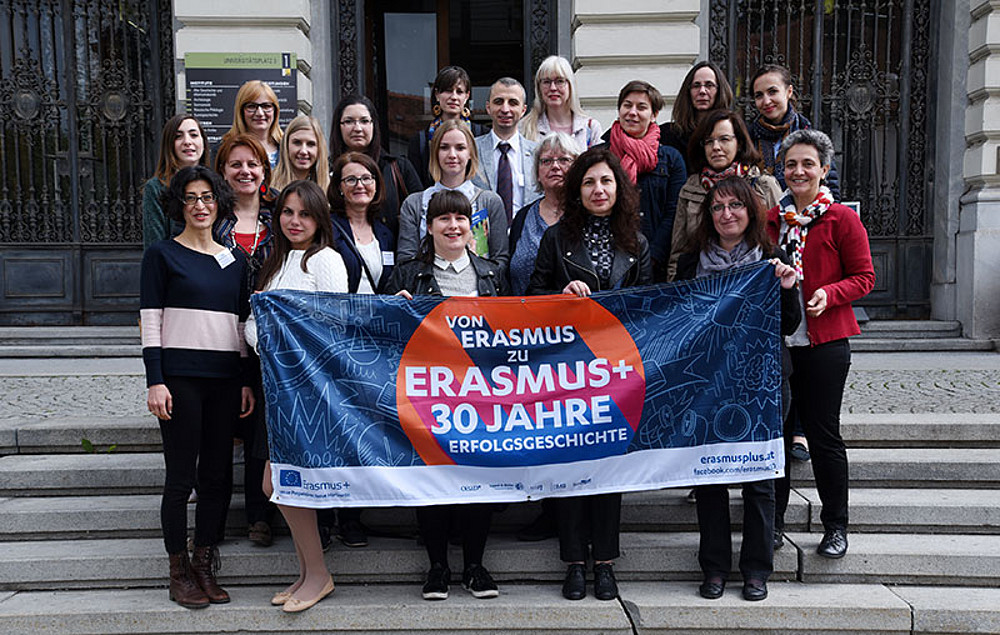
Die TeilnehmerInnen der Erasmus+ Staff Training Week mit Julia Taucher (Welcome Center, 2. Reihe, ganz links) und Diana Afrashteh (Büro für Internationale Beziehungen, 2. Reihe, ganz rechts). Foto: Uni Graz/Kastrun. ©Uni Graz/Kastrun

Die TeilnehmerInnen der Erasmus+ Staff Training Week mit Julia Taucher (Welcome Center, 2. Reihe, ganz links) und Diana Afrashteh (Büro für Internationale Beziehungen, 2. Reihe, ganz rechts). Foto: Uni Graz/Kastrun.

Die Erasmus+ Staff Training Week an der Uni Graz stand im Zeichen von Internationalisierung @ Home

Alles frisch macht der Mai und so standen neue Ideen, Inspirationen und das Lernen voneinander im Mittelpunkt der „International Staff Days“, die vom 9. bis 12. Mai 2017 an der Uni Graz über die Bühne gingen. Bereits zum siebten Mal veranstaltete das Büro für Internationale Beziehungen dieses Event, das heuer auch im Zeichen des 30-jährigen Erasmus-Jubiläums stand.


Erstmals waren die Abteilungen Personalressort, Forschungsmanagement und -service, Leistungs- und Qualitätsmanagement sowie die Studien- und Prüfungsabteilung auch Gastgeberinnen für FachkollegInnen. Andere Einrichtungen wie Lehr- und Studienservices, Presse und Kommunikation und das Vizerektorat für Finanzen, Ressourcen und Standortentwicklung unterstützten das Programm inhaltlich mit Vorträgen und extra Terminen für die Gäste.


Neunzehn KollegInnen von Partneruniversitäten in Algerien, Bulgarien, Dänemark, Deutschland, Italien, Kroatien, Litauen, Mazedonien, Portugal, Schweden, Spanien und der Ukraine nutzen die Möglichkeit, Kontakte mit den MitarbeiterInnen der Universität Graz zu knüpfen sowie von- und miteinander zu lernen. Im Sinne des lebenslangen Lernens stand der Austausch bester Praxis in der Abwicklung von Mobilitätsprogrammen und internationalen Kooperationsprojekten im Mittelpunkt des Trainings. Besondere Schwerpunkte lagen auf Know-How Transfer im Bereich der Internationalization @ Home, wo unter anderem erfolgreiche Projekte der Uni Graz, wie das „Teaching in English“-Modell und das Welcome Center präsentiert wurden.


Eine Besonderheit der diesjährigen Veranstaltung war die Teilnahme von KollegInnen aus dem von der Uni Graz koordinierten Erasmus Mundus Projekt „JoinEU-SEE>PENTA“ an einzelnen Programmpunkten der „International Staff Days“. Die Teilnahme rundete das Projektabschlusstreffen von JoinEU-SEE>PENTA, das am 10. Mai in Graz stattfand, ab und bot zusätzliche Möglichkeiten, sich zum Thema „Internationalization @ Home“ zu vernetzen und auszutauschen.


Die „International Staff Week“ fand im Rahmen der Aktionsschiene Erasmus+ Staff Training statt, die auch Bediensteten der Verwaltung sowie aus Dienstleistungseinrichtungen mit einem EU-Stipendium den Besuch von Partnereinrichtungen für Ausbildungszwecke ermöglicht.


Die nächste Bewerbungsfristen für Erasmus+ Staff Training Stipendien sind der 15. Mai und der 15. Juli 2017.

created by Gerhild Kastrun & Diana Afrashteh

Related news

AI in schools: Maria Bertel drafts legal guidelines for teachers

The legal expert and her team analysed the legal situation regarding the use of artificial intelligence in education as part of an EU project and answered open questions from practice.

Cosmetics in the environment: University of Graz proves danger to ants

Titanium dioxide, which is found in cosmetics, for example, is increasingly entering the environment in the form of nanoparticles. This could also put insects at risk. If ants ingest the substance in combination with the pesticide glyphosate, it disturbs the development of their offspring. Scientists at the University of Graz are drawing attention to the negative consequences of this toxic cocktail.

Varied and healthy: studies move

Exercise is the ideal way to balance out everyday stress, prevent illness and keep fit. Why this is the case, how to do it properly and what role human bodily functions and psychology play can be studied at the University of Graz.

Religious scholar Theresia Heimerl: Fasting as a spiritual boost

Fasting is not just a strategy for losing weight – it is a ritual dating back thousands of years with spiritual and evolutionary roots that has positive effects on the body. At the University of Graz, religious scholar Theresia Heimerl is investigating why fasting is a "spiritual boost".

Begin of page section:
Additional information:

University of Graz
Universitaetsplatz 3
8010 Graz
Austria
  • Contact
  • Web Editors
  • Moodle
  • UNIGRAZonline
  • Imprint
  • Data Protection Declaration
  • Accessibility Declaration
Weatherstation
Uni Graz

End of this page section. Go to overview of page sections

End of this page section. Go to overview of page sections

Begin of page section:

End of this page section. Go to overview of page sections