



Begin of page section:
Page sections:

  • Go to contents (Accesskey 1)
  • Go to position marker (Accesskey 2)
  • Go to main navigation (Accesskey 3)
  • Go to sub navigation (Accesskey 4)
  • Go to additional information (Accesskey 5)
  • Go to page settings (user/language) (Accesskey 8)
  • Go to search (Accesskey 9)

End of this page section. Go to overview of page sections

Begin of page section:
Page settings:

English en
Deutsch de
Search
Login

End of this page section. Go to overview of page sections

Begin of page section:
Search:

Search for details about Uni Graz
Close

End of this page section. Go to overview of page sections


Search

Begin of page section:
Main navigation:

Page navigation:

  • University

    University
    • About the University
    • Organisation
    • Faculties
    • Library
    • Working at University of Graz
    • Campus
    Developing solutions for the world of tomorrow - that is our mission. Our students and our researchers take on the great challenges of society and carry the knowledge out.
  • Research Profile

    Research Profile
    • Our Expertise
    • Research Questions
    • Research Portal
    • Promoting Research
    • Research Transfer
    • Ethics in Research
    • Commission for Scientific Integrity
    Scientific excellence and the courage to break new ground. Research at the University of Graz creates the foundations for making the future worth living.
  • Studies

    Studies
    • Prospective Students
    • Students
    • Registration for Study Programme (Winter semester 2026/27)
    • Welcome Weeks for First Year Students
  • Community

    Community
    • International
    • Location
    • Research and Business
    • Alumni
    The University of Graz is a hub for international research and brings together scientists and business experts. Moreover, it fosters the exchange and cooperation in study and teaching.
Topics
  • Sustainable University
  • Researchers answer
  • Work for us
Close menu

End of this page section. Go to overview of page sections

Begin of page section:
You are here:

University of Graz News Paving the way

End of this page section. Go to overview of page sections

Thursday, 29 April 2021

Paving the way

Photo: Kelly Sikema/unsplash.com
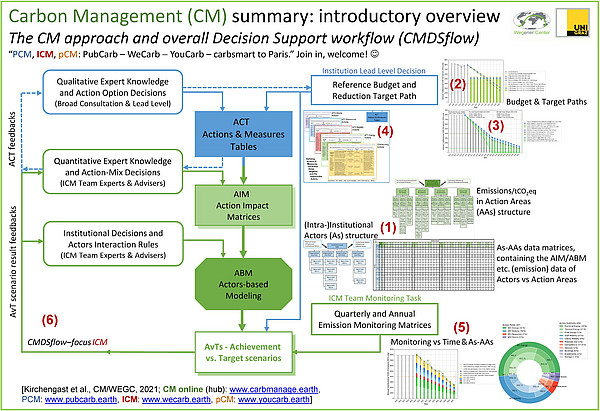
Photo: Kelly Sikema/unsplash.com

Uni Graz shows how we get global warming under control

Heat and drought as well as damaging frosts, flooding caused by heavy rain, wildfires and glacier melt: the widespread consequences of global warming are increasingly serious. To counteract this development, a deep reduction of greenhouse gas emissions is necessary. Just last week, the European Union published its climate target of emission reductions by at least 55 percent by 2030. Researchers at the University of Graz have now pioneered a new method of contributing to effective climate protection at all levels of society, known as "Carbon Management".

"For a significant reduction in greenhouse gases, we need to consider all areas, from entire states to companies and down to private consumption", states climate researcher Gottfried Kirchengast from the Wegener Center at the University of Graz, who conceived the Carbon Management approach and developed it together with his research team. As head of the project, he is now primarily addressing public institutions and private companies by “Institutional Carbon Management” (ICM), to support them in reaching their emission reduction aims along a path compliant with the Paris climate goals. However, the concept is also applicable to public actors such as whole countries and federal states as well as to private households or individuals.

The first step in Carbon Management is to estimate a greenhouse gas emissions budget for a base year, allocated to 2020, and to define decadal target budgets and target paths for reductions in all relevant emission areas on this basis. Next, specific measures for the emission reduction are developed in these action areas, such as energy consumption or mobility, and an emissions monitoring is set up. A decision support workflow provides integrated guidance to the implementation, in order to be capable to adjust early if an action area does not develop as desired, or to further strengthen successful measures.

The University of Graz itself is at the same time acting as a role model in this regard and aims to drastically reduce its emissions over the next two decades with the in-house project "ICM Uni Graz". Of the total emissions of around 18,500 tons of CO2 equivalents in the reference year 2020, around two thirds (approx. 12,000 tons) are attributable to energy use in the form of electricity and heat. Over a quarter (approx. 5,000 tons) is attributable to mobility, primarily business travel and commuting. "A flight to a neighbouring country, for example, produces around ten times as much CO2 as a train journey of the same length," explains Kirchengast.

By 2030, the University of Graz aims to have already reduced its emissions by two-thirds with appropriate measures, in order to achieve true climate neutrality by 2040, which requires at least 90 percent fossil emissions reductions according to the ICM standard. "We are amongst the international leaders in climate research and also want to actively make a significant contribution to climate protection ourselves", emphasizes Rector Martin Polaschek. In order to firm up the specific measures and to discuss them broadly in-house, the University has set up its own climate protection advisory board.

More information on the potential of the Carbon Management concept is available on the new website https://carbmanage.uni-graz.at. The work of the Wegener Center is part of the Field of Excellence “Climate Change” of the University of Graz.

Summary illustration of the carbon management approach. Source: Wegener Center Research Brief RB1-2021
created by Joachim Hirtenfellner

Related news

How formulas are making medicine more personalised

When Federica Caforio talks about the heart, it doesn’t sound like an operating theatre, but rather like equations, parameters and simulations. Yet this is precisely where the medical promise of her research lies: one day, clinical data will be used to create a digital twin of the heart – a virtual model that will enable a better understanding of diseases and allow for more personalised treatment plans. She will be presenting her research at the ‘ECMTB 2026’ mathematics conference.

University Spin-Off Company “Innovation Hub Graz” works to make Spin-Offs investor ready

The Medical University of Graz, University of Graz and TU Graz are once again joining forces to establish a joint Innovation Hub Graz (iHub Graz). At this transfer centre, selected, particularly promising university spin-offs are specifically prepared to be investor ready.

Adhesive force: Researchers demonstrate how cells determine their function

How does a single cell develop into an organism with skin, muscles, intestines, a heart and other specialised tissues? Two studies published in leading journals have identified a mechanism that links genes, chemical signals and the physical properties of tissues. Scientists from London, Heidelberg and Graz were involved in the research.

Vitamin E is the key: a pharmacist has discovered a substance that ‘switches off’ inflammation

Alzheimer’s, obesity or atherosclerosis: many lifestyle-related diseases are driven by or accompanied by inflammation. “Treatments usually aim to halt the progression of inflammation. However, for a long-term cure, it must be completely resolved,” explains Andreas Koeberle, a pharmacist at the University of Graz. Normally, the body carries out this work itself. However, if this process does not function properly, chronic inflammation can develop, which can contribute to conditions such as cardiovascular disease or cancer.

Begin of page section:
Additional information:

University of Graz
Universitaetsplatz 3
8010 Graz
Austria
  • Contact
  • Web Editors
  • Moodle
  • UNIGRAZonline
  • Imprint
  • Data Protection Declaration
  • Accessibility Declaration
Weatherstation
Uni Graz

End of this page section. Go to overview of page sections

End of this page section. Go to overview of page sections

Begin of page section:

End of this page section. Go to overview of page sections