Begin of page section:
Page sections:

  • Go to contents (Accesskey 1)
  • Go to position marker (Accesskey 2)
  • Go to main navigation (Accesskey 3)
  • Go to sub navigation (Accesskey 4)
  • Go to additional information (Accesskey 5)
  • Go to page settings (user/language) (Accesskey 8)
  • Go to search (Accesskey 9)

End of this page section. Go to overview of page sections

Begin of page section:
Page settings:

English en
Deutsch de
Search
Login

End of this page section. Go to overview of page sections

Begin of page section:
Search:

Search for details about Uni Graz
Close

End of this page section. Go to overview of page sections


Search

Begin of page section:
Main navigation:

Page navigation:

  • University

    University
    • About the University
    • Organisation
    • Faculties
    • Library
    • Working at University of Graz
    • Campus
    Developing solutions for the world of tomorrow - that is our mission. Our students and our researchers take on the great challenges of society and carry the knowledge out.
  • Research Profile

    Research Profile
    • Our Expertise
    • Research Questions
    • Research Portal
    • Promoting Research
    • Research Transfer
    • Ethics in Research
    Scientific excellence and the courage to break new ground. Research at the University of Graz creates the foundations for making the future worth living.
  • Studies

    Studies
    • Prospective Students
    • Students
  • Community

    Community
    • International
    • Location
    • Research and Business
    • Alumni
    The University of Graz is a hub for international research and brings together scientists and business experts. Moreover, it fosters the exchange and cooperation in study and teaching.
  • Spotlight
Topics
  • Our digital Advent calendar
  • Sustainable University
  • Researchers answer
  • Work for us
Close menu

End of this page section. Go to overview of page sections

Begin of page section:
You are here:

University of Graz News Better understanding of weather extremes: Uni Graz supports ESA mission EarthCARE

End of this page section. Go to overview of page sections

Wednesday, 29 May 2024

Better understanding of weather extremes: Uni Graz supports ESA mission EarthCARE

EarthCARE satellite over Europa ©ESA/ATG medialab

The measurement data from WegenerNet serves as a reference for ESA and supports the reliable calibration of the new satellite's innovative instruments. Image: ESA/ATG medialab

How do greenhouse gases, clouds and aerosols influence vertical radiation in the Earth's atmosphere? What role does this play in global warming and the occurrence of extreme weather events? ESA's EarthCARE mission will provide data to answer these questions. The new satellite was launched on 29 May 2024 as a joint venture of the European Space Agency (ESA) and the Japanese Space Agency (JAXA). The mission is being supported by the WegenerNet 3D climate research laboratory at the University of Graz.

With its close-meshed network of over 150 measuring stations, which record temperature, precipitation and other important climate variables every five minutes in south-east Styria, the WegenerNet is of great international interest for research. The temporal and spatial density as well as the quality of the measurements, which have been ongoing since 2007, are unique worldwide. Since 2020, the data recorded on the ground has been supplemented by the observation of climate variables in the atmosphere. This means that WegenerNet is now a 3D open-air laboratory for researching meteorological processes such as the course of extreme weather events.

"WegenerNet provides valuable data from the ground up to an altitude of around ten kilometres, i.e. in the entire weather layer, which is particularly relevant for the greenhouse effect. This makes us an interesting partner for the EarthCARE mission," explains Gottfried Kirchengast, climate researcher at the Wegener Centre at the University of Graz and head of the project selected by the European Space Agency. "Our data will serve ESA as a reference for cloud and precipitation measurements as well as for radiation modelling. In this way, we support the reliable calibration of the new satellite's innovative instruments so that it can also measure extreme weather events as accurately as possible," adds Kirchengast. EarthCARE wants to use this precise data to help improve climate and weather models.

The research of Gottfried Kirchengast's team is embedded in Climate Change Graz, a field of excellence at the University of Graz. WegenerNet is funded by the Ministry of Science and the Province of Styria. The City of Graz and sponsors contribute additional funds.
WegenerNet

EarthCARE

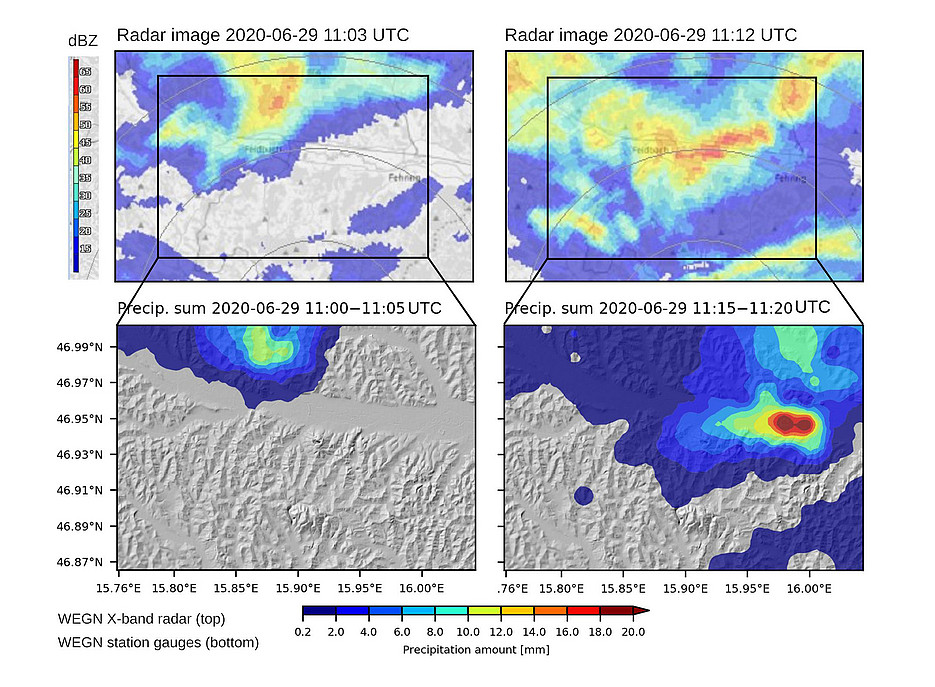
Images from the WegenerNet precipitation radar and ground network rain measurements ©University of Graz/Wegener Center
©University of Graz/Wegener Center
The WegenerNet combination of precipitation radar (above) and ground network rain measurements (below) provides reliable cloud and rain data, also for satellite validation. Image: University of Graz/Wegener Centre
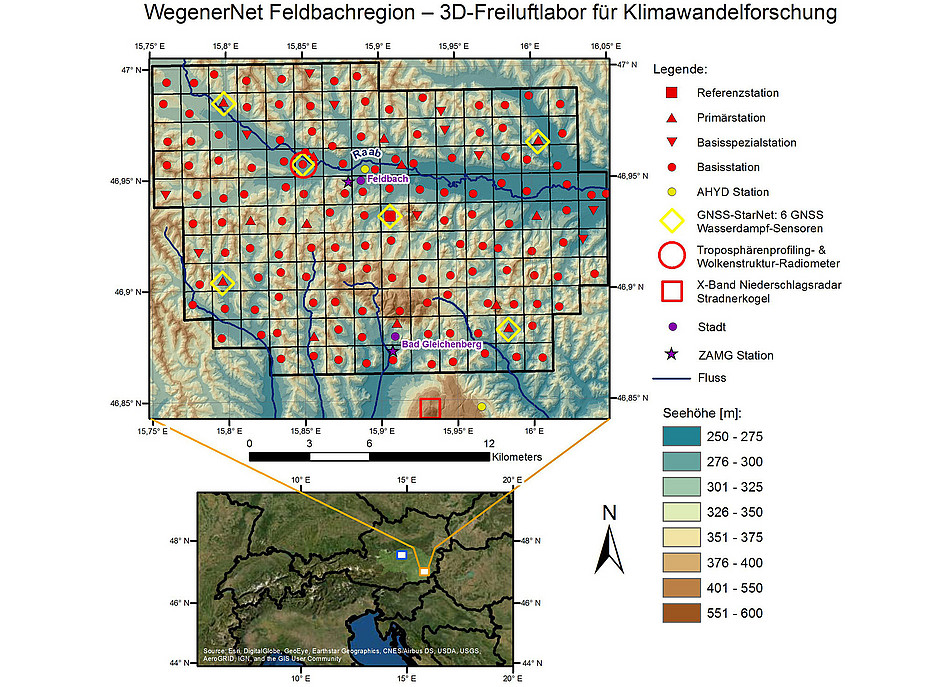
Graphic of the WegenerNet climate station network ©University of Graz/Wegener Center
©University of Graz/Wegener Center
The WegenerNet is a dense climate station network that has become a 3D open-air laboratory thanks to three-dimensional atmospheric sensors. Image: University of Graz/Wegener Centre
created by Gudrun Pichler

Related news

Chemical Christmas show at the University of Graz: An explosive evening at the Schauspielh

At the beginning of December, the University of Graz transformed the theater into a laboratory: as part of “Chemical Life,” teacher training students staged a chemical Christmas show for Styrian school classes—complete with ethanol rockets, nitrogen snow, and glowing effects. An evening designed to inspire interest in studying chemistry.

Train by train: Koralm railway accelerates exchange between the Universities

Lectures at the University of Klagenfurt in the morning, seminars at the University of Graz in the afternoon: Austria's longest tunnel and a journey time of around 45 minutes make it easy. The Koralm railway increases the speed of networking between the two university locations. The collaboration builds on existing cooperation - for example in the areas of teacher training, Slavic studies and as employers, the universities are well coordinated.

On the trail of the Big Bang: University of Graz receives 1.5 million euros for doctoral programmes

The Austrian Science Fund FWF has selected the Doctoral Programme in Theoretical Particle Physics at the University of Graz for funding from the Doc.funds. Six young scientists will be funded for 3.5 years. They will gain fundamentally new insights into the origins of the world.

From trans women and knee prostheses: sports science prizes awarded

Walking better with a prosthesis, successfully getting rid of excess weight, training more effectively, more fairness for trans people in sport: these were the topics addressed by the students at the University of Graz who were awarded the sports science prizes for their Master's theses on 3 December 2025.

Begin of page section:
Additional information:

University of Graz
Universitaetsplatz 3
8010 Graz
Austria
  • Contact
  • Web Editors
  • Moodle
  • UNIGRAZonline
  • Imprint
  • Data Protection Declaration
  • Accessibility Declaration
Weatherstation
Uni Graz

End of this page section. Go to overview of page sections

End of this page section. Go to overview of page sections

Begin of page section:

End of this page section. Go to overview of page sections