Begin of page section:
Page sections:

  • Go to contents (Accesskey 1)
  • Go to position marker (Accesskey 2)
  • Go to main navigation (Accesskey 3)
  • Go to sub navigation (Accesskey 4)
  • Go to additional information (Accesskey 5)
  • Go to page settings (user/language) (Accesskey 8)
  • Go to search (Accesskey 9)

End of this page section. Go to overview of page sections

Begin of page section:
Page settings:

English en
Deutsch de
Search
Login

End of this page section. Go to overview of page sections

Begin of page section:
Search:

Search for details about Uni Graz
Close

End of this page section. Go to overview of page sections


Search

Begin of page section:
Main navigation:

Page navigation:

  • University

    University
    • About the University
    • Organisation
    • Faculties
    • Library
    • Working at University of Graz
    • Campus
    Developing solutions for the world of tomorrow - that is our mission. Our students and our researchers take on the great challenges of society and carry the knowledge out.
  • Research Profile

    Research Profile
    • Our Expertise
    • Research Questions
    • Research Portal
    • Promoting Research
    • Research Transfer
    • Ethics in Research
    • Commission for Scientific Integrity
    Scientific excellence and the courage to break new ground. Research at the University of Graz creates the foundations for making the future worth living.
  • Studies

    Studies
    • Prospective Students
    • Students
    • Welcome Weeks for First Year Students
  • Community

    Community
    • International
    • Location
    • Research and Business
    • Alumni
    The University of Graz is a hub for international research and brings together scientists and business experts. Moreover, it fosters the exchange and cooperation in study and teaching.
Topics
  • Sustainable University
  • Researchers answer
  • Work for us
Close menu

End of this page section. Go to overview of page sections

Begin of page section:
You are here:

University of Graz News Transport in die Zelle

End of this page section. Go to overview of page sections

Wednesday, 16 January 2019

Transport in die Zelle

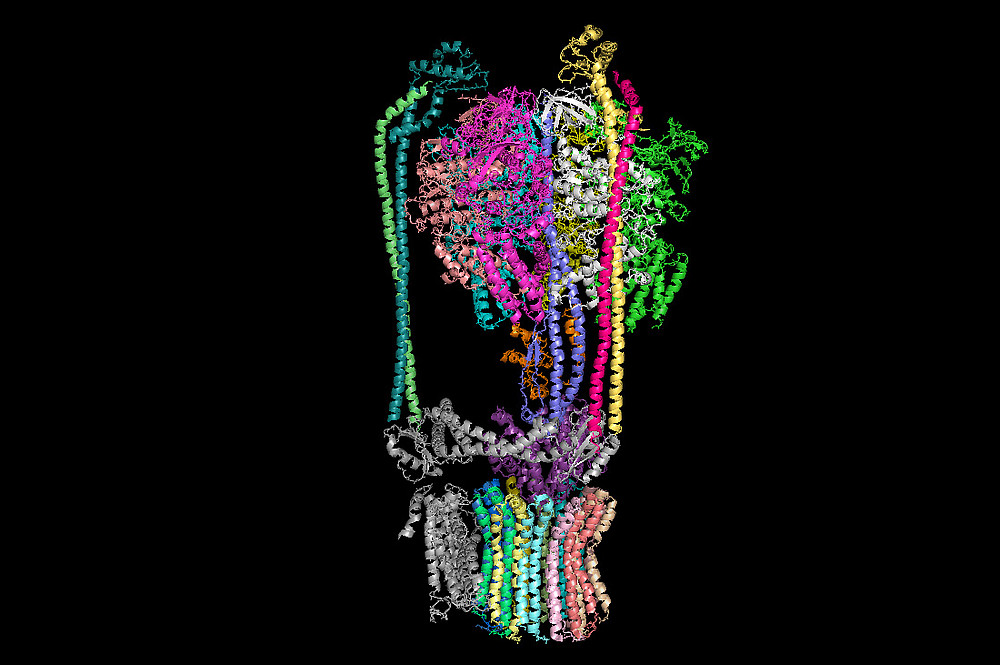
Struktur der V-ATPase von Hefe, sichtbar gemacht mit Kryoelektronenmikroskopie. Bild: erstellt von Zangger/Uni Graz, publiziert von Zhao, J., Benlekbir, S., Rubinstein, J.L. (2015), Nature, 521 241-245

Struktur der V-ATPase von Hefe, sichtbar gemacht mit Kryoelektronenmikroskopie. Bild: erstellt von Zangger/Uni Graz, publiziert von Zhao, J., Benlekbir, S., Rubinstein, J.L. (2015), Nature, 521 241-245

Grazer ForscherInnen klären Rätsel, wie Wasserstoff-Ionen durch die Membran gelangen

Bestimmte Zellen im Körper müssen sauer sein, um richtig arbeiten zu können. Für den optimalen pH-Wert sorgt ein Protein in der Zellmembran, die V-ATPase. Sie transportiert mit Hilfe der Aminosäure Arginin positiv geladene Wasserstoff-Ionen in die Zelle, was diese sauer macht. Funktioniert die V-ATPase nicht richtig, kommt es zu verschiedenen Erkrankungen, wie etwa der Osteopetrose, bei der die Knochen brüchig werden. Wie der Transport von H+-Ionen in die Zelle im Detail funktioniert, war bislang unklar. ForscherInnen der Universität Graz und der Medizinischen Universität Graz haben dieses Rätsel in Kooperation mit KollegInnen der Universität für Bodenkultur Wien nun geklärt und damit einen wichtigen Beitrag zum besseren Verständnis möglicher Krankheitsursachen geleistet. Die neuen Erkenntnisse wurden kürzlich im Journal of Biological Chemistry veröffentlicht.

Arginin ist hydrophil. Das bedeutet, dass es mit Wasser wechselwirkt. „In der V-ATPase bindet Arginin die H+-Ionen an sich“, erklärt Klaus Zangger vom Institut für Chemie der Universität Graz. Da sich in der Zellmembran sonst nur hydrophobe, sprich, wasserabstoßende Stoffe befinden, müsste das mit Wasserstoff beladene Arginin eigentlich an den Rand der Membran gedrängt werden und könnte seine Transportfunktion nicht erfüllen. Warum aber ist das nicht der Fall?
„Unsere Untersuchungen mittels Kernspinresonanzspektroskopie, Simulationen der molekularen Prozesse und Forschungen an Hefezellen zeigten, dass es in der Zellmembran zu einer sogenannten Kation-π-Wechselwirkung kommt, durch die das Arginin gewissermaßen eingeklemmt und festgehalten wird“, fasst Zangger zusammen. Unter einer Kation-π-Wechselwirkung versteht man die Interaktion von Kationen – positiv geladenen Ionen – mit der Oberfläche von unpolaren, aromatischen Strukturen, die auch Bausteine der V-ATPase sind.

Der Chemiker vermutet, dass die jüngsten Erkenntnisse nicht nur im Zusammenhang mit der V-ATPase relevant sind. „Kation-π-Wechselwirkungen könnten generell einen Mechanismus darstellen, wie sich mit H+-Ionen geladene Aminosäuren in einer hydrophoben Umgebung in einer Membran halten können.“

Die Arbeit entstand aus einer Kollaboration mit der Arbeitsgruppe Sepp Kohlwein im Doktoratskolleg „DK Molecular Enzymology“ und wurde finanziell unterstützt durch den Wissenschaftsfonds FWF, von NAWI Graz – dem Schulterschluss der Universität Graz und der TU Graz in den Naturwissenschaften – sowie von BioTechMed-Graz, der gemeinsamen Forschungsplattform von Universität Graz, TU Graz und Med Uni Graz.

Publikation
A cation-π interaction in a transmembrane helix of vacuolar ATPase retains the proton-transporting arginine in a hydrophobic environment
Walter Hohlweg, Gabriel E Wagner, Harald F Hofbauer, Florian Sarkleti, Martina Setz, Nina Gubensäk, Sabine Lichtenegger, Salvatore Fabio Falsone, Heimo Wolinski, Simone Kosol, Chris Oostenbrink, Sepp D. Kohlwein and Klaus Zangger
Journal of Biological Chemistry 2018 Dec 7, 293(49):18977-18988. doi: 10.1074/jbc.RA118.005276. Epub 2018 Sep 12.
created by Gudrun Pichler

Related news

Jurassic Sounds: Biologist reconstructs insect songs from 165 million years ago

It was apparently not just the roars of the dinosaurs that made up the soundscape of the animal world during the Jurassic period. Crickets and grasshoppers communicated through a variety of songs and high-pitched sounds, as Thorin Jonsson from the Institute of Biology at the University of Graz discovered together with colleagues from the universities of Lincoln, Bristol (UK), Beijing (China) and Tempe (USA). The findings on what are so far the oldest traces of sound on Earth have just been published in the journal PNAS.

EU funding boosts international exchange between universities

The University of Graz is further expanding its international study opportunities through the European university alliance Arqus and is taking the lead in two key projects. In future, students will benefit from even more joint degree programmes and from simplified recognition of academic achievements through the Joint European Degree Label.

Rescue and risks: Researchers have surveyed public perceptions of AI

The use of artificial intelligence has had to be made transparent since 2 August 2026. The EU’s AI Act, which has been in force since then, also sets out how risky an application is and which security measures apply as a result. However, the assessment of risks by the legislation differs in some cases significantly from the perceptions of the Austrian public. This is the finding of a representative study carried out by data scientist Stefan Thalmann from the University of Graz and his team.

The Healing Sea: Researchers discover new approaches to treating chronic inflammation in sponges

Chronic inflammation plays a key role in many diseases, ranging from metabolic disorders and cardiovascular diseases to tissue damage following injuries or infections. “Normally, the body is able to resolve inflammation on its own. If this process becomes unbalanced, immune cells remain permanently active and continue to drive negative changes in the tissue,” explains Andreas Koeberle, a pharmacist at the University of Graz.

Begin of page section:
Additional information:

University of Graz
Universitaetsplatz 3
8010 Graz
Austria
  • Contact
  • Web Editors
  • Moodle
  • UNIGRAZonline
  • Imprint
  • Data Protection Declaration
  • Accessibility Declaration
Weatherstation
Uni Graz

End of this page section. Go to overview of page sections

End of this page section. Go to overview of page sections

Begin of page section:

End of this page section. Go to overview of page sections