



Begin of page section:
Page sections:

  • Go to contents (Accesskey 1)
  • Go to position marker (Accesskey 2)
  • Go to main navigation (Accesskey 3)
  • Go to sub navigation (Accesskey 4)
  • Go to additional information (Accesskey 5)
  • Go to page settings (user/language) (Accesskey 8)
  • Go to search (Accesskey 9)

End of this page section. Go to overview of page sections

Begin of page section:
Page settings:

English en
Deutsch de
Search
Login

End of this page section. Go to overview of page sections

Begin of page section:
Search:

Search for details about Uni Graz
Close

End of this page section. Go to overview of page sections


Search

Begin of page section:
Main navigation:

Page navigation:

  • University

    University
    • About the University
    • Organisation
    • Faculties
    • Library
    • Working at University of Graz
    • Campus
    Developing solutions for the world of tomorrow - that is our mission. Our students and our researchers take on the great challenges of society and carry the knowledge out.
  • Research Profile

    Research Profile
    • Our Expertise
    • Research Questions
    • Research Portal
    • Promoting Research
    • Research Transfer
    • Ethics in Research
    • Commission for Scientific Integrity
    Scientific excellence and the courage to break new ground. Research at the University of Graz creates the foundations for making the future worth living.
  • Studies

    Studies
    • Prospective Students
    • Students
    • Registration for Study Programme (Winter semester 2026/27)
  • Community

    Community
    • International
    • Location
    • Research and Business
    • Alumni
    The University of Graz is a hub for international research and brings together scientists and business experts. Moreover, it fosters the exchange and cooperation in study and teaching.
Topics
  • Sustainable University
  • Researchers answer
  • Work for us
Close menu

End of this page section. Go to overview of page sections

Begin of page section:
You are here:

University of Graz News How can we stop cancer?

End of this page section. Go to overview of page sections

Tuesday, 25 June 2019

How can we stop cancer?

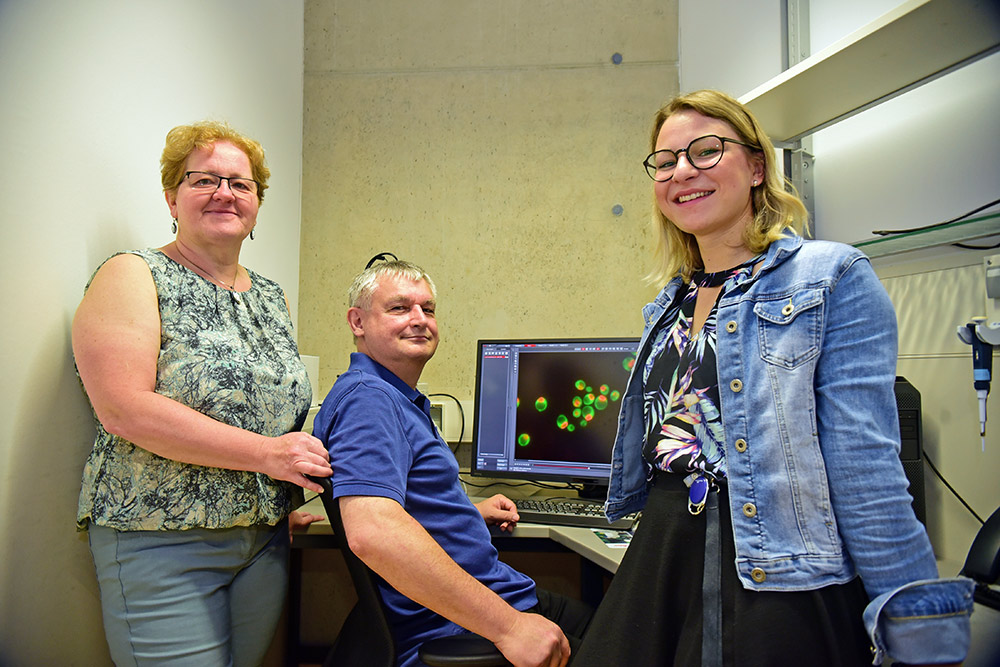
Tracing new treatments against cancer: Helmut Bergler and his colleagues Gertrude Zisser and Lisa Kofler. Foto: Uni Graz/Tzivanopoulos

Tracing new treatments against cancer: Helmut Bergler and his colleagues Gertrude Zisser and Lisa Kofler. Foto: Uni Graz/Tzivanopoulos

Researchers at the University of Graz identify potential growth inhibitors for tumour cells

Cancer cells proliferate extremely fast. The material they need for this generating process comes from protein-producers – known as ribosomes – and there are millions of them in every cell. This means that new ribosomes also need to be produced very quickly. “So finding a way to inhibit this process is a very promising strategy for the development of new medications to treat tumour diseases,” explains Helmut Bergler, from the Institute of Molecular Biosciences at the University of Graz. Heretofore, however, only a few substances have been known to accomplish this. Using a wide-ranging screening process, Bergler and his research group identified over a hundred new substances that are able to block various stages of ribosome biogenesis. Their results were published recently in the journal BMC Biology.
“These findings improve our understanding of the extremely complex production process for ribosomes, and offer some new, potentially very promising approaches to cancer medication,” says Bergler. The team has provided the basis for creating chemical inhibitors for individual maturation stages in the formation of ribosomes.
A second publication, in the specialist journal eLife, describes Bergler’s work in collaboration with international colleagues to find out how the active centre of the ribosome is formed within the cell, as part of this “building” process. This also provided the researchers with some initial indicators as to why errors in the formation of ribosomes lead to an increased predisposition to leukaemia. These new insights could potentially offer a basis for new approaches to treatment.


Publications:

D. Awad, M. Prattes, L. Kofler, I. Rössler, M. Loibl, M. Pertl, G. Zisser, H. Wolinski, B. Pertschy, H. Bergler, „Inhibiting eukaryotic ribosome biogenesis“, BMC Biol. 2019:46. doi: 10.1186/s12915-019-0664-2.

V. Kargas et al., „Mechanism of completion of peptidyltransferase centre assembly in eukaryotes“, eLife 2019; 8, doi: 10.7554/eLife.44904.001


 

created by Dagmar Eklaude

Related news

Complying with the norm: Why Do Standards Shape Our Lives, Elisabeth Staudegger?

Standards determine whether a sheet of paper fits in a printer or whether a charging plug can power multiple devices. These standards shape our everyday lives. But who actually sets these standards? Where are the weaknesses, and how could science help to improve them? Elisabeth Staudegger, Head of the ‘Law and IT’ Department at the Institute for Legal Foundations at the University of Graz, host the Academic Standards Day on 16 June. Here she relays how sciences can contribute to the topic of standardisation and reveals her personal favourite standard.

More body awareness than a culture war

In Italy, sex education lessons will in future only be permitted with parental consent, and will be banned entirely in nurseries and primary schools. At the same time, Pride Month highlights why knowledge about the body, relationships, boundaries and diversity is important for young people. A study by the University of Graz shows how important knowledge about the body, contraception, relationship skills and protection against violence is

Will Austria win the World Cup? Mathematician reveals calculation method

Michael Fischer uses the football tournament as a practical example for highschool lessons.

Survival strategies: How plants respond to drought

According to Geosphere Austria, this spring was the driest in Austria since records began around 170 years ago. The low rainfall put particular pressure on the agricultural sector. And climate change is set to make the situation even worse in the coming decades. We asked Johannes Liesche, a professor at the Department of Biology at the University of Graz, how plants react to water shortages and how they survive periods of drought.

Begin of page section:
Additional information:

University of Graz
Universitaetsplatz 3
8010 Graz
Austria
  • Contact
  • Web Editors
  • Moodle
  • UNIGRAZonline
  • Imprint
  • Data Protection Declaration
  • Accessibility Declaration
Weatherstation
Uni Graz

End of this page section. Go to overview of page sections

End of this page section. Go to overview of page sections

Begin of page section:

End of this page section. Go to overview of page sections

