



Begin of page section:
Page sections:

  • Go to contents (Accesskey 1)
  • Go to position marker (Accesskey 2)
  • Go to main navigation (Accesskey 3)
  • Go to sub navigation (Accesskey 4)
  • Go to additional information (Accesskey 5)
  • Go to page settings (user/language) (Accesskey 8)
  • Go to search (Accesskey 9)

End of this page section. Go to overview of page sections

Begin of page section:
Page settings:

English en
Deutsch de
Search
Login

End of this page section. Go to overview of page sections

Begin of page section:
Search:

Search for details about Uni Graz
Close

End of this page section. Go to overview of page sections


Search

Begin of page section:
Main navigation:

Page navigation:

  • University

    University
    • About the University
    • Organisation
    • Faculties
    • Library
    • Working at University of Graz
    • Campus
    Developing solutions for the world of tomorrow - that is our mission. Our students and our researchers take on the great challenges of society and carry the knowledge out.
  • Research Profile

    Research Profile
    • Our Expertise
    • Research Questions
    • Research Portal
    • Promoting Research
    • Research Transfer
    • Ethics in Research
    • Commission for Scientific Integrity
    Scientific excellence and the courage to break new ground. Research at the University of Graz creates the foundations for making the future worth living.
  • Studies

    Studies
    • Prospective Students
    • Students
    • Welcome Weeks for First Year Students
  • Community

    Community
    • International
    • Location
    • Research and Business
    • Alumni
    The University of Graz is a hub for international research and brings together scientists and business experts. Moreover, it fosters the exchange and cooperation in study and teaching.
Topics
  • Sustainable University
  • Researchers answer
  • Work for us
Close menu

End of this page section. Go to overview of page sections

Begin of page section:
You are here:

University of Graz News Mighty indicators

End of this page section. Go to overview of page sections

Wednesday, 15 January 2020

Mighty indicators

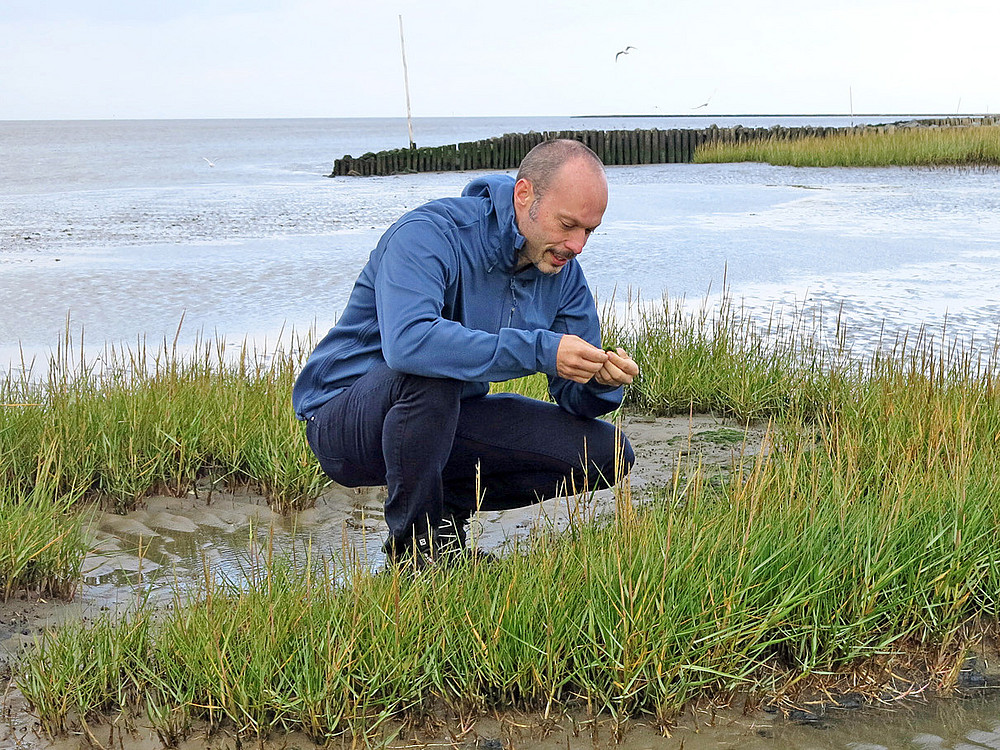
Tobias Pfingstl doing field research in Japan: The biologist and his team have studied biodiversity and climate change. Photo: Uni Innsbruck/Schatz

Tobias Pfingstl doing field research in Japan: The biologist and his team have studied biodiversity and climate change. Photo: Uni Innsbruck/Schatz

Researchers at the University of Graz study climate change by observing mites

There are not many people who would rate mites as particularly attractive creatures. For Tobias Pfingstl at the University of Graz’s Institute of Biology, however, they have a lot to offer. He is mainly interested in species that are endemic to coastal regions and are able to live both underwater and on land. They are the first to be affected by rising sea levels, and therefore also vulnerable to the effects of climate change. The latest research findings on the genetics and distribution of arachnids on the Japanese coast were published recently in Scientific Reports, a platform of the journal Nature and offer some insights into geographical and climatic changes.

“We studied several types of mites that are native to warm climate zones. Their distribution range has shifted strikingly over the last 1.5 million years, providing clear evidence of climatic changes,” explains Tobias Pfingstl. Genetic comparisons also showed that these arachnids have expanded their territory dramatically in the last 100,000 years. “Since they can neither fly, nor even crawl very far, they depend on water to be carried into new regions,” says Pfingstl. So these research findings are evidence of significant fluctuation in the sea level – apparently by as much as 200 metres since the last ice age.
The biologists’ conclusions from their study of mites may also be relevant to many other animal groups. Pfingstl and his team are continuing to record changes in the area of distribution, which will enable them to formulate prognoses for the entire coastal fauna.

The Japanese coastal regions are biotopes of particular interest to researchers, as they extend across several climate zones, and because the island geography means there are few opportunities for animals to migrate to other regions. “There are many species that have only survived in these areas, or which only evolved there at all,” explains Pfingstl. The biologists’ research project was funded by the Austrian Science Fund, and aims to study the entire biodiversity along the coast of this East Asian country.


Publication:
Tobias Pfingstl, Maximilian Wagner, Shimpei F. Hiruta, Stephan Koblmüller, Wataru Hagino, Satoschi Shimano: Phylogeographic patterns of intertidal arthropods (Acari, Oribatida) from southern Japanese islands reflect paleoclimatic events, Scientific Reports (2019) 9:19042

created by Dagmar Eklaude

Related news

Jurassic Sounds: Biologist reconstructs insect songs from 165 million years ago

It was apparently not just the roars of the dinosaurs that made up the soundscape of the animal world during the Jurassic period. Crickets and grasshoppers communicated through a variety of songs and high-pitched sounds, as Thorin Jonsson from the Institute of Biology at the University of Graz discovered together with colleagues from the universities of Lincoln, Bristol (UK), Beijing (China) and Tempe (USA). The findings on what are so far the oldest traces of sound on Earth have just been published in the journal PNAS.

EU funding boosts international exchange between universities

The University of Graz is further expanding its international study opportunities through the European university alliance Arqus and is taking the lead in two key projects. In future, students will benefit from even more joint degree programmes and from simplified recognition of academic achievements through the Joint European Degree Label.

Rescue and risks: Researchers have surveyed public perceptions of AI

The use of artificial intelligence has had to be made transparent since 2 August 2026. The EU’s AI Act, which has been in force since then, also sets out how risky an application is and which security measures apply as a result. However, the assessment of risks by the legislation differs in some cases significantly from the perceptions of the Austrian public. This is the finding of a representative study carried out by data scientist Stefan Thalmann from the University of Graz and his team.

The Healing Sea: Researchers discover new approaches to treating chronic inflammation in sponges

Chronic inflammation plays a key role in many diseases, ranging from metabolic disorders and cardiovascular diseases to tissue damage following injuries or infections. “Normally, the body is able to resolve inflammation on its own. If this process becomes unbalanced, immune cells remain permanently active and continue to drive negative changes in the tissue,” explains Andreas Koeberle, a pharmacist at the University of Graz.

Begin of page section:
Additional information:

University of Graz
Universitaetsplatz 3
8010 Graz
Austria
  • Contact
  • Web Editors
  • Moodle
  • UNIGRAZonline
  • Imprint
  • Data Protection Declaration
  • Accessibility Declaration
Weatherstation
Uni Graz

End of this page section. Go to overview of page sections

End of this page section. Go to overview of page sections

Begin of page section:

End of this page section. Go to overview of page sections

