Begin of page section:
Page sections:

  • Go to contents (Accesskey 1)
  • Go to position marker (Accesskey 2)
  • Go to main navigation (Accesskey 3)
  • Go to sub navigation (Accesskey 4)
  • Go to additional information (Accesskey 5)
  • Go to page settings (user/language) (Accesskey 8)
  • Go to search (Accesskey 9)

End of this page section. Go to overview of page sections

Begin of page section:
Page settings:

English en
Deutsch de
Search
Login

End of this page section. Go to overview of page sections

Begin of page section:
Search:

Search for details about Uni Graz
Close

End of this page section. Go to overview of page sections


Search

Begin of page section:
Main navigation:

Page navigation:

  • University

    University
    • About the University
    • Organisation
    • Faculties
    • Library
    • Working at University of Graz
    • Campus
    Developing solutions for the world of tomorrow - that is our mission. Our students and our researchers take on the great challenges of society and carry the knowledge out.
  • Research Profile

    Research Profile
    • Our Expertise
    • Research Questions
    • Research Portal
    • Promoting Research
    • Research Transfer
    • Ethics in Research
    Scientific excellence and the courage to break new ground. Research at the University of Graz creates the foundations for making the future worth living.
  • Studies

    Studies
    • Prospective Students
    • Students
  • Community

    Community
    • International
    • Location
    • Research and Business
    • Alumni
    The University of Graz is a hub for international research and brings together scientists and business experts. Moreover, it fosters the exchange and cooperation in study and teaching.
  • Spotlight
Topics
  • Our digital Advent calendar
  • Sustainable University
  • Researchers answer
  • Work for us
Close menu

End of this page section. Go to overview of page sections

Begin of page section:
You are here:

University of Graz News Secrets under the snow

End of this page section. Go to overview of page sections

Tuesday, 12 November 2019

Secrets under the snow

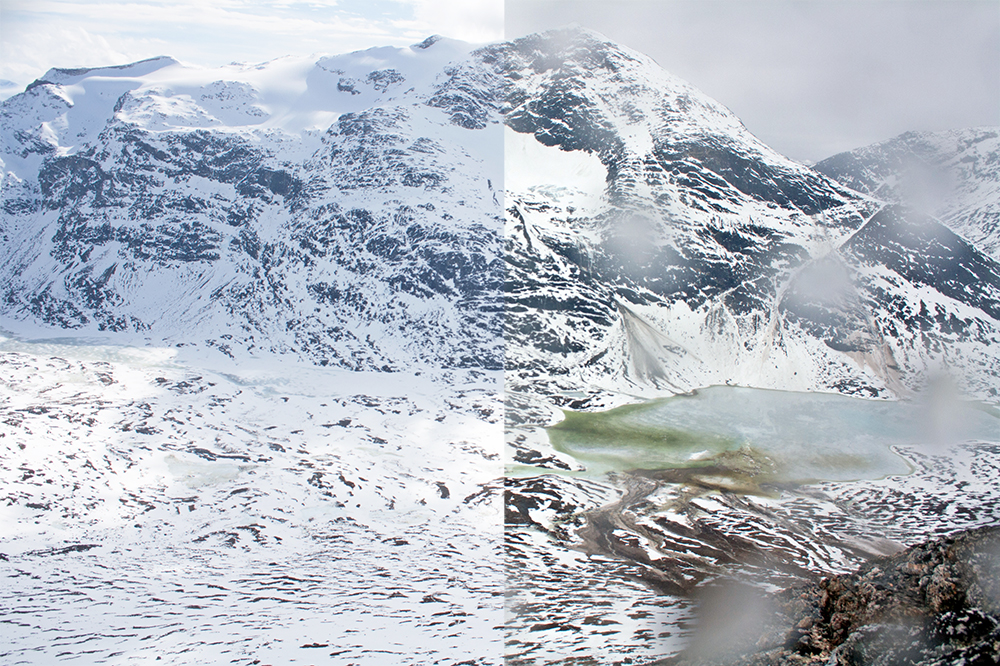
Before and after the extraordinary occurrence of avalanches: the pictures were taken at an interval of 24 hours.

Before and after the extraordinary occurrence of avalanches: the pictures were taken at an interval of 24 hours.

Extraordinary avalanche reveals new connection between ecological factors

A failed attempt to get some measurements presented Jakob Abermann, glaciologist and mountain hydrologist at the University of Graz, with a series of new scientific findings. He was out with his team taking measurements of the snow cover in Greenland. An unexpected spell of warm weather made almost the entire magnificent white landscape melt overnight – but also revealed a new phenomenon: “I discovered a huge quantity of avalanche debris on the site,” explains Abermann. “The debris was on very gentle slopes, where we wouldn’t have expected to find it in such large quantities.”
Using high-resolution satellite imagery and extensive monitoring of key climate, ground surface and flow data, the researchers were able to investigate this unusual phenomenon in more detail. “And sure enough, we found that over a very short period of time, more than 800 avalanches had occurred in an area the size of Tyrol,” explains Abermann. “So the debris we found was part of a larger event, possibly one of the largest ever recorded.”
Thanks to the comprehensive data available, the team was able to analyse the atmospheric conditions, air and ground surface temperatures, humidity, snow distribution and other parameters, and to identify the causes of these mysterious avalanches. “One factor was the extremely rapid increase in air temperature, combined with the large volume of rain that fell onto the snow,” explains meteorologist Abermann. Then, the frozen ground provided the perfect slippery surface.

Through these analyses the researchers gained new insights into the highly complex interactions between the atmosphere and snow cover during extreme events. “The Arctic is a region that is particularly sensitive to climate change,” as Abermann points out. “Global warming means that there will be more occurrences of large volumes of rain falling onto the winter snowpack, which may lead to similar large-scale avalanche events; these could affect both infrastructure and the ecosystem,” says Abermann.
These findings have been published in the trade journal “Natural Hazards”:

Jakob Abermann, Markus Eckerstorfer, Eirik Malnes, Birger Ulf Hansen, „A large wet snow avalanche cycle in West Greenland quantified using remote sensing and in situ observations“, Natural Hazards (2019) 97:517–534


created by Dagmar Eklaude

Related news

Fair distribution: Researchers determine just greenhouse gas budgets for all EU regions

Ten years ago, on 12 December 2015, the Paris Climate Agreement was signed at the UN Climate Conference. In order to limit global warming to well below two degrees, only a certain amount of CO2 may be emitted worldwide. While the focus was originally on national emission targets, more than 200 subnational regions and almost 300 cities have now adopted their own targets. But how many emissions are they fairly entitled to? Researchers at the University of Graz have now developed transparent criteria for fair distribution at the subnational level for the first time and determined corresponding greenhouse gas budgets for all European regions. The paper was published today in the scientific journal Nature Communications.

Chemical Christmas show at the University of Graz: An explosive evening at the Schauspielh

At the beginning of December, the University of Graz transformed the theater into a laboratory: as part of “Chemical Life,” teacher training students staged a chemical Christmas show for Styrian school classes—complete with ethanol rockets, nitrogen snow, and glowing effects. An evening designed to inspire interest in studying chemistry.

Train by train: Koralm railway accelerates exchange between the Universities

Lectures at the University of Klagenfurt in the morning, seminars at the University of Graz in the afternoon: Austria's longest tunnel and a journey time of around 45 minutes make it easy. The Koralm railway increases the speed of networking between the two university locations. The collaboration builds on existing cooperation - for example in the areas of teacher training, Slavic studies and as employers, the universities are well coordinated.

Im Eis zu Hause

Jakob Abermann erforscht die komplexen Zusammenhänge von Klima, Gletscher und Wasserkreislauf

Begin of page section:
Additional information:

University of Graz
Universitaetsplatz 3
8010 Graz
Austria
  • Contact
  • Web Editors
  • Moodle
  • UNIGRAZonline
  • Imprint
  • Data Protection Declaration
  • Accessibility Declaration
Weatherstation
Uni Graz

End of this page section. Go to overview of page sections

End of this page section. Go to overview of page sections

Begin of page section:

End of this page section. Go to overview of page sections