



Begin of page section:
Page sections:

  • Go to contents (Accesskey 1)
  • Go to position marker (Accesskey 2)
  • Go to main navigation (Accesskey 3)
  • Go to sub navigation (Accesskey 4)
  • Go to additional information (Accesskey 5)
  • Go to page settings (user/language) (Accesskey 8)
  • Go to search (Accesskey 9)

End of this page section. Go to overview of page sections

Begin of page section:
Page settings:

English en
Deutsch de
Search
Login

End of this page section. Go to overview of page sections

Begin of page section:
Search:

Search for details about Uni Graz
Close

End of this page section. Go to overview of page sections


Search

Begin of page section:
Main navigation:

Page navigation:

  • University

    University
    • About the University
    • Organisation
    • Faculties
    • Library
    • Working at University of Graz
    • Campus
    Developing solutions for the world of tomorrow - that is our mission. Our students and our researchers take on the great challenges of society and carry the knowledge out.
  • Research Profile

    Research Profile
    • Our Expertise
    • Research Questions
    • Research Portal
    • Promoting Research
    • Research Transfer
    • Ethics in Research
    • Commission for Scientific Integrity
    Scientific excellence and the courage to break new ground. Research at the University of Graz creates the foundations for making the future worth living.
  • Studies

    Studies
    • Prospective Students
    • Students
  • Community

    Community
    • International
    • Location
    • Research and Business
    • Alumni
    The University of Graz is a hub for international research and brings together scientists and business experts. Moreover, it fosters the exchange and cooperation in study and teaching.
  • Spotlight
Topics
  • Sustainable University
  • Researchers answer
  • Work for us
Close menu

End of this page section. Go to overview of page sections

Begin of page section:
You are here:

University of Graz News The power of nature

End of this page section. Go to overview of page sections

Wednesday, 17 July 2019

The power of nature

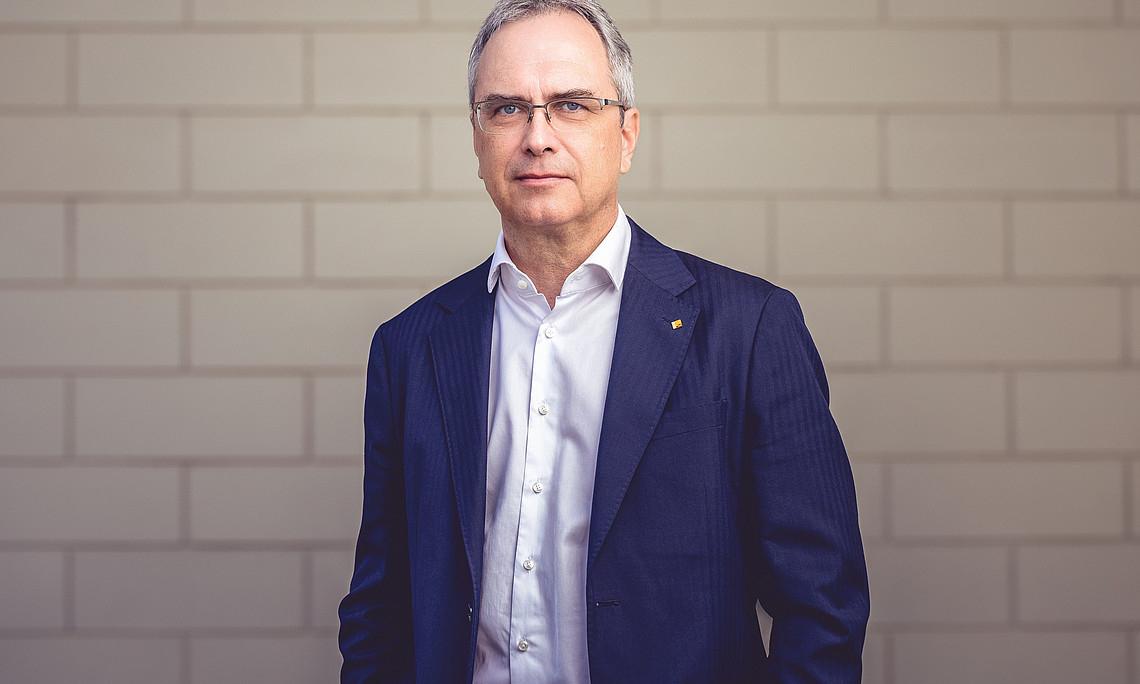
[Translate to English:] Wolfgang Kroutil ist Chemiker an der Universität Graz. Sein Spezialgebiet ist die Biokatalyse. In diesem Verfahren übernehmen Enzyme aus der natur komplexe chemische Reaktionen. Das kann mitunter dabei helfen, Medikamente günstiger zu gestalten. Foto: Uni Graz/Kanizaj

[Translate to English:] Wolfgang Kroutil ist Chemiker an der Universität Graz. Sein Spezialgebiet ist die Biokatalyse. In diesem Verfahren übernehmen Enzyme aus der natur komplexe chemische Reaktionen. Das kann mitunter dabei helfen, Medikamente günstiger zu gestalten. Foto: Uni Graz/Kanizaj

Enzymes act as accelerants in chemical reactions. This process, called biocatalysis, is a focal point of the research being carried out by Wolfgang Kroutil, a chemist from Graz

High costs are often the reason why treatments are unaffordable – or, in the worst case scenario, cannot be given at all. The pharmaceutical industry has found alternatives in cheaper manufacturing processes. Of course, these are not languishing in some desk drawer somewhere – they are very much in use. But how do they work exactly? Sitagliptin (Januvia) is a good example. This medication has been used very successfully to treat diabetes mellitus type II since 2005 and is now being manufactured with the help of organically producible enzymes. This process is called biocatalysis. The chemist Wolfgang Kroutil has been researching this green approach in chemistry for many years. He was also involved in the development and research of the enzymes required for Sitagliptin.

“On average, between five and 15 steps are needed to produce a medication,” explains Kroutil. This uses a lot of energy, which is expensive. “Waste that is harmful to the environment is also produced, which is difficult and costly to get rid of.” Biocatalysts enable the design of cleaner and more efficient chemical reactions. The approach pursued by researchers here is to look to nature for how it makes syntheses. Until recently, the use of biocatalysis in chemistry was comparable with the piecemeal renovation of a house. “We are now working to rebuild the house – this structure – completely, from the ground up. In order to enhance chemical reactions, we are using naturally occurring enzymes,” says Kroutil. Many chemical processes are being redesigned with the help of biocatalysts. The challenge facing scientists is to recreate the structure of organic molecules using enzymes. “Natural catalysts are precisely adapted to a substance and convert only this substance into a certain product,” explains the researcher. And this even functions at temperatures of between twenty and forty degrees Celsius. By comparison, organic chemistry involves reactions that need temperatures as low as ninety degrees below zero. The cooling required during the processes drives up costs.

Catalysts from amino acids. Microorganisms have a special place in biocatalysis. “On the one hand, we are able to manufacture catalysts from renewable raw materials such as sugar or protein. On the other, we can easily dispose of these materials by feeding them to animals or letting them biologically degrade.” Given the many tonnes of Sitagliptin produced every year, this has a significant impact on the environmental footprint of a company.

And what about the revenue potential? These medications could, of course, be offered on the market more cheaply, perhaps to offset out the imbalanced supply of medicines in developing countries. But Kroutil sees this as merely “a nice side-effect". The primary objectives of pharmaceutical companies are cost-reduction, efficient manufacturing and thus higher profit margins. Obviously!

 

created by Konstantin Tzivanopoulos

Related news

Higher Education Strategy 2040: Austria’s universities on course for the future

Austria has 77 higher education institutions, which is above the EU average – but does this really make sense? The new Higher Education Strategy 2040 focuses on cooperation rather than mergers. As one of the six largest universities in Austria, the University of Graz plays a central role in this.

Climate research in Greenland: Old data provides new insights

The polar explorer and University of Graz professor Alfred Wegener left behind a unique collection of climate data from Greenland. A research team from the University of Graz is now analysing this 100-year-old treasure trove of data and comparing it with current measurements.

Diversity in nature and science: How we talk about plants and each other

Ginkgo, kiwi, hemp: they exist as male and female plants. Anyone who paid attention in biology class will confirm this. But is this categorisation, established by Carl von Linné almost 300 years ago, still valid today? An interdisciplinary team at the University of Graz is questioning these attributions and using this as a starting point to provide food for thought for gender-sensitive interaction between students, scientific and teaching staff.

Around the world in eight stops: the Long Night of Research at the University of Graz

On 24 April from 5 pm, you can take a short trip around the globe at the University of Graz, discovering pecularities of foreign countries or new local features in the entrance hall of the University Library. The itinerary takes you through introduced animal species, political attitudes and the omnipotence of algorithms. There will also be a programme in the historic reading hall, as well as at the UniGraz@Museum and the University Archive.

Begin of page section:
Additional information:

University of Graz
Universitaetsplatz 3
8010 Graz
Austria
  • Contact
  • Web Editors
  • Moodle
  • UNIGRAZonline
  • Imprint
  • Data Protection Declaration
  • Accessibility Declaration
Weatherstation
Uni Graz

End of this page section. Go to overview of page sections

End of this page section. Go to overview of page sections

Begin of page section:

End of this page section. Go to overview of page sections

