



Begin of page section:
Page sections:

  • Go to contents (Accesskey 1)
  • Go to position marker (Accesskey 2)
  • Go to main navigation (Accesskey 3)
  • Go to sub navigation (Accesskey 4)
  • Go to additional information (Accesskey 5)
  • Go to page settings (user/language) (Accesskey 8)
  • Go to search (Accesskey 9)

End of this page section. Go to overview of page sections

Begin of page section:
Page settings:

English en
Deutsch de
Search
Login

End of this page section. Go to overview of page sections

Begin of page section:
Search:

Search for details about Uni Graz
Close

End of this page section. Go to overview of page sections


Search

Begin of page section:
Main navigation:

Page navigation:

  • University

    University
    • About the University
    • Organisation
    • Faculties
    • Library
    • Working at University of Graz
    • Campus
    Developing solutions for the world of tomorrow - that is our mission. Our students and our researchers take on the great challenges of society and carry the knowledge out.
  • Research Profile

    Research Profile
    • Our Expertise
    • Research Questions
    • Research Portal
    • Promoting Research
    • Research Transfer
    • Ethics in Research
    • Commission for Scientific Integrity
    Scientific excellence and the courage to break new ground. Research at the University of Graz creates the foundations for making the future worth living.
  • Studies

    Studies
    • Prospective Students
    • Students
  • Community

    Community
    • International
    • Location
    • Research and Business
    • Alumni
    The University of Graz is a hub for international research and brings together scientists and business experts. Moreover, it fosters the exchange and cooperation in study and teaching.
  • Spotlight
Topics
  • Sustainable University
  • Researchers answer
  • Work for us
Close menu

End of this page section. Go to overview of page sections

Begin of page section:
You are here:

University of Graz News Competences for Kids

End of this page section. Go to overview of page sections

Tuesday, 16 July 2019

Competences for Kids

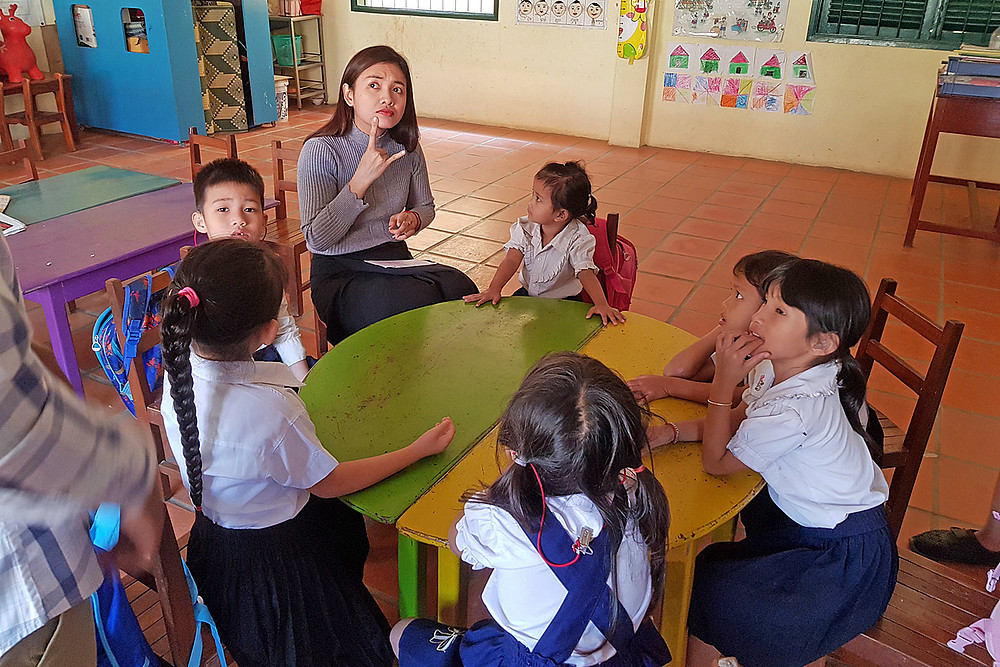
Providing a better future for schoolkids in Southeast Asia is the aim of the project CONTESSA. Photo: Contessa

Providing a better future for schoolkids in Southeast Asia is the aim of the project CONTESSA. Photo: Contessa

the University of Graz establishes a new teacher-training model in South East Asia

Children thirsty for knowledge, inundating their teachers with questions and happy to work on the three Rs: this is something you will rarely see at primary schools in Sri Lanka and Cambodia. Vestiges of the civil war and the Khmer Rouge regime can still be felt in the education sector; there is a lack of qualified teachers. Classes, if they take place at all, mostly consist of pupils learning entire chapters of books by heart. Those who do not manage are punished severely. ‘Especially in these rural areas, it is nearly impossible for children to keep up with demands’, says Sandra Hummel from the Institute of Educational Sciences at the University of Graz. Hummel initiated a unique, EU-funded project designed to sustainably improve the situation.

‘CONTESSA’, which stands for Contemporary Teaching Skills for South Asia, addresses issues at several levels to establish teaching methods that meet children’s needs. As she explains, ‘First we have to implement an approach to training that focuses on learners’. Until now, universities with teacher-training programmes only focused on theories and content that was sometimes dated, completely ignoring pupils’ perspectives and needs as well as methods which would motivate them to think critically and develop their skills. ‘It does not address practical considerations, and prospective teachers also do not learn anything about learning prerequisites’, the researcher adds.
All these things are being integrated into training for primary school teachers in both countries. The methods and materials required are being put together by the researchers in Graz and their Asian colleagues. As Hummel happily notes, ‘Professors and students are extremely interested; they are already rethinking things’. In addition, there will be compulsory continuing education courses for those already teaching in schools. A ‘train-the-trainer’ programme will be set up at the same time so new concepts and approaches also become an integral part of the Asian teaching institutions.

Culturally-sensitive restructuring
For all this to be successful, the teacher training researcher from Graz began with a detailed examination of the situation of Cambodian and Sri Lankan students studying to become teachers. She conducted in-depth interviews with everyone involved. ‘That was an important prerequisite for our ideas to also be compatible with existing structures. And we also wanted to make sure we could fulfil the target group’s needs’, says Hummel. Two Cambodian and two Sri Lankan universities are project partners. Their tasks include, among others, translation of the materials into the national languages. They also make sure that ethnic and cultural specificities are sufficiently taken into account.
All course content will be available on an open-access platform, which provides users with a flexible and affordable way to make use of the materials. The Technical University of Dresden is taking care of the technical implementation. ‘Our German colleagues are providing a great deal of training and other forms of support on location, as the students and teachers there still have a great deal of respect for computers’, Hummel notes. But the strong interest of the teacher training institutions and the broad backing from the ministries of education in both countries make them confident that the project will run as planned. The goal is to create a self-sufficient system in three years’ time; this system will be maintained by experts in both countries. ‘By reaching out to students, trainers and teachers already in the classroom, we have high hopes that things will actually benefit the children in the end. That is something I find very appealing’, stresses the teacher training researcher from Graz. It is possible that the project will be extended to include secondary school teachers. The material will also be available in other countries, provided that it is translated into the respective national languages.

Historical burden
The Sri Lankan Civil War, which ended in 2009, still has a notable impact on the rural regions of northeast Sri Lanka. The population, mostly Tamils, has poor access to educational opportunities owing to limited financial resources, among others. Under Cambodia’s Khmer Rouge regime until the 1970s it was considered a crime to be educated. Most teachers fled or were killed. Consequently, there is still a lack of trained teachers today. For this reason, pedagogical or subject-specific training are not a prerequisite for teaching in the classroom.

 

created by Dagmar Eklaude

Related news

Higher Education Strategy 2040: Austria’s universities on course for the future

Austria has 77 higher education institutions, which is above the EU average – but does this really make sense? The new Higher Education Strategy 2040 focuses on cooperation rather than mergers. As one of the six largest universities in Austria, the University of Graz plays a central role in this.

Climate research in Greenland: Old data provides new insights

The polar explorer and University of Graz professor Alfred Wegener left behind a unique collection of climate data from Greenland. A research team from the University of Graz is now analysing this 100-year-old treasure trove of data and comparing it with current measurements.

Diversity in nature and science: How we talk about plants and each other

Ginkgo, kiwi, hemp: they exist as male and female plants. Anyone who paid attention in biology class will confirm this. But is this categorisation, established by Carl von Linné almost 300 years ago, still valid today? An interdisciplinary team at the University of Graz is questioning these attributions and using this as a starting point to provide food for thought for gender-sensitive interaction between students, scientific and teaching staff.

Around the world in eight stops: the Long Night of Research at the University of Graz

On 24 April from 5 pm, you can take a short trip around the globe at the University of Graz, discovering pecularities of foreign countries or new local features in the entrance hall of the University Library. The itinerary takes you through introduced animal species, political attitudes and the omnipotence of algorithms. There will also be a programme in the historic reading hall, as well as at the UniGraz@Museum and the University Archive.

Begin of page section:
Additional information:

University of Graz
Universitaetsplatz 3
8010 Graz
Austria
  • Contact
  • Web Editors
  • Moodle
  • UNIGRAZonline
  • Imprint
  • Data Protection Declaration
  • Accessibility Declaration
Weatherstation
Uni Graz

End of this page section. Go to overview of page sections

End of this page section. Go to overview of page sections

Begin of page section:

End of this page section. Go to overview of page sections

