Begin of page section:
Page sections:

  • Go to contents (Accesskey 1)
  • Go to position marker (Accesskey 2)
  • Go to main navigation (Accesskey 3)
  • Go to sub navigation (Accesskey 4)
  • Go to additional information (Accesskey 5)
  • Go to page settings (user/language) (Accesskey 8)
  • Go to search (Accesskey 9)

End of this page section. Go to overview of page sections

Begin of page section:
Page settings:

English en
Deutsch de
Search
Login

End of this page section. Go to overview of page sections

Begin of page section:
Search:

Search for details about Uni Graz
Close

End of this page section. Go to overview of page sections


Search

Begin of page section:
Main navigation:

Page navigation:

  • University

    University
    • About the University
    • Organisation
    • Faculties
    • Library
    • Working at University of Graz
    • Campus
    Developing solutions for the world of tomorrow - that is our mission. Our students and our researchers take on the great challenges of society and carry the knowledge out.
  • Research Profile

    Research Profile
    • Our Expertise
    • Research Questions
    • Research Portal
    • Promoting Research
    • Research Transfer
    • Ethics in Research
    Scientific excellence and the courage to break new ground. Research at the University of Graz creates the foundations for making the future worth living.
  • Studies

    Studies
    • Prospective Students
    • Students
  • Community

    Community
    • International
    • Location
    • Research and Business
    • Alumni
    The University of Graz is a hub for international research and brings together scientists and business experts. Moreover, it fosters the exchange and cooperation in study and teaching.
  • Spotlight
Topics
  • Our digital Advent calendar
  • Sustainable University
  • Researchers answer
  • Work for us
Close menu

End of this page section. Go to overview of page sections

Begin of page section:
You are here:

University of Graz News Well received on the job

End of this page section. Go to overview of page sections

Monday, 17 June 2019

Well received on the job

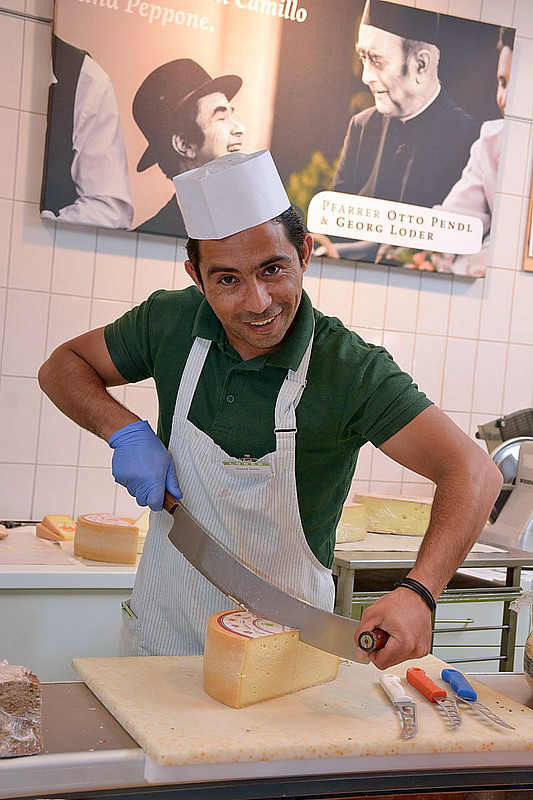
Omar Owied fled to Austria from Syria. A network of volunteers helped him find a job. Foto: Uni Graz/cp-pictures ©cp-pictures

Omar Owied fled to Austria from Syria. A network of volunteers helped him find a job. Foto: Uni Graz/cp-pictures

Researcher at the University of Graz investigates refugee integration in the labour market

The massive refugee flows of 2015 have long since subsided, but many a challenge remains to be mastered. For example, asylum seekers with a residence permit need a permanent and adequate job. Renate Ortlieb has researched what jobs they have found, how comfortable they feel there, and how the companies see the situation. Ortlieb, Head of the Institute of Human Resource Management at the University of Graz, has also developed a concept together with her team for making integration easier.

The study is the first and most comprehensive of its type. ‘All previous studies worldwide have focused on how refugees find a job. But how it goes for them and their surroundings once they get the job is just as relevant for further successful placements’, emphasises Ortlieb. It is important to find longer-term and satisfactory jobs so that those affected do not end up back at the Austrian Employment Service (AMS) after a few months. ‘This also requires a change in companies’ thinking’, says Ortlieb. More flexibility would also make it easier for older people, as well as women, after a long period taking care of children, to find a position.
According to the current survey, about a quarter of those entitled to asylum can make good use of their own qualifications and have better-paid, longer-term employment. ‘However, the wage level for refugees is about 500 Euro lower than the average monthly salary in Austria’, Ortlieb points out. Another 25 per cent feel comfortable at their workplace and are able to develop further, yet they are paid poorly. About a quarter of them feel that they are being exploited, doing unskilled and often dangerous jobs for low wages.

Important bridges
As a general rule, people from Afghanistan and Syria do not have educational certificates recognised here. The AMS certifies their qualifications using skill checks, thereby providing essential support for the job search process. However, private individuals or NGO employees who establish personal contacts with companies and arrange traineeships or trial opportunities are particularly important. ‘Considerably more refugees were employed in this way than through the usual formal application procedures’, says Ortlieb. Patrons and mentors also make an essential contribution to the integration of new employees into firms. ‘Their role should definitely be strengthened, to everyone’s benefit’, emphasises Ortlieb.
Asylum seekers are finding employment primarily in understaffed professions. At their job, many superiors and direct colleagues stand up for them. However, their cultural background is rarely seen as an advantage. ‘Employers could make better use of the skills held by refugees. For example, people from the Middle East often have very good networks within their own communities, and that could also help a company’, says Ortlieb. Moreover, alcohol consumption is a problem in many production facilities, but generally, this doesn’t apply to Muslims.
 
A little too well-meant
While some companies lack an understanding of different cultural traits, those fugitives who are socially very well integrated are also often under pressure. ‘They are frequently praised effusively, yet at the same time they are expected to assimilate. They are supposed to speak Styrian dialect and be good – or even better – Austrians’, says Ortlieb. It would be important for colleagues and superiors to recognise this otherness and value diversity, as this generally reduces the potential for conflict in the company, including among locals.
Ortlieb has developed a tool that can be implemented quickly and easily in companies in order to eliminate simmering dissatisfaction and promote team development. ‘Working shoulder to shoulder with colleagues, taking a peek at other areas, and conducting staff appraisals in which the topic of migration is openly addressed are effective measures’, says Ortlieb. The concept helps in general to improve structures and cooperation in companies, not just for people from other cultures. ‘This is about recognising, developing and using skills’, summarises Ortlieb.


created by Dagmar Eklaude

Related news

Semester abroad without barriers: University of Graz wins award for promoting inclusion

The University of Graz has been awarded the Internationalization Award for its new inclusion initiative. Students with fewer opportunities now also receive financial support for their semester abroad outside Europe.

Fair distribution: Researchers determine just greenhouse gas budgets for all EU regions

Ten years ago, on 12 December 2015, the Paris Climate Agreement was signed at the UN Climate Conference. In order to limit global warming to well below two degrees, only a certain amount of CO2 may be emitted worldwide. While the focus was originally on national emission targets, more than 200 subnational regions and almost 300 cities have now adopted their own targets. But how many emissions are they fairly entitled to? Researchers at the University of Graz have now developed transparent criteria for fair distribution at the subnational level for the first time and determined corresponding greenhouse gas budgets for all European regions. The paper was published today in the scientific journal Nature Communications.

Chemical Christmas show at the University of Graz: An explosive evening at the Schauspielh

At the beginning of December, the University of Graz transformed the theater into a laboratory: as part of “Chemical Life,” teacher training students staged a chemical Christmas show for Styrian school classes—complete with ethanol rockets, nitrogen snow, and glowing effects. An evening designed to inspire interest in studying chemistry.

Train by train: Koralm railway accelerates exchange between the Universities

Lectures at the University of Klagenfurt in the morning, seminars at the University of Graz in the afternoon: Austria's longest tunnel and a journey time of around 45 minutes make it easy. The Koralm railway increases the speed of networking between the two university locations. The collaboration builds on existing cooperation - for example in the areas of teacher training, Slavic studies and as employers, the universities are well coordinated.

Begin of page section:
Additional information:

University of Graz
Universitaetsplatz 3
8010 Graz
Austria
  • Contact
  • Web Editors
  • Moodle
  • UNIGRAZonline
  • Imprint
  • Data Protection Declaration
  • Accessibility Declaration
Weatherstation
Uni Graz

End of this page section. Go to overview of page sections

End of this page section. Go to overview of page sections

Begin of page section:

End of this page section. Go to overview of page sections