Begin of page section:
Page sections:

  • Go to contents (Accesskey 1)
  • Go to position marker (Accesskey 2)
  • Go to main navigation (Accesskey 3)
  • Go to sub navigation (Accesskey 4)
  • Go to additional information (Accesskey 5)
  • Go to page settings (user/language) (Accesskey 8)
  • Go to search (Accesskey 9)

End of this page section. Go to overview of page sections

Begin of page section:
Page settings:

English en
Deutsch de
Search
Login

End of this page section. Go to overview of page sections

Begin of page section:
Search:

Search for details about Uni Graz
Close

End of this page section. Go to overview of page sections


Search

Begin of page section:
Main navigation:

Page navigation:

  • University

    University
    • About the University
    • Organisation
    • Faculties
    • Library
    • Working at University of Graz
    • Campus
    Developing solutions for the world of tomorrow - that is our mission. Our students and our researchers take on the great challenges of society and carry the knowledge out.
  • Research Profile

    Research Profile
    • Our Expertise
    • Research Questions
    • Research Portal
    • Promoting Research
    • Research Transfer
    • Ethics in Research
    Scientific excellence and the courage to break new ground. Research at the University of Graz creates the foundations for making the future worth living.
  • Studies

    Studies
    • Prospective Students
    • Students
  • Community

    Community
    • International
    • Location
    • Research and Business
    • Alumni
    The University of Graz is a hub for international research and brings together scientists and business experts. Moreover, it fosters the exchange and cooperation in study and teaching.
  • Spotlight
Topics
  • Our digital Advent calendar
  • Sustainable University
  • Researchers answer
  • Work for us
Close menu

End of this page section. Go to overview of page sections

Begin of page section:
You are here:

University of Graz News Multi-purpose weapon identified

End of this page section. Go to overview of page sections

Tuesday, 03 September 2019

Multi-purpose weapon identified

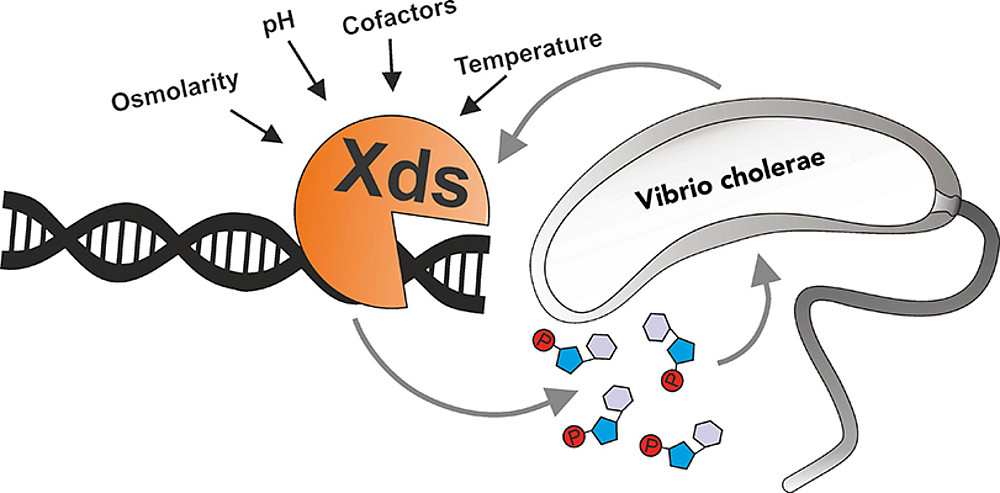
The enzyme Xds plays an important role for the cholera pathogen Vibrio cholerae. Researchers have now completed the first biochemical definition of this rare enzyme, and identified which factors are relevant for its survival fitness. Graphic: Katharina Preßler.

The enzyme Xds plays an important role for the cholera pathogen Vibrio cholerae. Researchers have now completed the first biochemical definition of this rare enzyme, and identified which factors are relevant for its survival fitness. Graphic: Katharina Preßler.

Researchers publish first-ever description of key enzyme of cholera pathogen

The bacterium Vibrio cholerae is a fighting machine and at the same time a master of survival: it can live both inside the human body and outside it, and a special defence mechanism enables it to defy attacks by predators, nutrient deficiencies, and UV radiation. Researchers at the University of Graz have now discovered an approach for developing a targeted therapy to combat this life-threatening pathogen. The enzyme Xds, which is used by Vibrio cholerae for several purposes, plays the key role. “We provide a first biochemical characterisation of this unique enzyme, which is mainly present in bacterial human-pathogens like Vibrio cholerae. This is a major step towards a possible treatment to fight cholera,” explains Stefan Schild, from the university’s Institute of Molecular Biosciences. These findings have been published in the highly-respected online specialist journal “Frontiers in Microbiology”.

Stefan Schild’s team has already established the enormous importance of Xds to the cholera pathogen. Xds – together with a second important enzyme – helps the bacterium to build its protective layer, the biofilm. The two enzymes also ensure that Vibrio cholerae is able to detach from the biofilm when it reaches the human intestine, for example by oral ingestion. There the pathogen attaches itself to intestinal cells and triggers the fatal diarrhoea illness. “Before it gets to that point, the immune system recruits its first defenders, known as neutrophils, to the location of the infection,” explains Schild. As soon as the neutrophils have located the bacteria, these immune cells separate into their constituent parts. The DNA of the neutrophils functions like a net that catches and slowly kills the bacterial attackers. So far, so good – but the Xds enzyme not only destroys this trap, but also consumes it and stores the nutrients until they are needed. For Vibrio cholerae, Xds is a very effective multi-purpose weapon. Since this enzyme is so rare, there has previously been no adequate biochemical definition of its characteristics,” says Schild.

The current study reveals one of the most important offensive weapons of the cholera pathogen: “We now know where the active centre of the enzyme is located, which amino acids are involved, and what additional factors, such as salts or temperature, are important for its survival fitness,” the research scientist explains, summarising these findings. As Xds homologous are not expressed by the human host, the enzyme could represent a promising therapeutic target. Next steps will focus on the identification of specific inhibitors blocking the enzyme activity. The long term goal envisions an inhibition of Xds combined with conventional therapies that could result in more effective treatments reducing the use of antibiotics and duration of treatment.

The research study was conducted under two intersecting doctoral programmes at the University of Graz – the recently concluded “molecular enzymology” programme, and the newly established “molecular metabolism” (MOBILES) programme supported by the Austrian Science Fund (FWF) doc.funds initiative. The spokesperson for Mobiles is Monika Oberer from the Institute of Molecular Biosciences, who was the first person to model the structure of Xds on the computer. A further investigation will aim to identify the exact crystal structure of the enzyme.


Publication: Katharina Pressler, Fabian Mitterer, Dina Vorkapic, Joachim Reidl, Monika Oberer and Stefan Schild. Characterization of Vibrio cholerae’s extracellular nuclease Xds. Front. Microbiol. - Microbial Physiology and Metabolism, in press. DOI: 10.3389/fmicb.2019.02057. https://www.frontiersin.org/articles/10.3389/fmicb.2019.02057/


Further Literature:

1    Seper A, Fengler VH, Roier S, Wolinski H, Kohlwein SD, Bishop AL, Camilli A, Reidl J, Schild S. Extracellular nucleases and extracellular DNA play important roles in Vibrio cholerae biofilm formation. Mol Microbiol. 2011 Nov;82(4):1015-37. doi: 10.1111/j.1365-2958.2011.07867.x. Epub 2011 Oct 27.
2    Seper A, Hosseinzadeh A, Gorkiewicz G, Lichtenegger S, Roier S, Leitner DR, Röhm M, Grutsch A, Reidl J, Urban CF, Schild S. Vibrio cholerae evades neutrophil extracellular traps by the activity of two extracellular nucleases. PLoS Pathog. 2013;9(9):e1003614. doi: 10.1371/journal.ppat.1003614.
3    Gumpenberger T, Vorkapic D, Zingl FG, Pressler K, Lackner S, Seper A, Reidl J, Schild S. Nucleoside uptake in Vibrio cholerae and its role in the transition fitness from host to environment. Mol Microbiol. 2016 Feb;99(3):470-83. doi: 10.1111/mmi.13143.


created by Gerhild Leljak

Related news

Semester abroad without barriers: University of Graz wins award for promoting inclusion

The University of Graz has been awarded the Internationalization Award for its new inclusion initiative. Students with fewer opportunities now also receive financial support for their semester abroad outside Europe.

Fair distribution: Researchers determine just greenhouse gas budgets for all EU regions

Ten years ago, on 12 December 2015, the Paris Climate Agreement was signed at the UN Climate Conference. In order to limit global warming to well below two degrees, only a certain amount of CO2 may be emitted worldwide. While the focus was originally on national emission targets, more than 200 subnational regions and almost 300 cities have now adopted their own targets. But how many emissions are they fairly entitled to? Researchers at the University of Graz have now developed transparent criteria for fair distribution at the subnational level for the first time and determined corresponding greenhouse gas budgets for all European regions. The paper was published today in the scientific journal Nature Communications.

Chemical Christmas show at the University of Graz: An explosive evening at the Schauspielh

At the beginning of December, the University of Graz transformed the theater into a laboratory: as part of “Chemical Life,” teacher training students staged a chemical Christmas show for Styrian school classes—complete with ethanol rockets, nitrogen snow, and glowing effects. An evening designed to inspire interest in studying chemistry.

Train by train: Koralm railway accelerates exchange between the Universities

Lectures at the University of Klagenfurt in the morning, seminars at the University of Graz in the afternoon: Austria's longest tunnel and a journey time of around 45 minutes make it easy. The Koralm railway increases the speed of networking between the two university locations. The collaboration builds on existing cooperation - for example in the areas of teacher training, Slavic studies and as employers, the universities are well coordinated.

Begin of page section:
Additional information:

University of Graz
Universitaetsplatz 3
8010 Graz
Austria
  • Contact
  • Web Editors
  • Moodle
  • UNIGRAZonline
  • Imprint
  • Data Protection Declaration
  • Accessibility Declaration
Weatherstation
Uni Graz

End of this page section. Go to overview of page sections

End of this page section. Go to overview of page sections

Begin of page section:

End of this page section. Go to overview of page sections