Immediately after the European Digital Sovereignty Summit in Berlin, where the Austrian Declaration was ratified, the second Technology Impact Summit, a joint initiative of the University of Graz, Graz University of Technology, JOANNEUM RESEARCH, and FH JOANNEUM, brings together experts from science, technology, business, and politics in Graz. Under the title “AI in Action: Competencies – Applications – Impact,” they will focus on current applications and future strategies to make Europe an independent player in global competition at the think tank event. The discussion at the Seifenfabrik in Graz will range from self-reflective criticism of overregulation to opportunities arising from the interaction between science and research, business, and politics.
Austrian Declaration
“Europe has woken up and is in the process of regaining its independence. The smart way forward is a cooperative multi-strategy based on our own development strength and reliable partnerships,” said State Secretary for Digitalization Alexander Pröll in his opening statement. Over the past few months, his team has developed a declaration on digital sovereignty and resilience, which was signed by all EU member states at the EU summit in Berlin. This kick-off will be followed by concrete actions for technological sovereignty, data independence, and the strengthening of IT professionals. The aim is to preserve our democracy through a common understanding of digital transformation.
Henna Virkkunen, Executive Vice President for Technical Sovereignty, Security, and Democracy at the European Commission, also sent a message of greeting. “The speed at which artificial intelligence is changing our entire lives is breathtaking. The European Union is developing new strength through digital sovereignty and pursuing a long-term strategy to support all economic sectors in technological development to become global leaders. Investment and legal certainty are the guard rails that shape the path to the future.”
Science is the pacemaker of digital evolution
The TIS is organized by the University of Graz, Graz University of Technology, FH Joanneum, and Joanneum Research. In his welcome address, University of Graz Rector Peter Riedler emphasized: “The strength of universities lies in the networking of expertise and the transfer of new technologies to the economy.” TU Graz Rector Horst Bischof reminded the audience that science is always open to new findings. “The decisive factor in new technologies is trustworthiness, which is created through open and transparent dialogue between science, industry, and society.”
Heinz Mayer from Joanneum Research reminded the audience that artificial intelligence and machine learning are not new territory for Austrian science. “The concentrated and well-founded knowledge at domestic research institutions is a locational advantage from which Austria benefits.” FH-Joanneum Managing Director Martin Payer emphasized the importance of practical application: “With artificial intelligence, we are breaking down silos between theory and practice and giving students new opportunities.”
Europe's technological sovereignty
Rector Horst Bischof (Graz University of Technology) discusses the fundamental question of Europe's digital and technological sovereignty with Karl-Theodor zu Guttenberg (Spitzberg Partners), Taiwan expert Josie-Marie Perkuhn (University of Trier), and Harald Leitenmüller (Microsoft). Strategic autonomy not only creates independence, but also protects values and value creation. In the future, sovereignty will become a protective wall for the democratic system.
Leitenmüller advocates pragmatic cooperation instead of dogmatic isolation and sees the ability to choose between the qualities of different providers as a strength. Smart regulation is an advantage in favoring partners with a similar understanding of values. Although he advocates regulation as a guide, he feels that the European Union lacks speed in implementation and adaptability to technological innovation. “The Austrian Declaration is a first step by politicians to take responsibility for digital independence.”
“We are massively overregulated by an obsessive risk-averse mentality and are terrified of failure in Europe,” warns zu Guttenberg. The entrepreneur is convinced that fruitful cooperation with allies can only come from our own strength. According to TU Rector Bischof, overregulation prevents groundbreaking projects from being transferred from research to practice. The rector sees little merit in the digital omnibus, as it does not create sufficient opportunities for science, business, and research. He describes the legislative bodies in the European Union as impractical and risk-averse. Perkuhn criticizes the lack of protection for European data externally, while the handling of data within the EU is hampered by overregulation. She calls for more international cooperation and a practical approach to data.
(Artificial) intelligence for all: Smart use of resources brings competitive advantage
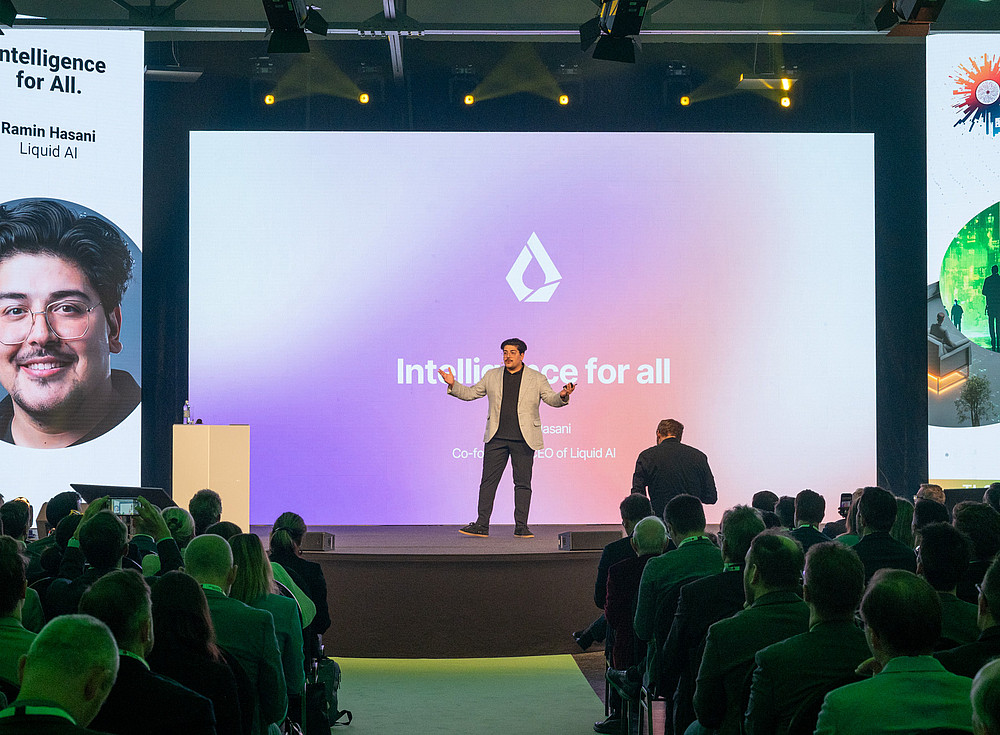
In his keynote speech, Liquid AI founder Ramin Hasani creates a new approach to artificial intelligence and forms a classification between complexity, risks, costs, and opportunities. The infrastructure and energy requirements of artificial intelligence counteract sustainability and climate goals, but at the same time contribute to their achievement. Scientific research makes it possible to derive social added value from technologies. Regulations such as those of the European Union are essential for researchers and entrepreneurs to solve issues of energy consumption and data protection and to control the development of technologies.
Hasani points to the enormous computing capacity that remains unused on a large number of end devices and in cars. Processes in data centers currently still generate considerable data traffic and associated costs, which can be avoided in the future through smart innovations, reducing the need for investment. “The efficient use of existing resources and architectures is fundamental to substantially reducing energy requirements and bringing economic competitiveness into line with climate and environmental protection,” Hasani summarizes.
The true value of artificial intelligence
It is only a matter of time before the first unicorn without employees emerges in Silicon Valley. Georg Schneider (University of Graz) speaks of a phase of creative destruction and sees efficiency gains only when artificial intelligence finds its way into robotics and industrial production. Patrick Wollner (McKinsey & Company) fears that the economy is currently bogged down in inefficient pilot projects with little impact. According to the management consultant, current applications offer few economic advantages and hardly any scaling effects. He misses the grand vision of strategically developing companies through technology. The current bubble diminishes the true value of artificial intelligence.
He would discontinue 80 percent of the AI initiatives currently being implemented because they are neither measurable nor do they bring any added value to the company. “Major progress will only be made with major investments. Europe urgently needs to catch up in order to develop solutions with effective impact. Otherwise, there is a risk of remaining an imitator and not becoming an innovator,” says Schneider. He identifies numerous fig leaf projects that lack real implementation possibilities. Both experts warn against making innovation an end in itself and losing sight of its actual benefits. While US big tech companies follow an overarching strategy in their profit orientation, European entrepreneurs get lost in minutiae. “Hard factors and measurability are needed to avoid losing sight of the direction of technological development. The concrete business case must be the goal for the use of artificial intelligence: technology and economic thinking must be brought together,” emphasizes Wollner.
Artificial intelligence in practice: From guideline to capability
The trend toward hiding complexity from consumers reduces user competence and understanding of technologies. In addition to media literacy, technological literacy is also needed for the responsible and trustworthy use of artificial intelligence. It is changing all areas of life, including the way we learn. Intuitive use of technologies requires solid basic knowledge. “Users must be able to make well-informed decisions in a complex environment,” demands Andreas Windisch (JOANNEUM RESEARCH). “Motivated learning does not come about through paragraphs and overregulation, but through freedom, a culture of error, and exploration.”
Currently, more than half of society does not consciously and actively use artificial intelligence, which means that the debate on the topic has not yet reached the necessary breadth. There is a lack of contact with deep tech and a basic understanding of technologies for critical consideration: fear of contact and skepticism prevail over tech enthusiasm. “People learn from each other in networks. Legal and regulatory guidelines as well as trustworthy role models and multipliers are needed to steer the process in the right direction,” counters Petia Niederländer (Austrian National Bank). “Public administration plays an important role in developing trust in new technologies.”
Paradigm shift through transformation
Organizations will develop in three stages, with AI-enabled enterprises representing the beginning. AI-integrated companies and AI-first organizations represent the future. Currently, employees use artificial intelligence to complete tasks faster and more efficiently, with tools (artificial narrow intelligence) performing predefined tasks. In the next step, artificial intelligence will be so deeply embedded in business processes that it will become inseparable (artificial general intelligence). It will become a team member, while humans will become process designers and feedback providers for the machine. In the final stage, artificial super intelligence will actively shape the company, and the role of humans will become that of ethical framework designers.
This is the prediction of change expert Michael Timmermann (Timmermann). In an automated and digitized world, the human factor will gain importance due to the emotional aspect. The advent of artificial intelligence will change the functional structure of companies in favor of cross-functional teams.
Andreas Zehetner (Timmermann) predicts a new culture based on equal cooperation between humans and machines. Companies will have to find new places in the ecosystem to generate value. “Currently, companies are trying to solve problems with artificial intelligence that cannot be solved by artificial intelligence,” Zehetner notes.
Timmermann speaks of a new leadership culture that leads combined teams of humans and artificial intelligence. Managing human-machine cooperation will become a central task. Figuratively speaking, artificial intelligence is evolving from an intern to a senior consultant, while the role of humans is evolving into that of an ethical authority.
Shaping change in society – and not just surviving it
Elisabeth L'Orange (Deloitte) refers to the “Janus moment” in human history due to the enormous speed of technological development. Human cognition can hardly keep up with the exponential development of technology.
The tech podcaster sees the great danger in the growing competence of artificial intelligence in the decline of human abilities when humans rely too much on machines. Since the introduction of social media around 2010, cognitive decline has been taking place with a significant impact on reading, writing, and arithmetic skills. At the same time, artificial intelligence is increasing cognitive challenges. Constant interaction with algorithms has a lasting impact on the structure of the brain and turns dopamine into the new currency. The use of artificial intelligence increases productivity, but reduces motivation and enthusiasm for work.
Forward-looking practical examples in focus at the Technology Impact Summit 2025
With its afternoon program, the Technology Impact Summit 2025 not only addressed the big questions, but also provided concrete impetus for transformation, impact, and action – perfect for executives, technology enthusiasts, and transformation managers who want to do more than just talk, but actually shape the future. "Artificial intelligence unfolds its greatest value where it empowers people: by reducing complexity, providing sound support for decisions, and creating space for genuine innovation. The contributions at the Technology Impact Summit make it clear that artificial intelligence is no longer a vision of the future, but is already providing decisive impetus for business, administration, and society today," said Markus Fallenböck, Vice Rector of the University of Graz and co-initiator of the Technology Impact Summit.
From theory to practice with seven use cases from the DACH region
ACP impressively demonstrated how artificial intelligence and human expertise are jointly revolutionizing inside sales in technical wholesale. The starting point was an everyday challenge: unstructured, telephone-based, and often time-critical customer inquiries, as well as scattered data and a growing skills gap among young talent.
“We tried to bring AI and HI – human intelligence – together in a collaborative effort,” emphasized Alexander Liebl, Director of Business Consulting at ACP. The new system combines AI voice agents for routine inquiries and call routing with an HI voice agent that operates with AI support. In several stages of development – from the foundation sprint to scalable product maturity – a solution was created that continuously learns on its own. “AI is the new player in intelligent collaboration. Only those who intelligently combine data and processes can create a working environment with effective collaboration between human intelligence and artificial intelligence,” Liebl summarizes.
CANCOM presented an AI solution that is permanently changing operational document management. Until now, customers have suffered from duplicate entries, missing assignments, and an enormous variety of invoice formats – a problem that overwhelmed traditional regulatory frameworks. “The big problem for our customers is that duplicate entries and missing assignments have occurred,” explained Jürgen Altenriederer, Technical Consultant at CANCOM. AI-based extraction, semantic understanding through large language models, and a clearly focused user experience ultimately resulted in 84 percent automation, drastically reduced throughput times, and significantly improved data quality. “AI does not replace people—it needs people who shape change,” emphasized Altenriederer. The added value is reflected in the ROI: efficiency, traceability, and compliance from a single source.
FH JOANNEUM showed how AI strengthens cybersecurity without replacing human expertise. In the “AI & Industrial Penetration Testing” project, the technology helps identify vulnerabilities in industrial systems by taking on standard tasks and monotonous “boring tasks.” At the same time, sensitive data and the lack of test systems remain a challenge:
“There are hardly any test systems, so you have to be careful,” emphasized FH professor Klaus Gebeshuber. His conclusion remained clear: “AI & Industrial Penetration Testing has enormous potential, but human collaboration is still indispensable.”
Östererreichische Post Business Solutions addressed a problem that costs companies millions: manual document processing. A German industrial company processes around 500,000 documents annually – at six euros per document, this amounts to costs of around three million euros. With DAiTA – Document AI Transformation and Automation – content is automatically recognized, extracted, and processed, from simple rules to LLM-supported semantic analyses. “We eliminate the business risk of incorrect input data,” explained division manager and managing director George Wallner. Scalable processing – whether one or 20,000 pages per hour – and quality assurance measures (“human in the loop”) ensure maximum precision.
The use cases extended to the HR department, where AI checks application documents for completeness. “Cascading logic creates efficiency and cost-effectiveness,” said Wallner. Raiffeisen-Landesbank Steiermark presented a simulation-based forecasting model that supports strategic decisions based on data.
The goal: to better understand how customer numbers, product features, and demand will develop in the future – in the context of social trends and taking into account the bank's own measures. “AI is often overestimated – technology alone cannot solve fundamental problems,” emphasized Florian Brugger, head of the department for software development, data science, automation, business intelligence, and artificial intelligence. The team therefore focused on the careful integration of relevant data sources, machine learning models for forecasts and simulations, and supplementary use cases relating to distance behavior, product interests, and marketing measures. The model forms the basis for location decisions, targeted sales, and strategic planning.
VTU and Leftshift One presented a solution that makes internal expert knowledge in large industrial companies usable. The challenge: knowledge exists, but it is difficult to access. AI serves as an intelligent assistant that searches documents, extracts information, and provides answers in natural language. “AI is not a trend; AI does not replace our thinking, it makes knowledge usable,” explained Patrick Ratheiser, founder of Leftshift One. Karin Kaltseis, Director of Quality Management at the VTU Group, emphasized how crucial human training was for fine-tuning: “There is a world of difference between the initial output and where we are now.” The basis for this is, above all, clear documentation that ensures quality, safety, and compliance.
The German Aerospace Center presented AI applications in one of the most demanding fields of all: space travel. Safety and fault tolerance are central to this field. AI uses reinforcement learning based on digital twins to develop autonomous controls for rocket engines. “AI in safety-critical applications: major challenges, major potential,” explained Kai Dresia, researcher at the German Aerospace Center.
Two levels of integration were tested: First, AI generates a control sequence with 15,000 commands, which is monitored by humans; later, AI works as an “in-the-loop” agent that can actively respond to disturbances. The approach shows how autonomous systems can make missions safer and more efficient in the long term.
About the Technology Impact Summit
The Technology Impact Summit is a joint initiative of the University of Graz, Graz University of Technology, JOANNEUM RESEARCH, and FH JOANNEUM. The think tank event offers a unique platform for in-depth discussion and reflection on the latest developments and trends, building bridges between science, technology, and application. High conciseness is ensured through discussions in the form of Oxford-style debates, presentations of use cases in the form of “lightning talks,” or the “Impact Gallery.” The Technology Impact Summit 2025 is supported by ACP, AVL List, Austria Wirtschaftsservice, Bankenverband, Bearing Point, brutkasten, Federal Ministry for Women, Science and Research, Federal Ministry for Economy, Energy and Tourism, CANCOM, Die Presse, Die 7. Fakultät, Gady Family, Grazer Wechselseitige, IDea_Lab, Industriellenvereinigung Steiermark, Kleine Zeitung, Land Steiermark, Leftshift One, LexisNexis, Microsoft, Nortal, NTS, PostBusiness Solutions, Raiffeisen Landesbank Steiermark, RTR, Steiermärkische Sparkasse, Steirische Tourismus und Standortmarketing GmbH, Studo, TCM, Timmermann, Wirtschaftskammer Steiermark, Zoom, and 4Events. Further information is available at ti-summit.com.