Begin of page section:
Page sections:

  • Go to contents (Accesskey 1)
  • Go to position marker (Accesskey 2)
  • Go to main navigation (Accesskey 3)
  • Go to sub navigation (Accesskey 4)
  • Go to additional information (Accesskey 5)
  • Go to page settings (user/language) (Accesskey 8)
  • Go to search (Accesskey 9)

End of this page section. Go to overview of page sections

Begin of page section:
Page settings:

English en
Deutsch de
Search
Login

End of this page section. Go to overview of page sections

Begin of page section:
Search:

Search for details about Uni Graz
Close

End of this page section. Go to overview of page sections


Search

Begin of page section:
Main navigation:

Page navigation:

  • University

    University
    • About the University
    • Organisation
    • Faculties
    • Library
    • Working at University of Graz
    • Campus
    Developing solutions for the world of tomorrow - that is our mission. Our students and our researchers take on the great challenges of society and carry the knowledge out.
  • Research Profile

    Research Profile
    • Our Expertise
    • Research Questions
    • Research Portal
    • Promoting Research
    • Research Transfer
    • Ethics in Research
    Scientific excellence and the courage to break new ground. Research at the University of Graz creates the foundations for making the future worth living.
  • Studies

    Studies
    • Prospective Students
    • Students
  • Community

    Community
    • International
    • Location
    • Research and Business
    • Alumni
    The University of Graz is a hub for international research and brings together scientists and business experts. Moreover, it fosters the exchange and cooperation in study and teaching.
  • Spotlight
Topics
  • Our digital Advent calendar
  • Sustainable University
  • Researchers answer
  • Work for us
Close menu

End of this page section. Go to overview of page sections

Begin of page section:
You are here:

University of Graz News Legal historian Anita Ziegerhofer on 30 years of Austria in the EU

End of this page section. Go to overview of page sections

Friday, 03 October 2025

Legal historian Anita Ziegerhofer on 30 years of Austria in the EU

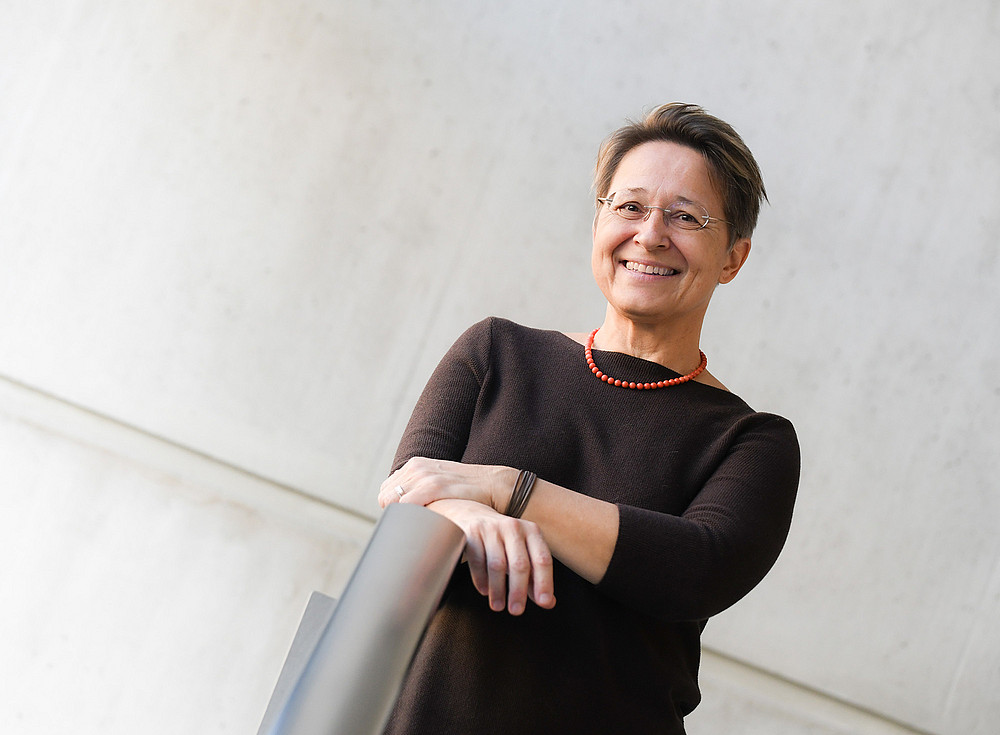
Anita Ziegerhofer, portrait, in front of a grey concrete wall, her hands on a stainless steel railing ©Uni Graz/Tzivanopoulos

One of Anita Ziegerhofer's main research interests is the history of European integration law. Photo: University of Graz / Tzivanopoulos

These are challenging times for the European Union. The war in Ukraine and the threat posed by Russia, US President Donald Trump's customs policy and right-wing populism in its member states are putting the EU under pressure. Austria is celebrating the 30th anniversary of its membership this year. The advantages this has brought to our country and whether it can be described as a success story will be the topic of the "Rechtshistorischer Dialog" at the University of Graz on 6 October 2025. Anita Ziegerhofer, initiator of the event series, invites former EU Commissioner and Minister of Agriculture Franz Fischler, former Minister of Finance Ferdinand Lacina, Tina Obermoser from Europe direct/Land Steiermark and European law expert Paul Gragl from the University of Graz to the discussion. Ziegerhofer, a legal historian, is passionate about the idea of a united Europe, but is concerned about the future of the Union because, "We still haven't learned to think European."


At the beginning of 2025, only 41 per cent of Austrians surveyed in a Eurobarometer poll said they had an overall positive view of the EU. 38 per cent rated the Union neither positively nor negatively, while 21 per cent viewed it negatively. More than 31 years ago, on 12 June 1994, two-thirds of participants in a referendum in Austria voted in favour of EU accession. Why has the view of the European Union changed so much?

Anita Ziegerhofer: Before Austria joined the EU on 1 January 1995, the then governing coalition of the SPÖ and ÖVP created a joint “euphoric” narrative: together into the European Union. The mood in the country was very positive, and although not everyone welcomed accession, the majority did. Soon afterwards, this euphoria gave way to everyday politics. Economically, Austria has definitely benefited greatly, but from a socio-political perspective, we have not learned – or have failed – to think European.

What do you mean by that?

Ziegerhofer: Who is the European Union? It is the 27 member states that make up the EU and whose governments should pursue a common European policy. But politicians still see themselves as representatives of their own countries. They may appear European in Brussels, but when they return to their countries, they are first and foremost “national politicians” again. It would be desirable not only to think about one's own country and how to get the most out of the EU. All member states should pull together, and politicians should lead by example. So far, this has only happened, if at all, in the context of crises.

Why don't we think European?

Ziegerhofer: Many people feel threatened by the manifold crises: many take refuge in conspiracy theories, which are mainly spread via social media – this is a lever that really divides society. When there are grievances, people look for someone to blame. And that someone is “those people in Brussels”, who are far away and supposedly have no idea about the situation in the country. Right-wing populism promotes this image. It is a major threat to the European Union. Many Austrians are very critical of the EU, but I don't believe that an “Öxit” would gain a majority.

How could unjustified perceptions of the EU be corrected?

Ziegerhofer: We need a positive-critical narrative about the European Union. People in Austria have benefited from EU accession in many ways. For example, through the opportunity to work in many professions anywhere in Europe. Travelling within the EU has also become easier and the variety of goods in supermarkets is significantly greater. Austria, especially Styria, has been able to position itself much more strongly internationally through funding for research and innovation within the framework of European projects. New opportunities for cross-border exchange and cooperation have opened up at universities, for example through the Erasmus education programme and EU research funding. The introduction of the ECTS credit system for studies and a uniform bachelor's-master's-doctorate system has created a common European higher education area.

Why is there no positive narrative about the EU despite all this?

Ziegerhofer: I think young people don't think much about the European Union. They have grown up with its advantages. And older people tend to think that everything was better in the past. The media prefer to report on negative issues such as the “cucumber regulation” or the “ban on light bulbs” rather than the successes of the EU. They could – as could educational work in schools, universities and adult education – do a lot to correct the image of the Union. It is important to me that we talk openly about the EU, its strengths and weaknesses. Let's seek dialogue with its critics, listen to them and also talk about what would happen if we weren't in the EU!

What does the European Union need in order to have a future?

Ziegerhofer: I am convinced that the EU has a future, but it will have to adapt to geopolitical changes. Looking back at history, the idea of Europe has always been popular when there has been a threat from outside. This was also a driving force behind the European integration process from 1950 onwards. The EU must be much more self-confident in its dealings with the US and China. But it is also clear that it can only be as strong as its members allow it to be. I hope that the EU will emerge stronger from all these crises and become an equal player in the newly forming world order.

Rechtshistorischer Dialog “30 Jahre EU-Mitgliedschaft Österreichs”
6 October 2025, 6:00–8:00 p.m.
University of Graz, RESOWI, Universitätsstraße 15, Building A, 2nd floor, SZ 15.21

created by Gudrun Pichler

Related news

Train by train: Koralm railway accelerates exchange between the Universities

Lectures at the University of Klagenfurt in the morning, seminars at the University of Graz in the afternoon: Austria's longest tunnel and a journey time of around 45 minutes make it easy. The Koralm railway increases the speed of networking between the two university locations. The collaboration builds on existing cooperation - for example in the areas of teacher training, Slavic studies and as employers, the universities are well coordinated.

On the trail of the Big Bang: University of Graz receives 1.5 million euros for doctoral programmes

The Austrian Science Fund FWF has selected the Doctoral Programme in Theoretical Particle Physics at the University of Graz for funding from the Doc.funds. Six young scientists will be funded for 3.5 years. They will gain fundamentally new insights into the origins of the world.

From trans women and knee prostheses: sports science prizes awarded

Walking better with a prosthesis, successfully getting rid of excess weight, training more effectively, more fairness for trans people in sport: these were the topics addressed by the students at the University of Graz who were awarded the sports science prizes for their Master's theses on 3 December 2025.

Influential: Rupert Baumgartner and Holger Hoff among the highly cited researchers

The number of publications in scientific journals is considered to be a measure of a researcher's scientific achievement. How often these works are cited by colleagues provides information about the relevance of the publications. Sustainability researcher Rupert Baumgartner and transdisciplinarity expert Holger Hoff from the University of Graz are among the top 1 per cent of the most cited scientists in their fields of research.

Begin of page section:
Additional information:

University of Graz
Universitaetsplatz 3
8010 Graz
Austria
  • Contact
  • Web Editors
  • Moodle
  • UNIGRAZonline
  • Imprint
  • Data Protection Declaration
  • Accessibility Declaration
Weatherstation
Uni Graz

End of this page section. Go to overview of page sections

End of this page section. Go to overview of page sections

Begin of page section:

End of this page section. Go to overview of page sections