Begin of page section:
Page sections:

  • Go to contents (Accesskey 1)
  • Go to position marker (Accesskey 2)
  • Go to main navigation (Accesskey 3)
  • Go to sub navigation (Accesskey 4)
  • Go to additional information (Accesskey 5)
  • Go to page settings (user/language) (Accesskey 8)
  • Go to search (Accesskey 9)

End of this page section. Go to overview of page sections

Begin of page section:
Page settings:

English en
Deutsch de
Search
Login

End of this page section. Go to overview of page sections

Begin of page section:
Search:

Search for details about Uni Graz
Close

End of this page section. Go to overview of page sections


Search

Begin of page section:
Main navigation:

Page navigation:

  • University

    University
    • About the University
    • Organisation
    • Faculties
    • Library
    • Working at University of Graz
    • Campus
    Developing solutions for the world of tomorrow - that is our mission. Our students and our researchers take on the great challenges of society and carry the knowledge out.
  • Research Profile

    Research Profile
    • Our Expertise
    • Research Questions
    • Research Portal
    • Promoting Research
    • Research Transfer
    • Ethics in Research
    • Commission for Scientific Integrity
    Scientific excellence and the courage to break new ground. Research at the University of Graz creates the foundations for making the future worth living.
  • Studies

    Studies
    • Prospective Students
    • Students
  • Community

    Community
    • International
    • Location
    • Research and Business
    • Alumni
    The University of Graz is a hub for international research and brings together scientists and business experts. Moreover, it fosters the exchange and cooperation in study and teaching.
Topics
  • Sustainable University
  • Researchers answer
  • Work for us
Close menu

End of this page section. Go to overview of page sections

Begin of page section:
You are here:

University of Graz News Nitrogen as the key: the overestimated effect of CO2 as a plant fertiliser

End of this page section. Go to overview of page sections

Tuesday, 25 November 2025

Nitrogen as the key: the overestimated effect of CO2 as a plant fertiliser

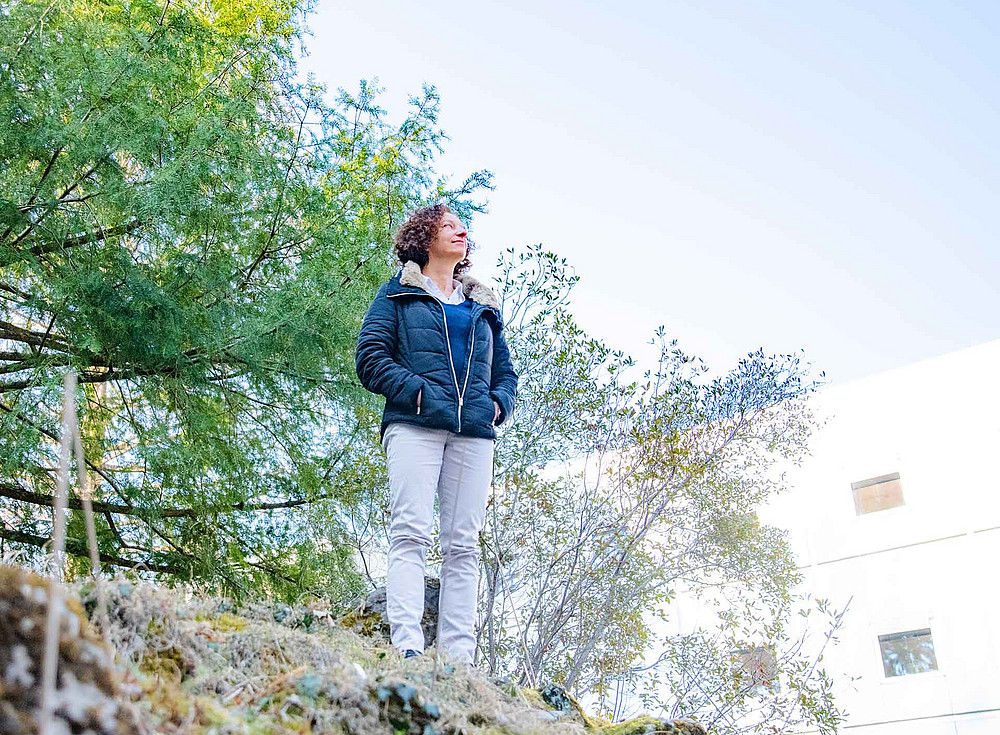
Bettina Weber ©Uni Graz/Tzivanopoulos

Bettina Weber ist Biologin an der Uni Graz und beschäftigt sich mit der biologischen Stickstofffixierung und deren Auswirkung auf den Klimawandel. Foto: Uni Graz/Tzivanopoulos

High levels of atmospheric CO2 can intensify climate change. Having said that, high CO2 also stimulates plant growth which decreases climate change. But only if, among other things, nitrogen is present in sufficient quantities. The actual amount of nitrogen has only recently been reassessed. The “fertilising effect” of CO2 has been significantly overestimated, as a brand-new study involving the University of Graz now shows.

In order to use nitrogen, the element must be fixed in the soil with the help of microorganisms. This biological binding occurs in natural ecosystems, but also on agricultural land. “While this process has been significantly overestimated in nature, it has increased by 75 percent over the past 20 years due to agriculture,” Bettina Weber, biologist at the University of Graz, summarises the findings of a publication from earlier this year.
A new study based on these results now shows that existing calculations on nitrogen fixation in certain Earth System models, which are used, among other things, in the World Climate Report, have been revised. This is the conclusion of the new study, which has been published on 24 November in the scientific journal PNAS.
The publication was led by Sian Kou-Giesbrecht from Simon Fraser University in Burnaby, Canada, as part of a working group on biological nitrogen fixation, of which Bettina Weber is a member. The working group is supported by the U.S. Geological Survey (USGS) John Wesley Powell Centre for Analysis and Synthesis.

“We compared different Earth System models with current nitrogen fixation values and found that they overestimate the nitrogen fixation rate on natural surfaces by about 50 per cent,” Weber explains. Overall, this overestimation of biological nitrogen fixation leads to a reduction in the CO2 fertilisation effect of about 11 per cent.
Weber therefore advocates revising the Earth System models in order to better assess developments. “This is because gases such as nitrogen oxides and nitrous oxide are produced as part of the nitrogen cycle. These can be released into the atmosphere through conversion processes and alter or disrupt climate processes.”


created by Andreas Schweiger

Related news

Superti-Furga will becomefounding director of the CORI Institute in Graz

The Austrian Academy of Sciences (ÖAW) is establishing a new flagship centre for research into metabolic diseases in collaboration with the three universities in Graz. This innovative research approach combines mathematics and experimental biology with artificial intelligence

A match for life

Stem cell donations save lives. However, the only way to determine who is ultimately compatible with whom is through a testing process. Pharmacist Marion Mußbacher explains the mechanisms behind this. On 6 May 2026, the ÖH and the charity “Geben für Leben” are calling for people to come forward for typing at the University of Graz.

Mild Research Night: Around 750 visitors travelled around the world at the university

Lovely weather and a wide range of research topics drew visitors to the University of Graz last Friday. Highlights included a journey around the globe in eight stops, a ‘speed-dating’ session with books, insights into Alfred Wegener’s Greenland expedition, and guided tours of the democracy exhibition at the UniGraz@Museum.

Career Booster: How the Research Careers Campus supports researchers

They are innovative, creative and productive – researchers who have not yet been appointed to a professorship make a massive contribution to a university’s research output. To provide them with even better support on their career path, the University of Graz has established the Research Careers Campus. The official launch took place on 22 April 2026 with a ‘festival’.

Begin of page section:
Additional information:

University of Graz
Universitaetsplatz 3
8010 Graz
Austria
  • Contact
  • Web Editors
  • Moodle
  • UNIGRAZonline
  • Imprint
  • Data Protection Declaration
  • Accessibility Declaration
Weatherstation
Uni Graz

End of this page section. Go to overview of page sections

End of this page section. Go to overview of page sections

Begin of page section:

End of this page section. Go to overview of page sections