Begin of page section:
Page sections:

  • Go to contents (Accesskey 1)
  • Go to position marker (Accesskey 2)
  • Go to main navigation (Accesskey 3)
  • Go to sub navigation (Accesskey 4)
  • Go to additional information (Accesskey 5)
  • Go to page settings (user/language) (Accesskey 8)
  • Go to search (Accesskey 9)

End of this page section. Go to overview of page sections

Begin of page section:
Page settings:

English en
Deutsch de
Search
Login

End of this page section. Go to overview of page sections

Begin of page section:
Search:

Search for details about Uni Graz
Close

End of this page section. Go to overview of page sections


Search

Begin of page section:
Main navigation:

Page navigation:

  • University

    University
    • About the University
    • Organisation
    • Faculties
    • Library
    • Working at University of Graz
    • Campus
    Developing solutions for the world of tomorrow - that is our mission. Our students and our researchers take on the great challenges of society and carry the knowledge out.
  • Research Profile

    Research Profile
    • Our Expertise
    • Research Questions
    • Research Portal
    • Promoting Research
    • Research Transfer
    • Ethics in Research
    Scientific excellence and the courage to break new ground. Research at the University of Graz creates the foundations for making the future worth living.
  • Studies

    Studies
    • Prospective Students
    • Students
  • Community

    Community
    • International
    • Location
    • Research and Business
    • Alumni
    The University of Graz is a hub for international research and brings together scientists and business experts. Moreover, it fosters the exchange and cooperation in study and teaching.
  • Spotlight
Topics
  • Our digital Advent calendar
  • Sustainable University
  • Researchers answer
  • Work for us
Close menu

End of this page section. Go to overview of page sections

Begin of page section:
You are here:

University of Graz News Staubfänger

End of this page section. Go to overview of page sections

Wednesday, 16 March 2022

Staubfänger

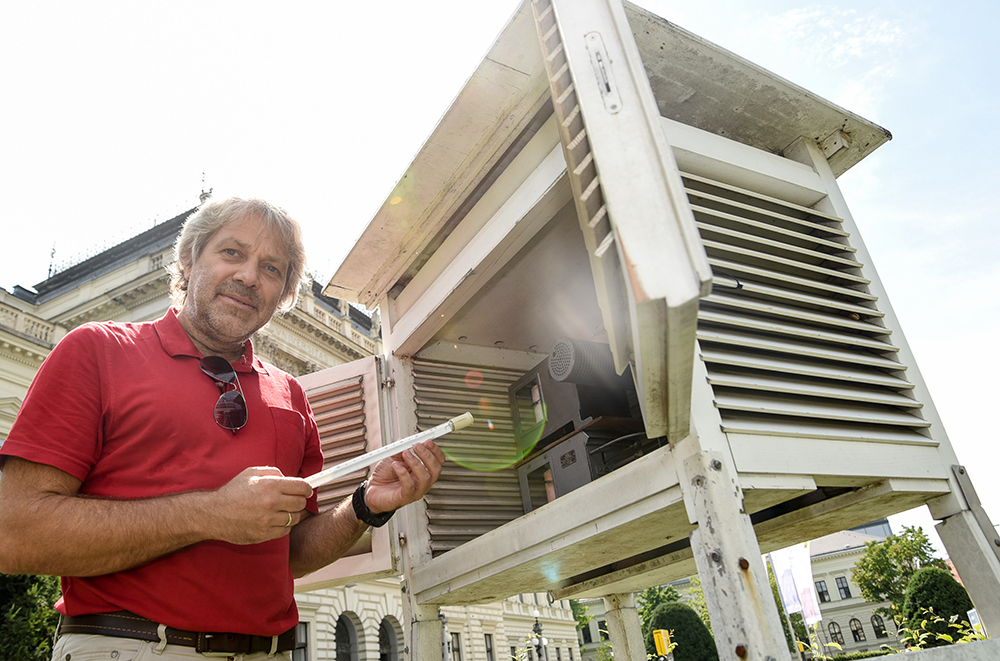
Ulrich Foelsche beschäftigt sich am Institut für Physik mit Wetterphänomenen. Foto: Uni Graz/Tzivanopoulos

Ulrich Foelsche beschäftigt sich am Institut für Physik mit Wetterphänomenen. Foto: Uni Graz/Tzivanopoulos

Ulrich Foelsche erklärt, warum sich der Himmel rötlich färbte

Viele sahen gestern Dienstag rot. Sahara-Staub tauchte das Land in ein rötlich-oranges Licht. „In dieser Intensität handelt es sich um ein seltenes Ereignis“, schildert Ulrich Foelsche, Meteorologe am Institut für Physik.
Verantwortlich für das Phänomen ist ein aktuelles Mittelmeertief. Feinste Partikel wurden in Afrika hochgewirbelt und von Winden in einer Höhe zwischen 2000 und 6000 Metern tausende Kilometer weit nach Europa transportiert. „Eine gute Quelle bilden feinkörnige Ablagerungen in der Bodélé-Depression im Tschad, Überbleibsel des einst riesigen Sees, sowie die El Djouf-Region in Mauretanien“, weiß Foelsche.
Zig-Tonnen können dann in den Wolken liegen. Studien haben ergeben, dass jährlich zwischen 200 und 400 Millionen Tonnen Staub über den Globus befördert werden. Bis zu 40 Millionen Tonnen fliegen allein über den Atlantik und landen im Amazonas-Gebiet. „In diesem an Nährstoffen armen Gebiet bildet der Sahara-Staub einen wichtigen Dünger“, so der Experte. Hierzulande ärgert man sich höchstens über Sand auf Auto oder Terrasse. Fürs Klima selbst spielt das Wolkenspektakel keine Rolle, zerstreut Foelsche Sorgen. Einzig auf Schnee und Gletschern löst die dunkle Oberfläche eine stärkere Schmelze aus. Das führte übrigens einst dazu, dass das Eis am Tisenjoch zwischen Nord- und Südtirol taute und Ötzi zum Vorschein kam, erinnert Ulrich Foelsche.

Und einen interessanten Blick zurück eröffnet der Forscher: „Eisbohrkerne in Grönland haben gezeigt, dass es in besonders kalten Zeiten viel staubiger als heute war.“
Und abschließend ein Blick in die Zukunft. Trifft die Prognose der Zentralanstalt für Meteorologie und Geodynamik zu, ist mit weiterem Sahara-Staub vor allem im Westen Österreichs zu rechnen.

created by Andreas Schweiger

Related news

Semester abroad without barriers: University of Graz wins award for promoting inclusion

The University of Graz has been awarded the Internationalization Award for its new inclusion initiative. Students with fewer opportunities now also receive financial support for their semester abroad outside Europe.

Fair distribution: Researchers determine just greenhouse gas budgets for all EU regions

Ten years ago, on 12 December 2015, the Paris Climate Agreement was signed at the UN Climate Conference. In order to limit global warming to well below two degrees, only a certain amount of CO2 may be emitted worldwide. While the focus was originally on national emission targets, more than 200 subnational regions and almost 300 cities have now adopted their own targets. But how many emissions are they fairly entitled to? Researchers at the University of Graz have now developed transparent criteria for fair distribution at the subnational level for the first time and determined corresponding greenhouse gas budgets for all European regions. The paper was published today in the scientific journal Nature Communications.

Chemical Christmas show at the University of Graz: An explosive evening at the Schauspielh

At the beginning of December, the University of Graz transformed the theater into a laboratory: as part of “Chemical Life,” teacher training students staged a chemical Christmas show for Styrian school classes—complete with ethanol rockets, nitrogen snow, and glowing effects. An evening designed to inspire interest in studying chemistry.

Train by train: Koralm railway accelerates exchange between the Universities

Lectures at the University of Klagenfurt in the morning, seminars at the University of Graz in the afternoon: Austria's longest tunnel and a journey time of around 45 minutes make it easy. The Koralm railway increases the speed of networking between the two university locations. The collaboration builds on existing cooperation - for example in the areas of teacher training, Slavic studies and as employers, the universities are well coordinated.

Begin of page section:
Additional information:

University of Graz
Universitaetsplatz 3
8010 Graz
Austria
  • Contact
  • Web Editors
  • Moodle
  • UNIGRAZonline
  • Imprint
  • Data Protection Declaration
  • Accessibility Declaration
Weatherstation
Uni Graz

End of this page section. Go to overview of page sections

End of this page section. Go to overview of page sections

Begin of page section:

End of this page section. Go to overview of page sections