



Begin of page section:
Page sections:

  • Go to contents (Accesskey 1)
  • Go to position marker (Accesskey 2)
  • Go to main navigation (Accesskey 3)
  • Go to sub navigation (Accesskey 4)
  • Go to additional information (Accesskey 5)
  • Go to page settings (user/language) (Accesskey 8)
  • Go to search (Accesskey 9)

End of this page section. Go to overview of page sections

Begin of page section:
Page settings:

English en
Deutsch de
Search
Login

End of this page section. Go to overview of page sections

Begin of page section:
Search:

Search for details about Uni Graz
Close

End of this page section. Go to overview of page sections


Search

Begin of page section:
Main navigation:

Page navigation:

  • University

    University
    • About the University
    • Organisation
    • Faculties
    • Library
    • Working at University of Graz
    • Campus
    Developing solutions for the world of tomorrow - that is our mission. Our students and our researchers take on the great challenges of society and carry the knowledge out.
  • Research Profile

    Research Profile
    • Our Expertise
    • Research Questions
    • Research Portal
    • Promoting Research
    • Research Transfer
    • Ethics in Research
    • Commission for Scientific Integrity
    Scientific excellence and the courage to break new ground. Research at the University of Graz creates the foundations for making the future worth living.
  • Studies

    Studies
    • Prospective Students
    • Students
    • Registration for Study Programme (Winter semester 2026/27)
  • Community

    Community
    • International
    • Location
    • Research and Business
    • Alumni
    The University of Graz is a hub for international research and brings together scientists and business experts. Moreover, it fosters the exchange and cooperation in study and teaching.
Topics
  • Sustainable University
  • Researchers answer
  • Work for us
Close menu

End of this page section. Go to overview of page sections

Begin of page section:
You are here:

University of Graz News Startschuss

End of this page section. Go to overview of page sections

Friday, 07 October 2022

Startschuss

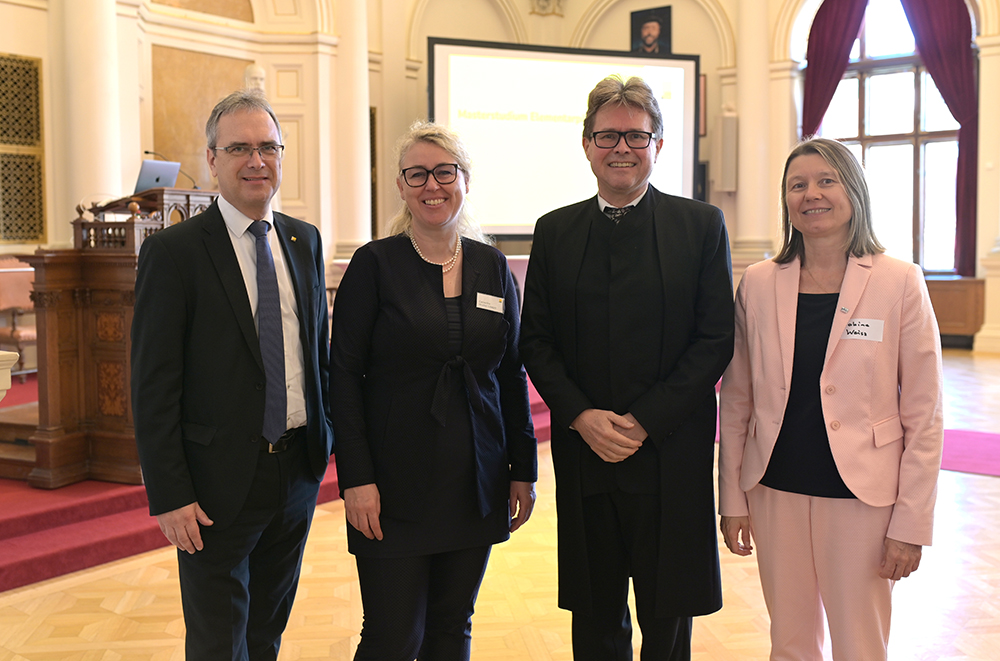
Auftakt für das erste Masterstudium für Elementarpädagogik: Uni-Graz-Rektor Peter Riedler, Uni-Graz-Vizerektorin Catherine Walter-Laager, Wissenschaftsminister Martin Polaschek und PH-Burgenland-Rektorin Sabine Weisz (v. l.) Foto: Uni Graz/Schweiger

Auftakt für das erste Masterstudium für Elementarpädagogik: Uni-Graz-Rektor Peter Riedler, Uni-Graz-Vizerektorin Catherine Walter-Laager, Wissenschaftsminister Martin Polaschek und PH-Burgenland-Rektorin Sabine Weisz (v. l.) Foto: Uni Graz/Schweiger

Die Besten für die Kleinsten: Ansturm auf Österreichs erstes Masterstudium für Elementarpädagogik

Profis in Krippen und Kindergärten sind gefragter denn je. Die Universität Graz schafft dafür die Basis: Österreichs erstes universitäres Masterstudium für Elementarpädagogik hat dieser Tage begonnen. Die Anmeldung von derzeit 112 – die Inskription ist bis Ende Oktober möglich – übertrifft alle Erwartungen. Bildungsminister Martin Polaschek gab heute am 7. Oktober 2022 den offiziellen Startschuss in der Aula der Uni Graz.

„Wir brauchen die Besten für die Kleinsten“, unterstrich Martin Polaschek, Bundesminister für Bildung, Wissenschaft und Forschung. „Denn die Elementarpädagogik legt den Grundstein für die weitere Bildungs- und Berufslaufbahn.“ Der Bund stelle daher für den Bereich österreichweit insgesamt mehr als eine Milliarde Euro in den kommenden fünf Jahren zur Verfügung, das entspricht einem Plus von 40 Prozent. Minister Polaschek: „Für gut ausgebildete Elementarpädagog:innen benötigen wir auch die entsprechende Forschung und Lehre, dafür ist die Universität Graz Österreichs Kompetenzzentrum.“

Digitaler Kern
Catherine Walter-Laager, Vizerektorin für Studium und Lehre: „Die große Nachfrage ist eine Bestätigung dafür, was Expert:innen lange gefordert haben. Es braucht die Professionalisierung der Ausbildung von Elementarpädagog:innen.“
Und den Bedarf spiegelt das Alter der Erstsemestrigen wider. Die Hälfte der fast ausschließlich weiblichen Studierenden ist über 35 Jahre alt, die sich höher qualifizieren wollen. Mit dem „ausgeprägten digitalen Kern“ des Studiums, betont Vizerektorin Walter-Laager, ist das auch berufsbegleitend möglich: „Internationale Fachleute lehren großteils online sowie in geblockten Präsenzveranstaltungen, so dass Studierende in unterschiedlichen Lebenslagen teilnehmen können.“
Das österreichweite einzigartige Studium hat das Interesse in allen Bundesländern geweckt. Neben der Steiermark (40 Prozent) ist es von Studierenden aus Kärnten (20 Prozent) und Niederösterreich (11 Prozent) stark nachgefragt.

Bedürfnisse der Kleinsten
Sich mit neuesten Forschungsergebnissen beschäftigen. Die Qualität der Betreuung in elementarpädagogischen Einrichtungen verbessern. Bildungsgerechtigkeit und Diversität fördern. Diese Ziele verfolgt das neue Masterstudium. „Eine intensive, wissenschaftliche fundierte Auseinandersetzung mit den ersten Lebens- und Bildungsjahren bereitet die Absolvent:innen optimal auf unterschiedliche Berufsfelder mit Kindern und Familien vor“, beschreibt Walter-Laager eine Auswahl der Kompetenzen. Zudem eröffnen sie den Zugang zu einer akademischen Karriere und elementarpädagogischer Forschung. In diesem Bereich weist die Uni Graz ein hohes Maß an Expertise aus, etwa durch das internationale Zentrum für Professionalisierung in der Elementarpädagogik.

created by Andreas Schweiger

Related news

Save, invest or guarantee: What Austrians expect from the state

Austria needs to make savings. But where? And what should the Republic actually be spending its money on? The answers are provided by the initial findings of a major study involving the University of Graz. 99 per cent of those surveyed are in favour of the state ensuring healthcare provision. Almost three-quarters would like to see more public funding for education, whilst only around three per cent are in favour of cuts in this sector.

Complying with the norm: Why Do Standards Shape Our Lives, Elisabeth Staudegger?

Standards determine whether a sheet of paper fits in a printer or whether a charging plug can power multiple devices. These standards shape our everyday lives. But who actually sets these standards? Where are the weaknesses, and how could science help to improve them? Elisabeth Staudegger, Head of the ‘Law and IT’ Department at the Institute for Legal Foundations at the University of Graz, host the Academic Standards Day on 16 June. Here she relays how sciences can contribute to the topic of standardisation and reveals her personal favourite standard.

More body awareness than a culture war

In Italy, sex education lessons will in future only be permitted with parental consent, and will be banned entirely in nurseries and primary schools. At the same time, Pride Month highlights why knowledge about the body, relationships, boundaries and diversity is important for young people. A study by the University of Graz shows how important knowledge about the body, contraception, relationship skills and protection against violence is

Will Austria win the World Cup? Mathematician reveals calculation method

Michael Fischer uses the football tournament as a practical example for highschool lessons.

Begin of page section:
Additional information:

University of Graz
Universitaetsplatz 3
8010 Graz
Austria
  • Contact
  • Web Editors
  • Moodle
  • UNIGRAZonline
  • Imprint
  • Data Protection Declaration
  • Accessibility Declaration
Weatherstation
Uni Graz

End of this page section. Go to overview of page sections

End of this page section. Go to overview of page sections

Begin of page section:

End of this page section. Go to overview of page sections

