



Begin of page section:
Page sections:

  • Go to contents (Accesskey 1)
  • Go to position marker (Accesskey 2)
  • Go to main navigation (Accesskey 3)
  • Go to sub navigation (Accesskey 4)
  • Go to additional information (Accesskey 5)
  • Go to page settings (user/language) (Accesskey 8)
  • Go to search (Accesskey 9)

End of this page section. Go to overview of page sections

Begin of page section:
Page settings:

English en
Deutsch de
Search
Login

End of this page section. Go to overview of page sections

Begin of page section:
Search:

Search for details about Uni Graz
Close

End of this page section. Go to overview of page sections


Search

Begin of page section:
Main navigation:

Page navigation:

  • University

    University
    • About the University
    • Organisation
    • Faculties
    • Library
    • Working at University of Graz
    • Campus
    Developing solutions for the world of tomorrow - that is our mission. Our students and our researchers take on the great challenges of society and carry the knowledge out.
  • Research Profile

    Research Profile
    • Our Expertise
    • Research Questions
    • Research Portal
    • Promoting Research
    • Research Transfer
    • Ethics in Research
    • Commission for Scientific Integrity
    Scientific excellence and the courage to break new ground. Research at the University of Graz creates the foundations for making the future worth living.
  • Studies

    Studies
    • Prospective Students
    • Students
    • Welcome Weeks for First Year Students
  • Community

    Community
    • International
    • Location
    • Research and Business
    • Alumni
    The University of Graz is a hub for international research and brings together scientists and business experts. Moreover, it fosters the exchange and cooperation in study and teaching.
Topics
  • Sustainable University
  • Researchers answer
  • Work for us
Close menu

End of this page section. Go to overview of page sections

Begin of page section:
You are here:

University of Graz News Stabil oder Chaos?

End of this page section. Go to overview of page sections

Monday, 24 October 2022

Stabil oder Chaos?

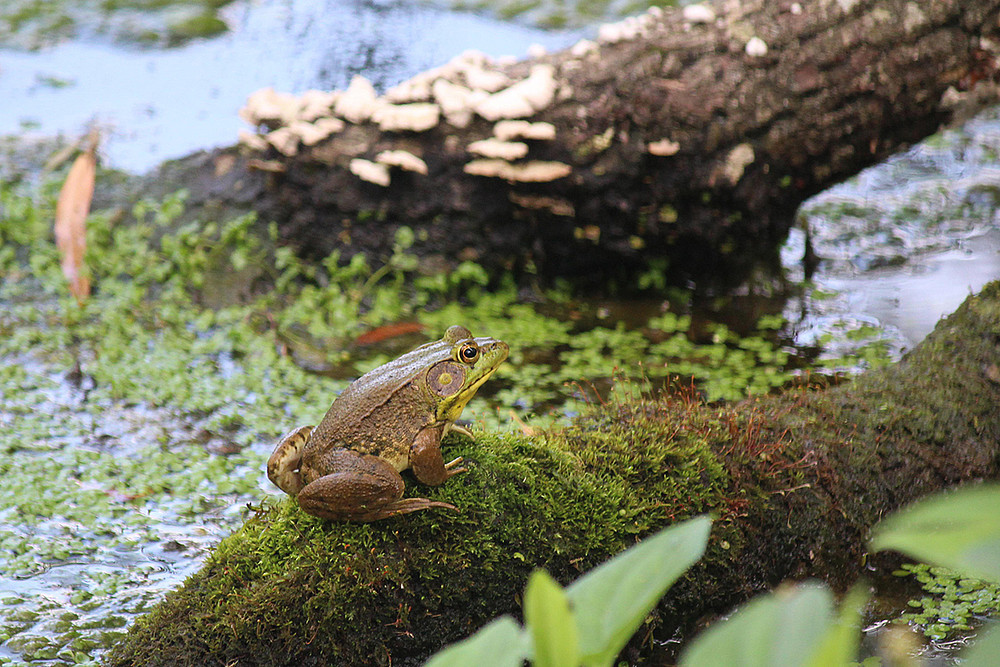
Frosch sitzt auf Ast im Teich. Foto: Pixabay

Anhand des Grads der Biodiversität und der Stärke der Interaktionen zwischen den Arten lässt sich vorhersagen, ob ein Ökosystem stabil bleiben wird oder nicht. Foto: pixabay

Forschende entdecken Schlüssel, um die Zukunft von Ökosystemen vorherzusagen

Ob im Darm, im See, im Wald oder auf der Wiese: Überall in der Natur bilden verschiedenste Lebewesen Ökosysteme. Wie sich diese entwickeln, ist eine Frage, die sowohl in der Medizin als auch im Umweltschutz äußerst relevant ist. Einem internationalen Team von Forschenden, unter ihnen Daniel Rodriguez Amor von der Universität Graz, ist es gelungen, im Labor eine Antwort auf diese Frage zu finden: „Nur zwei Faktoren – die Anzahl der Arten und die durchschnittliche Intensität der Interaktion zwischen ihnen – bestimmen, ob ein Ökosystem stabil bleibt oder nicht“, fasst Rodriguez Amor das Ergebnis der Studie zusammen, die im renommierten Wissenschaftsmagazin Science veröffentlicht wurde.

Die Dynamik von Ökosystemen zu erforschen ist schwierig, da sich in der Natur kaum kontrollierte Experimente durchführen lassen. Gezielte Eingriffe könnten unabsehbare Folgen haben. Daher untersuchen Wissenschafter:innen unter der Leitung des Physikers Jeff Gore am Massachusetts Institute of Technology (MIT) in den USA die Interaktionen zwischen Arten anhand von Bakterien im Labor. „Wir haben unterschiedlich zusammengesetzte Gemeinschaften von zwei bis 48 Mikrobenarten gebildet und beobachtet, wie sie sich unter verschiedenen Bedingungen entwickeln“, berichtet der Biophysiker Daniel Rodriguez Amor, der an der Uni Graz im Exzellenzfeld „COLIBRI – Complexity of Life in Basic Research and Innovation“ forscht. Als Postdoc war er am MIT und hat an der Studie mitgearbeitet.

Vielfalt und Interaktion
In der ersten Phase war die Population jeder Spezies stabil. Dann erhöhten die Forscher:innen nach und nach die Komplexität der Gemeinschaften, indem sie mehr Arten hinzufügten und/oder die Stärke der Wechselwirkungen zwischen den Spezies durch eine höhere Nährstoffkonzentration in der Umgebung intensivierten. „Überschreiten die Anzahl der Arten und/oder deren Wechselwirkungen einen bestimmten Schwellenwert, tritt das System abrupt in eine neue Phase ein, in der einige Spezies auszusterben beginnen, die Populationen der verbleibenden aber stabil sind“, erklärt Rodriguez Amor. Kommen noch mehr Arten hinzu und/oder steigt die Intensität ihrer Interaktionen weiter, erfolgt der Übergang in Phase drei: „Die Populationen der einzelnen Spezies beginnen wild zu schwanken. Ein Hinweis darauf, dass das Ökosystem an Stabilität verloren hat“, sagt der Biophysiker. Mit ihren Experimenten, unterstützt von einem mathematischen Modell, konnten die Forschenden zeigen, dass sich die Phasenübergänge allein durch die Artenvielfalt in der Gemeinschaft und die Stärke der Wechselwirkungen zwischen den Spezies vorhersagen lassen.

Vom Labor in die Natur
Inwieweit diese Ergebnisse auch in freier Natur gültig sind, muss nun weiter erforscht werden. Hinweise darauf gibt es: „In Seen beispielsweise kann der Anstieg der Nährstoffkonzentration durch Düngemittel aus der Landwirtschaft zu einer Blüte von Cyanobakterien führen. Diese verbrauchen Sauerstoff, was zum Aussterben vieler Arten führen kann. Nach unserem Modell müssten wir möglicherweise die Nährstoffeinträge begrenzen, damit die Intensität der Wechselwirkungen gering und eine stabile Koexistenz der Spezies möglich bleibt“, meint Rodriguez Amor.

Publikation:
Emergent phases of ecological diversity and dynamics mapped in microcosms
Jiliang Hu, Daniel R. Amor, Matthieu Barbier, Guy Bunin, Jeff Gore
Science, 6 Oct 2022, Vol 378, Issue 6615, pp. 85-89
https://www.science.org/doi/10.1126/science.abm7841
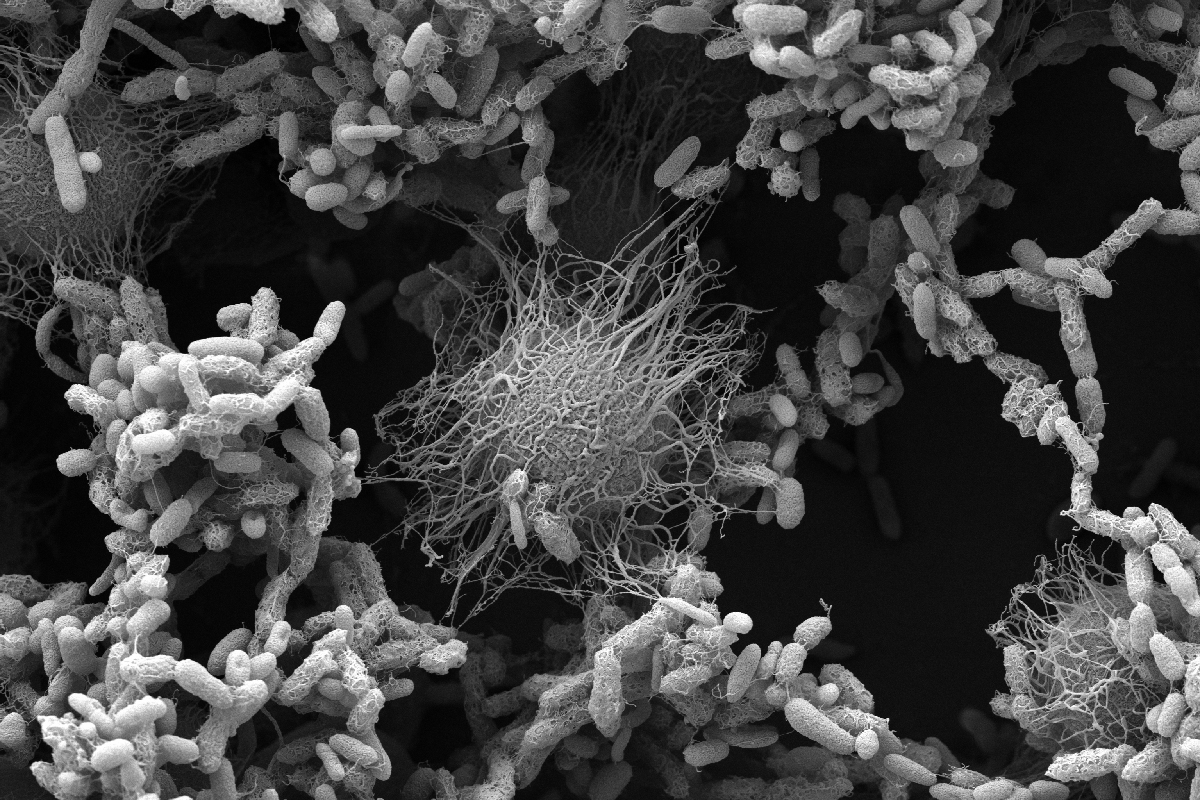
Verschiedene Arten von Bakterien (zylindrisch) und ein Pilz interagieren miteinander. Foto: William Lopes, CMM-UFRGS (Center for Microscopy and Microanalysis at Universidade Federal do Rio Grande do Sul), Brazil
Ökosystem im Labor: Verschiedene Arten von Bakterien (zylindrisch) und ein Pilz interagieren miteinander. Foto: William Lopes, CMM-UFRGS (Center for Microscopy and Microanalysis at Universidade Federal do Rio Grande do Sul), Brazil
created by Gudrun Pichler

Related news

Legal scholar Clarissa Groß on European values at the EU’s external borders

The tense situation in the Spanish exclave of Ceuta has been making headlines for weeks. The exodus of thousands of Moroccans has once again placed migration and border policy at the very top of the EU’s agenda. Clarissa Groß, a research assistant at the Institute for European Law, is examining the reform of the Common European Asylum System (CEAS), the design and practical implementation of the new border procedures, and their compatibility with the right to personal liberty as part of her doctoral thesis. She recently visited the Greek island of Lesbos, which remains a migration hotspot, to assess the situation on the ground.

Graz is a magnet for 750 physicists: international conference on campus

Whether in mobile phones, medical devices or solar power systems: physical phenomena are part of our everyday lives. The vast scope of this discipline will be explored at a major conference taking place at the University of Graz from 20 to 25 September 2026. More than 750 scientists will transform the campus into a European hub for physics.

A fresh start, a calling, holidays: what draws people from other career paths to teaching

They used to develop software; now they teach maths in the classroom. Career changers are expected to help address the shortage of qualified teachers in Austria’s schools. In their doctoral theses at the Institute for Educational Research and Teacher Training at the University of Graz, Melanie Gürentz and Claudia Mair examined how these new teachers perceive their new professional roles.

Talent Talks bridge the gap in career guidance

The Styrian Chamber of Commerce (WKO Steiermark), the Styrian Chamber of Labour (AK Steiermark) and the AMS are joining forces when it comes to training young people and, through the “Talent Talks”, are creating a seamless pathway to career guidance. This takes preparation and follow-up support – just in time for the start of the term and the scheme’s tenth anniversary – to a whole new level. A new survey conducted by the Talent Centre among 2,687 former participants to mark the anniversary shows just how important this development is. Of the young people who received follow-up support from the Talent Report, 74.6 per cent stated that they had a good understanding of their own strengths and talents following the Talent Check. Without follow-up support, the figure was 66.5 per cent – a significant difference of 8.1 percentage points.

Begin of page section:
Additional information:

University of Graz
Universitaetsplatz 3
8010 Graz
Austria
  • Contact
  • Web Editors
  • Moodle
  • UNIGRAZonline
  • Imprint
  • Data Protection Declaration
  • Accessibility Declaration
Weatherstation
Uni Graz

End of this page section. Go to overview of page sections

End of this page section. Go to overview of page sections

Begin of page section:

End of this page section. Go to overview of page sections