


For two semesters, six students tackled the issue of vacant premises on Annenstraße as part of the Austria-wide Sustainability Challenge. How did this come about?
Holger Hoff: As Transdisciplinary Interface Manager for the Climate Change research area, my aim is to work with partners to further develop university knowledge in an application-oriented way and put it into practice. The key partner was ökoprofit Graz, specifically the City of Graz’s Environmental Office, which selected the topic. My role is to integrate the academic perspective.
In your view, what makes this course format special?
Hoff: Students can strengthen their problem-solving skills whilst earning ECTS credits. Furthermore, it fosters an exchange between the scientific community and society. We need much more of this in the field of climate change and in the socio-ecological transition.
As a Master’s student in Environmental Systems Sciences, why did you decide to take part in the Sustainability Challenge?
Antonia Kieber: It was exciting to tackle real-world issues outside the lecture theatre and to channel my enthusiasm for sustainability into a specific topic. It makes the whole thing tangible, because I naturally have a connection to Annenstraße and have come into contact with local stakeholders.
Hoff: I also see it as preparation for working life. After all, a lot of it doesn’t match up to academic expectations; it can even be a bit of a reality check. For example, when you suddenly have to design a leaflet, approach people or improvise other things. These are valuable experiences.
What was the starting point for the project in autumn 2025?
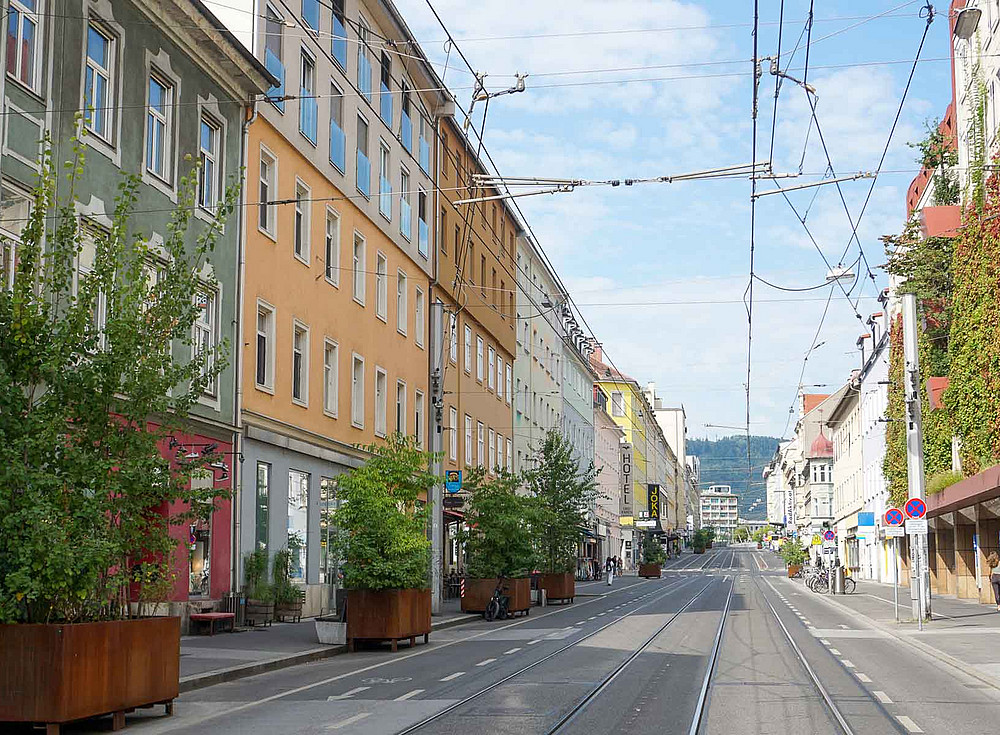
Kieber: As well as mapping, our aim was to capture the reasons behind the vacant premises, the atmosphere and the character of the street. In doing so, we noticed, for example, that whilst there are many beautiful, old façades, muted colours and shades of beige and grey dominate. Unlike other long streets, it’s striking that there are hardly any green spaces and relatively few cafés and outdoor dining areas.
You mentioned that you spoke to lots of people. How did you reach out to them?
Kieber: Shortly before Christmas, we invited local residents and interested members of the public to a low-threshold event which we called ‘Punch & Talk’. Together with them, we gathered ideas on what makes Annenstraße special and what it is lacking. We also looked at examples of best practice. For instance, benches were installed on the corner of Dominikanergasse; these are well used and help to bring the area to life. We then held a workshop with property owners. This included, amongst other things, short presentations on funding opportunities and support for renovation. We took part in the neighbourhood’s Lendwirbel festival with a treasure hunt.
Have you devised any scenarios for what Annenstraße might look like in the future?
Kieber: There are now lots of ideas on the table because, much like a snowball effect, we’ve managed to get a great many stakeholders on board. Fundamentally, we wanted to keep the process open.
Hoff: In addition to our work on developing visions, the Institute of Urban Planning at Graz University of Technology developed proposals during the summer term for the reuse of three vacant sites
The project was concluded in June with a presentation and in August with a comprehensive report. What are the next steps?
Hoff: A process has been set in motion, part of which was the course. Networks have emerged that are continuing to exist. From October this year, a Living Lab will be set up in the former Leiner building so that we can start taking action together.
Kieber: The people from Annenstraße, their needs and living circumstances must be involved in this. And we need a coordinator with a clear mandate and a dedicated time allocation.
Hoff: I see the Sustainability Challenge as a pilot for the Living Lab – a platform that regularly brings together researchers and students with representatives of the city’s population.